Sim racing and flight simulation can give 3D V-Cache a real job. Physics, AI traffic, world streaming and cockpit systems place irregular demands on the CPU, while a busy grid or detailed airport can expose lows that a simple average misses.
Quick Answer
An X3D processor is worth prioritising when your chosen simulator is CPU-limited, especially in large grids, complex aircraft or dense scenery. Keep a balanced standard CPU when the graphics card is already saturated by VR, triple screens or high visual settings.
Start with AMD desktop processors for gaming builds, then compare Intel CPUs in the same simulator tests. Use current results for the exact title, since simulation engines respond differently.
The Hard Part Happens Off Screen
A simulator updates vehicle physics, tyres, suspension, AI opponents, weather and the world around you. Flight software can add avionics, traffic and scenery streaming. Many of these jobs depend on a few demanding threads and frequent access to game data.
Large cache can keep more of that working set close to the cores. When the engine benefits, frame-time dips improve in the scenes that feel worst: the race start, a crowded pit lane or an approach into a detailed airport.
Test the Scenario You Use
Built-in benchmarks may skip the heavy case. Save a replay with a full field, choose your busiest circuit, or load the aircraft and airport that strain the current PC. Record frame times, main-thread behaviour and GPU utilisation.
For VR, include headset resolution and reprojection state. For a triple-screen rig, use the full combined resolution. These setups can turn a CPU test into a GPU test, so hold every display setting constant.
Check the Main Thread
Overall CPU use can look low while one game thread is full. Watch per-core activity and the simulator's own timing overlay where available. Lower resolution or graphics load. A flat frame rate with reduced GPU utilisation points toward the CPU side.
Traffic and physics settings can also change the limit. Reduce AI count without touching graphics. If lows recover, the processor is handling the pressure you care about, and X3D becomes a more relevant comparison.
Build Around the Rig
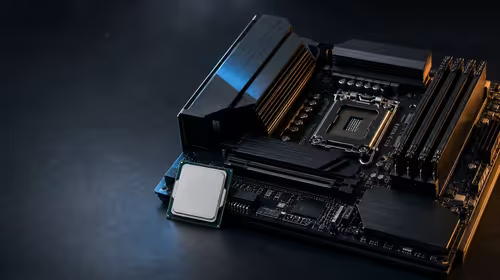
Sim systems often include USB wheels, pedals, yokes, trackers and several displays. Choose the motherboard for enough direct USB, expansion and storage alongside CPU performance. Avoid a board that requires a nest of adapters to finish the cockpit.
Keep the GPU budget intact for VR and high-resolution screens. The strongest gaming CPU paired with insufficient graphics can still miss the required headset frame time.
An X3D chip is compelling when it improves your worst repeatable sim scene. Let that frame-time result decide, rather than genre reputation alone.
FAQ
Does 3D V-Cache help every simulator?
No. Gains vary by engine, scene and GPU limit. Check current tests for your exact simulator.
Is X3D more important for VR?
VR needs stable frame times, but its high render load can also be GPU-bound. Test both sides of the pipeline.
Should I upgrade CPU or GPU for a triple-screen rig?
Lower graphics load and inspect GPU use. The component that remains at its limit should lead the upgrade.
Benchmark your busiest grid, airport or VR route, then match the X3D premium to the frame-time problem you can reproduce.