You’ve seen the videos. The perfect, inky blacks. The vibrant, popping colours. An OLED monitor is the ultimate visual upgrade for any South African PC gamer, making every scene in Cyberpunk 2077 or Alan Wake 2 look breathtaking. But before you splash the cash, there's a critical question buzzing in your head: "Will my PC even handle it?" Let's break down the real-world OLED monitor PC compatibility requirements so you can upgrade with confidence. ✨
The Core Question: Is Your GPU Ready for OLED?
Let's get one thing straight: the OLED technology itself doesn't demand more from your rig. The real performance question comes from the resolution and refresh rate that these premium screens offer. A 4K 165Hz OLED monitor needs a beastly graphics card to push that many pixels that quickly, regardless of the panel type.
So, the first step in checking your OLED monitor PC compatibility is looking at your GPU.
- For 1080p/1440p High-Refresh-Rate OLEDs: If you're targeting a QHD (2560x1440) OLED, you're in a great spot. A graphics card like an NVIDIA GeForce RTX 3060 Ti / 4060 or an AMD Radeon RX 6700 XT / 7700 XT will provide a fantastic experience in most games, letting you enjoy high frame rates and stunning visuals. These are common among many premium gaming monitors and represent the sweet spot for many PC builders.
- For 4K OLED Gaming: This is where things get serious. To properly drive a 4K OLED and make the investment worthwhile, you'll want a high-end GPU. Think NVIDIA GeForce RTX 4070 Ti SUPER or higher, or an AMD Radeon RX 7900 XT. These cards have the raw power and VRAM needed to handle modern games at such a demanding resolution.
Beyond the GPU: Other Compatibility Factors
A powerful graphics card is the main piece of the puzzle, but it's not the only one. Your system's overall balance is crucial for ensuring a smooth, bottleneck-free experience.
Connectivity is Key: DisplayPort vs. HDMI 🔧
You can have the best PC in the world, but it means nothing without the right cable. To get the high bandwidth needed for 4K resolutions at high refresh rates, you need a modern connection.
- DisplayPort 1.4: This is the go-to standard for most PC gamers. It has more than enough bandwidth for 4K at 120Hz+ with HDR.
- HDMI 2.1: This is equally capable and is essential if you plan to connect a PlayStation 5 or Xbox Series X as well.
Always check that both your GPU and your chosen monitor have at least one of these ports. Most modern high-resolution 4K monitors will feature both, giving you flexibility.
OLED Care Tip ✨
To minimise the risk of burn-in, set your taskbar to auto-hide, use a dark desktop background or a rotating slideshow, and set a short screen sleep timer (e.g., 2-5 minutes). Modern OLEDs have built-in pixel shifting and refresh features, but these simple habits provide extra peace of mind.
Your CPU, RAM, and Overall System Health
While the GPU does the heavy lifting for resolution, your CPU is vital for high frame rates. If you pair a brand-new RTX 4090 with a ten-year-old processor, the CPU will become a bottleneck, preventing the GPU from reaching its full potential. You don't need the absolute best CPU, but a modern 6-core processor (like a Ryzen 5 7600X or Intel Core i5-13600K) is a solid foundation.
For RAM, 16GB is the minimum for a good gaming experience today, but 32GB is quickly becoming the new standard, especially if you multitask while gaming. Considering an upgrade is never a bad idea when looking at our full range of PC monitors.
The OLED Experience: Is It Worth It?
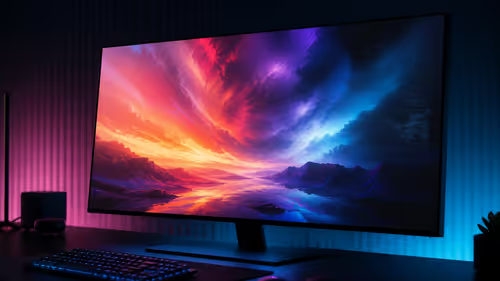
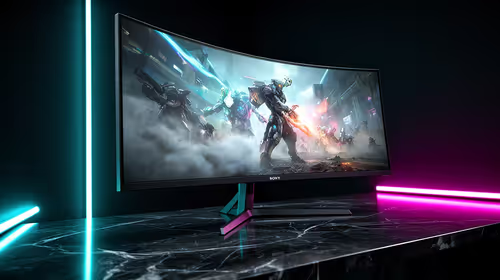
Absolutely. The perfect blacks create an infinite contrast ratio that makes older LED/IPS monitors look grey and washed out. The near-instantaneous pixel response times mean zero ghosting or motion blur, which is a massive advantage in fast-paced shooters. Many gamers find the immersive nature of curved monitors is amplified even further by OLED's incredible image quality.
This incredible tech isn't just for your main desktop anymore either; it's even finding its way into high-end portable monitors, offering stunning visuals on the go.
The question of OLED monitor PC compatibility isn't about whether your PC can display an image—it can. It's about whether your PC can deliver the frame rates and fluid experience that make the investment in such a premium panel truly worth it. By checking your GPU, connectivity, and overall system balance, you can ensure your rig is ready for the most significant visual upgrade you can make. 🚀
If you find your current setup might struggle, don't worry. Technologies like NVIDIA DLSS and AMD FSR can provide a massive performance boost, making high-resolution gaming more accessible than ever. Be sure to check out the best monitor deals to see what fits your budget and your rig.
Ready to See the Difference for Yourself? Checking your OLED monitor PC compatibility is the first step to a massive visual upgrade. The jaw-dropping contrast and response times are worth it. Explore our massive range of OLED and gaming monitors and find the perfect screen to bring your games to life.