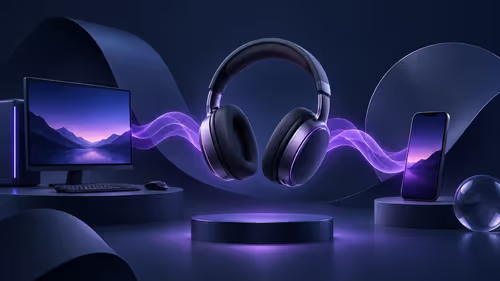
From the Karoo to Cape Town, a new canvas is emerging... not of paint, but of pixels and processing power. The wave of AI art in South Africa is more than just a digital trend; it’s a full-blown cultural revolution, empowering anyone with a decent PC to become a visual artist. But this new creative freedom hinges on one critical component: a powerful graphics card. Your journey into AI-generated art starts with choosing the right graphics card.
Your GPU: The New Digital Paintbrush
Forget easels and oils. In the world of AI art, your Graphics Processing Unit (GPU) is your most essential tool. When you type a prompt like "a protea made of starlight over Table Mountain," the AI model performs billions of calculations to interpret your words and render an image. This immense workload falls squarely on your GPU.
The most important spec to consider is VRAM (Video RAM). Think of it as your GPU's short-term memory or workspace. The more VRAM you have, the larger and more complex the images you can generate without your system grinding to a halt. For anyone serious about creating high-resolution AI art in South Africa, a GPU with at least 8GB of VRAM is the recommended starting point.
Choosing Your Engine for AI Art
When it comes to generating AI art locally on your machine (using software like Stable Diffusion), the GPU ecosystem is largely dominated by two major players.
NVIDIA's Dominance with CUDA
Most of the popular AI art tools are heavily optimised for NVIDIA's CUDA cores, a parallel computing architecture that excels at the type of maths required for AI. This gives cards in NVIDIA's GeForce lineup a significant performance advantage and broader software compatibility. Models like the RTX 3060 12GB offer a fantastic entry point with a healthy amount of VRAM for a reasonable price.
AMD's Rising Potential
While NVIDIA has the lead in compatibility, don't count AMD out. Powerful AMD Radeon GPUs often provide excellent raw performance for their price in ZAR. The software ecosystem is catching up, with projects like ROCm and DirectML enabling Radeon cards to run Stable Diffusion. It might require a bit more tinkering, but the results can be just as stunning. ✨
Prompt Crafting Pro Tip 🎨
Your words are your brushstrokes. Be specific! Instead of "a car," try "a photorealistic, red 1967 Ford Mustang, cinematic lighting, golden hour." Add negative prompts (--no blurry, deformed) to tell the AI what to avoid. This simple trick dramatically improves the quality of AI-generated art.
From Hobby to Hustle: When to Upgrade
As you dive deeper, you'll inevitably want to generate images faster, at higher resolutions, and even train your own custom AI models. This is where your trusty gaming GPU might start to feel the strain.
Moving up to dedicated workstation graphics cards, like those in the NVIDIA RTX Ada Generation series, unlocks a new level of performance. With massive VRAM pools (24GB, 48GB, or more), they can handle enormous datasets and complex rendering tasks that would choke a consumer-grade card. For professional South African digital artists and studios looking to integrate AI into their workflow, this is the definitive upgrade path. 🚀
The creative potential unlocked by this technology is immense. Whether you're a gamer looking to experiment or a professional artist exploring a new medium, the AI art revolution in South Africa is here, and it’s powered by the incredible hardware available today.
Ready to Create Your Masterpiece?
The future of digital creativity runs on powerful hardware. Whether you're just starting out or building a professional rig, the right GPU is everything. Explore our massive range of graphics cards and find the perfect engine for your imagination.