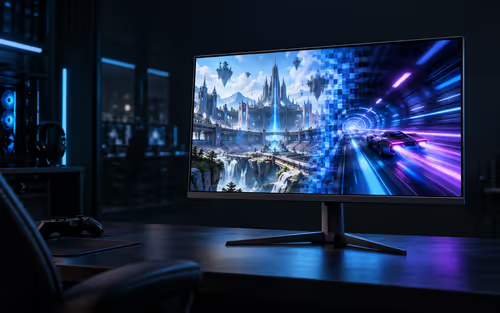
From generating wild images with Stable Diffusion to running your own local ChatGPT, artificial intelligence is no longer just sci-fi... it's the new frontier in PC performance. But is your rig ready? For many South African gamers and creators, the hardware is already there. You just need to know how to optimize your PC for AI to unlock its true potential. This guide will show you exactly how to tune your machine for the AI revolution. 🚀
Why AI PC Optimization Matters
Gaming is demanding, but AI workloads are a different beast entirely. While a high frame rate in Call of Duty relies on raw clock speed, generating AI art or training a model hammers your GPU's memory and parallel processing cores. Proper AI PC optimization means faster results, the ability to run more complex models locally (without paying for cloud services), and a smoother creative workflow. It's about turning your gaming PC into a powerful creative studio.
Hardware Deep Dive: What Your AI PC Needs 🔧
Before touching any software, let's look at the heart of the machine. To effectively optimize your PC for AI, you need the right components doing the heavy lifting.
The GPU: The Undisputed AI King
Your Graphics Processing Unit (GPU) is the single most important component for most consumer-level AI tasks. Its thousands of cores are perfect for the parallel computations AI requires.
- NVIDIA: With their CUDA cores and dedicated Tensor Cores, NVIDIA is the current leader in the AI space. Tools like TensorFlow and PyTorch often have the best support for their cards. If you're serious about AI, exploring a rig from our range of NVIDIA GeForce gaming PCs is a fantastic starting point. VRAM is crucial here; aim for 12GB or more for high-resolution image generation.
- AMD: Team Red isn't sitting on the sidelines. With powerful hardware and improving software support through ROCm, AMD cards offer incredible value. For those looking for a powerful alternative that still crushes games, our selection of AMD Radeon gaming PCs delivers serious performance for both gaming and budding AI enthusiasts.
CPU, RAM, and Storage: The Vital Support Team
While the GPU gets the spotlight, the rest of your system prevents bottlenecks.
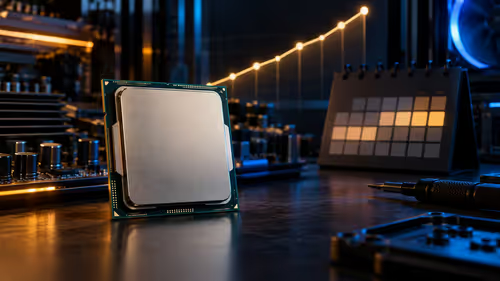
- CPU: Your processor still manages the whole show, from preparing data to running the operating system. A modern multi-core CPU (like an Intel Core i7/i9 or AMD Ryzen 7/9) is essential.
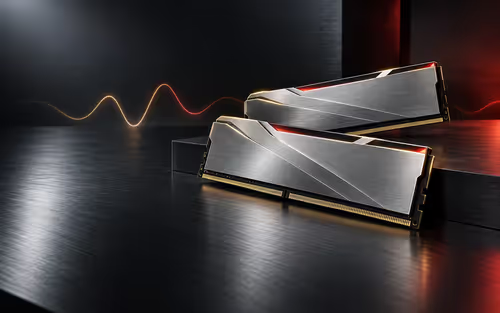
- RAM: AI models can be memory-hungry. 16GB is the absolute minimum, but 32GB of fast DDR5 RAM is the sweet spot for a smooth experience when you optimize your PC for AI workloads.
- Storage: A fast NVMe SSD is non-negotiable. It dramatically cuts down on loading times for large datasets and AI models, getting you from idea to result in seconds, not minutes.
Software Tweaks for Peak AI Performance
Hardware is only half the story. This part of our guide to optimize your PC for AI focuses on simple software changes that yield big results.
- Update Your Drivers: Always install the latest NVIDIA Studio Driver or AMD Software: Adrenalin Edition. These are specifically tuned for creative and computational tasks, not just gaming.
- Windows Settings: Enable "Hardware-accelerated GPU scheduling" in Windows settings (System > Display > Graphics > Change default graphics settings). This gives your GPU more direct control over its memory.
Pro AI Environment Tip 🧠
For those diving into Python-based AI tools like Stable Diffusion, using Windows Subsystem for Linux (WSL) can be a massive performance booster. It provides a native Linux environment directly within Windows, often leading to better compatibility and speed for many AI frameworks. You can install it directly from the Microsoft Store!
Gaming PC vs. Dedicated Workstation: Making the Call
So, is your gaming PC enough? For experimenting and hobbyist projects, absolutely. The steps above will help you get the most out of your current hardware. However, if you're a professional creative, a data scientist, or anyone whose livelihood depends on performance and stability, it's time to consider a purpose-built machine.
A dedicated workstation offers certified drivers, more robust components, and is designed for sustained, heavy workloads. This is the ultimate way to get an AI-optimized PC. For those who need maximum power without compromise, our custom Workstation PCs are engineered for exactly these demanding AI and creative tasks.
Ready to Build Your AI Powerhouse? Whether you're upgrading your gaming rig or building a dedicated creative machine, having the right hardware is the key to unlocking the future of AI. Design your own Custom-Built PC and configure the ultimate system to bring your most ambitious ideas to life.