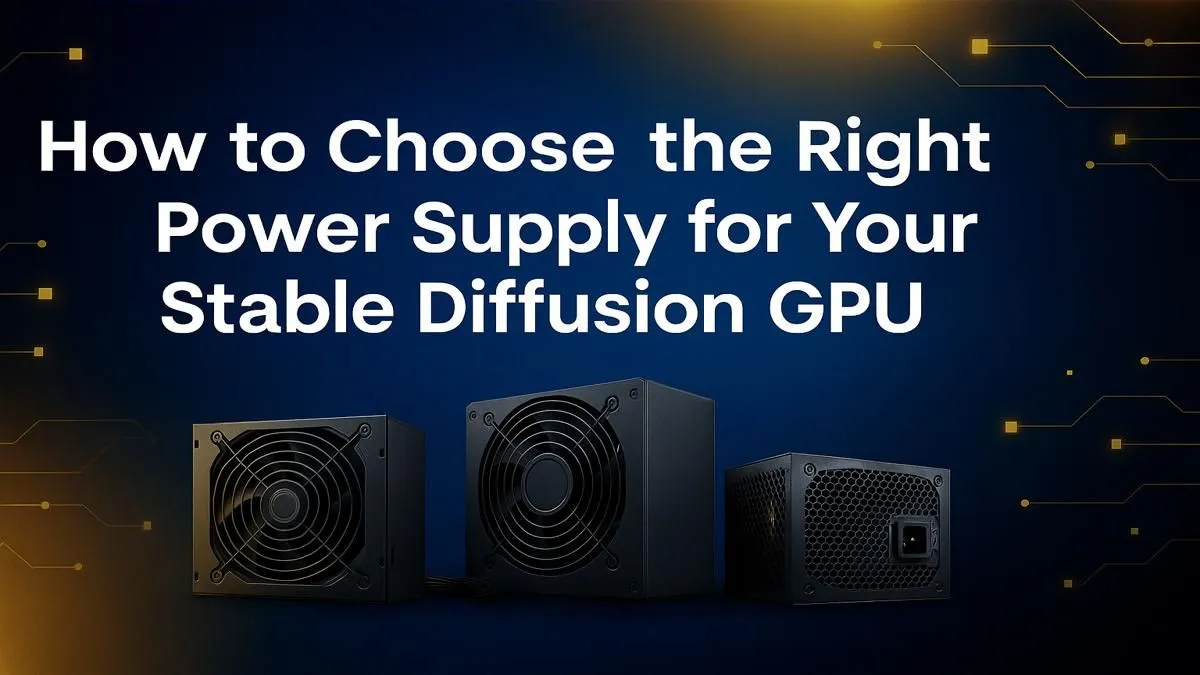
So, you’re diving into the incredible world of AI art with Stable Diffusion. You've spent hours tweaking prompts, only for your PC to suddenly restart mid-render. Sound familiar? Before you blame the software, look at your rig's unsung hero: the power supply unit (PSU). Choosing the right Stable Diffusion GPU power supply isn't just about getting enough watts; it’s about providing clean, stable power to protect your precious components. Let's get it sorted. ⚡
Why Your PSU is Crucial for Stable Diffusion
Running AI models like Stable Diffusion isn't like playing a game. It pushes your graphics card to its absolute limit for sustained periods, causing massive and often unpredictable power draws. A cheap or underpowered PSU can't handle these sudden spikes.
This can lead to:
- System Instability: Random crashes, blue screens, and reboots, especially during long image generation batches.
- Component Damage: Inconsistent voltage can slowly degrade or even destroy your GPU, motherboard, and other parts.
- Wasted Time: Losing hours of rendering progress is beyond frustrating.
Think of your PSU as the heart of your PC. A strong, reliable heart ensures everything else runs smoothly, especially under the heavy stress of AI workloads.
Calculating Your Power Needs 🔧
Figuring out your wattage requirement is the first step. It's not just about the number on the box; it's about understanding what your components actually consume. Modern GPUs, in particular, are thirsty for power and can experience "transient power spikes" well above their rated TDP (Thermal Design Power).
A simple formula is:
GPU Max Power Draw + CPU Max Power Draw + ~150W for everything else = Base Wattage
From there, add a healthy 20-30% overhead to handle those spikes and ensure your PSU runs efficiently. You can find the power requirements for most modern graphics cards on their official product pages. Whether you're building with the latest NVIDIA GeForce GPUs or a powerful card from the AMD Radeon lineup, checking the manufacturer's recommended PSU wattage is a non-negotiable step.
PSU Pro Tip ✨
Don't guess your wattage! Use an online PSU calculator like the one from Cooler Master or be quiet!. Enter all your components—CPU, GPU, RAM, drives, and fans—and it will give you a solid recommendation. Always aim for a little higher than the suggested number for future-proofing and peak performance.
Beyond Wattage: Efficiency and Quality Matter
Not all 850W power supplies are created equal. This is where the 80 Plus rating comes in. This certification measures a PSU's energy efficiency at different loads. A higher rating (like Gold, Platinum, or Titanium) means less energy is wasted as heat, leading to a cooler, quieter, and more reliable system.
For a dedicated AI machine, a Gold-rated PSU is the recommended minimum. It strikes a great balance between price and performance. Skimping here with a low-quality, unrated unit is a recipe for disaster. It's like putting cheap fuel in a performance car... it just doesn't make sense. For professional creators running non-stop renders, investing in top-tier workstation graphics cards and a Platinum-rated PSU is a wise move for long-term stability.
Quick Guide: Choosing the Right PSU for Your GPU
To make things easier, here’s a quick reference for pairing a quality Stable Diffusion GPU power supply with popular graphics cards in South Africa.
- Mid-Range Build (e.g., RTX 4060 Ti / RX 7700 XT): A high-quality 650W-750W 80+ Gold PSU is perfect. It provides ample power and efficiency without breaking the bank.
- High-End Build (e.g., RTX 4070 Ti SUPER / RX 7900 XT): Step up to an 850W 80+ Gold or Platinum model. This will comfortably handle the higher power draw and transient spikes of these powerful cards.
- Enthusiast AI Rig (e.g., RTX 4090): Don't even think about anything less than a 1000W-1200W 80+ Platinum PSU. The RTX 4090 is a power-hungry beast, and giving it a premium power source is essential for stable, high-speed rendering. 🚀
Ultimately, your PSU is the foundation of your creative workstation. A solid choice ensures your hardware is protected and your creative flow is never interrupted by a sudden power failure.
Ready to Power Up Your AI Creativity?
Don't let an unstable power supply bottleneck your creative genius. A reliable PSU is the best investment you can make for your Stable Diffusion rig. Explore our wide range of high-quality power supplies and find the perfect foundation for your AI masterpiece.