Ever soared over a breathtakingly real Table Mountain in Microsoft Flight Simulator, only for the scenery to stutter and pop in? That jarring moment is often a hardware bottleneck. The sim’s magic lies in its live world streaming… a feature that demands the right gear. As we look towards 2025, ensuring your PC has the right hardware for world streaming is the key to a truly immersive, butter-smooth experience from Cape Town to Cairo. ✈️
Why Storage is Critical for World Streaming
Microsoft Flight Simulator doesn't store the entire planet on your PC; that would be impossible. Instead, it streams photorealistic scenery and data from Bing Maps in real-time. This data is temporarily stored in a "rolling cache" on your drive.
When you fly over a new area, the sim downloads heaps of data and needs to write it to your cache instantly. Simultaneously, it reads data for the scenery right in front of you. If your storage can't keep up with this constant read/write demand, you get those dreaded stutters and low-detail textures. This makes your storage drive the single most important component for the sim's world streaming after your GPU and CPU. A slow drive simply can't feed the simulation engine fast enough.
The SSD Hierarchy for Flight Sim Pilots
Not all storage is created equal. If you're still running Flight Sim on a mechanical hard drive (HDD), an upgrade is non-negotiable. But even within the world of Solid-State Drives (SSDs), there are levels to this.
The Baseline: SATA SSDs
A SATA SSD is a massive leap from an HDD and represents the minimum requirement for a decent experience. It will slash loading times and reduce most major stutters. While they are a fantastic budget-friendly starting point, their technology is older, and they can sometimes struggle with the intense, simultaneous read/write operations of world streaming. They are a solid choice for storing the base game and add-ons, and you can browse a wide variety of solid state drives to get started.
The Sweet Spot: NVMe SSDs ⚡
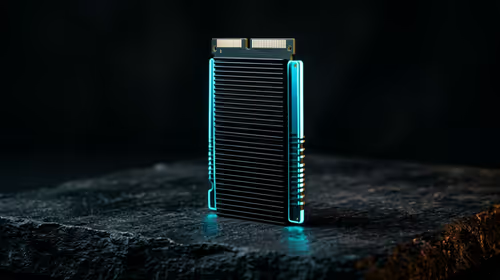
This is where the magic happens. An NVMe (Non-Volatile Memory Express) SSD connects directly to your motherboard's PCIe slot, bypassing the slower SATA interface entirely. The result? Speeds that are 5 to 10 times faster than a standard SATA SSD. For MSFS, this means the rolling cache can be written to and read from almost instantaneously. Pop-in becomes a thing of the past, and the simulation feels incredibly fluid. Investing in quality NVMe SSDs offers the best performance for your rig and is the best hardware upgrade you can make for world streaming.
The Flexible Friend: External SSDs
What if your internal storage is already full? A high-speed USB-C external SSD can be a surprisingly viable option. While not ideal for the primary rolling cache, they are perfect for storing the massive base game installation (often over 150GB) and your collection of third-party aircraft or scenery. This frees up precious space on your main NVMe drive. Check out these powerful external SSD options to expand your capacity without opening your case.
Optimising Your Rig for a Smooth Flight 🔧
Having the best hardware is one thing; configuring it correctly is another. Your primary focus should be the "Rolling Cache."
Pro Tip: Configure Your Rolling Cache ⚡
In the Flight Simulator settings under 'Data', you can set the size and location of your rolling cache. Always place this cache on your fastest drive (your NVMe SSD). A size of 32GB to 64GB is a great starting point. This dedicated space allows the sim to pre-load and access scenery data at maximum speed, drastically reducing in-flight stutters.
While your SSD is the star player, remember that it works as part of a team. Ensure you have at least 16GB of RAM (32GB is recommended for high settings) and a stable, fast internet connection. Without enough bandwidth, even the fastest SSD can't access the world data it needs. The right combination makes for a great world streaming setup. For a comprehensive look at all your options, our main SSDs category is the perfect place to compare models.
Finding the Best SSD Value in South Africa ✨
Upgrading your hardware for the sim doesn't have to break the bank. SSD prices have become incredibly competitive in South Africa, and the performance leap you get for your rand is massive.
The key is to find the sweet spot between capacity and speed. A 1TB NVMe SSD is often the perfect balance, offering enough space for your operating system, Flight Simulator, and a healthy rolling cache. You don't need the absolute top-of-the-line Gen5 drive to see a monumental difference. A reliable Gen3 or Gen4 NVMe drive will deliver a flawless experience. Keep an eye on the latest promotions to get the most performance for your money; you can often find some of the best SSD deals in ZA right here.
Ready for a Turbulence-Free Takeoff?
A stuttering sim can ground even the best virtual pilot. The right SSD is your ticket to a smooth, immersive experience over a photorealistic South Africa. Don't let slow storage be your bottleneck. Explore our massive range of PC components and find the perfect upgrade to conquer the virtual skies.