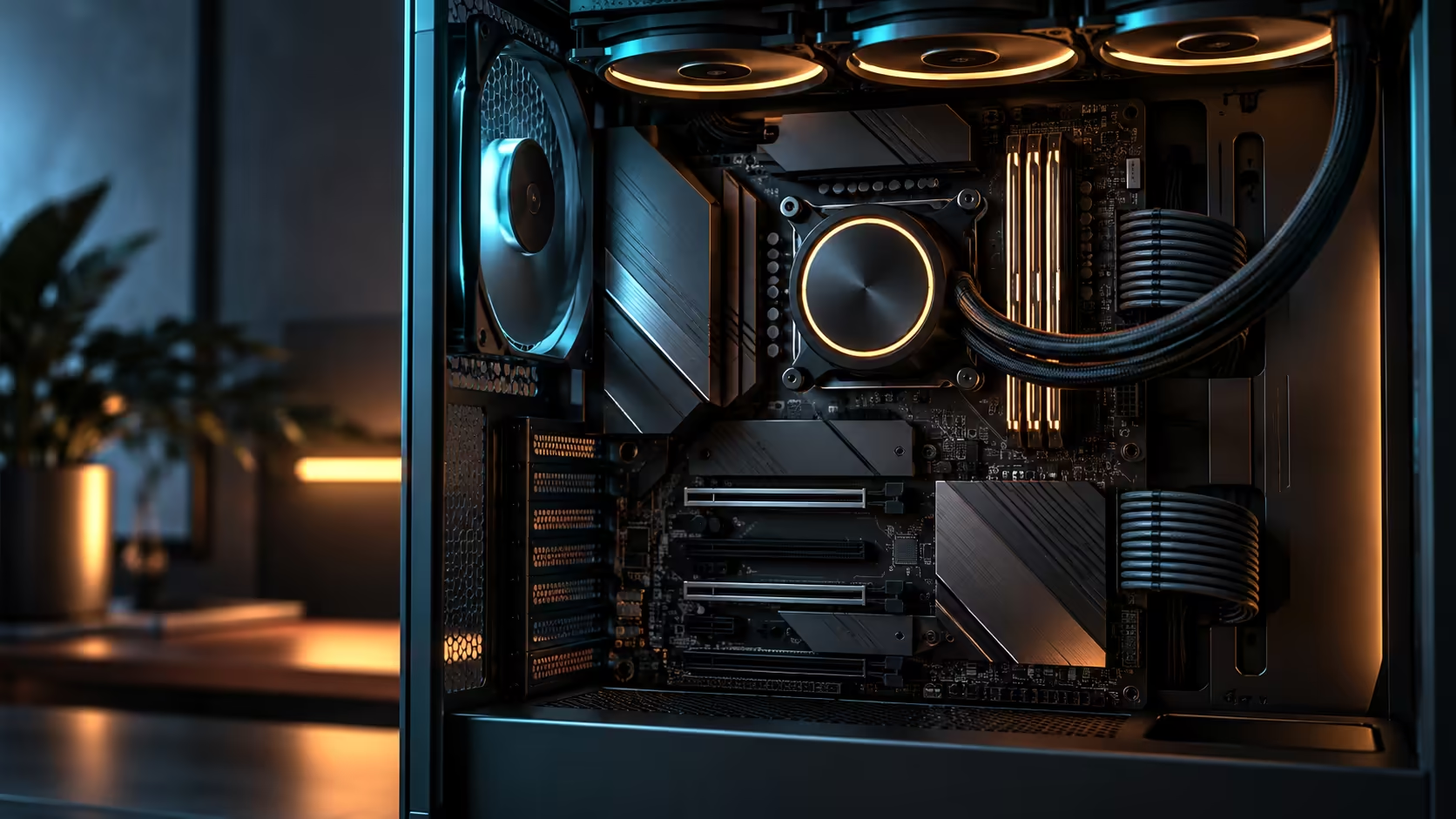
Most E-ATX motherboard and case compatibility problems trace back to three numbers nobody checked before the order was placed, and every one of them is printed somewhere on the case's own spec sheet. Catching them before you buy costs nothing; catching them after the board arrives costs a return, a delay, or a case swap.
Quick Answer
Check the case's E-ATX width limit, the depth behind the motherboard tray for cable routing, and the roof radiator clearance, in that order, before buying either component. This particular E-ATX flagship, the R54,999 ROG Crosshair X870E Edition 20, is wider than a standard ATX board, and that extra width is exactly what fills the side cable cut-outs some cases reserve for cable management, which is where the most common fit problems actually start.
📏 Width is the number that gets skipped
Case marketing often says "supports E-ATX" without stating the maximum width it actually clears, and E-ATX itself is not one fixed dimension across every board maker, though 305mm is the most common figure. Confirm the case's stated E-ATX width limit in millimetres against the specific board's own width from the AMD board catalogue, rather than trusting the word "supports" on its own.
The practical failure mode is a board that physically bolts down but covers the case's side cable pass-through holes entirely, since those holes sit exactly where a wider board's edge now extends. A board that mounts is not the same as a board that mounts cleanly.
🧰 Depth behind the tray decides how the cables actually look
E-ATX's extra width, roughly 60mm more than standard ATX, usually eats into the space reserved behind the motherboard tray for routing cables, since the case's total internal width is fixed and the wider board simply takes more of it. A case with generous cable depth behind the tray absorbs this without issue; a case designed tightly around standard ATX can leave barely enough room to close the side panel once cables are routed.
Measure the stated depth behind the tray against your actual cable bundle, not just the connector count, since a modular power supply's thicker custom cables take up noticeably more space than the thin stock cables most reviews are shot with.
🌡️ Roof clearance is where a bundled cooler changes the calculation
A board that arrives with its own AIO, like the Crosshair X870E Edition 20's included Ryujin 360, removes the guesswork of matching a separate cooler to the case, but the case's own radiator clearance still has to be checked on its own merits. Read the millimetre figure the case maker publishes for its roof, typically somewhere around 55mm for a single fan row and closer to 80mm with fans mounted on both sides, and treat that printed number as the answer rather than estimating by eye.
RAM height matters here too, since a roof radiator sitting low over the DIMM slots can physically contact tall memory heatsinks. Check the case's documented radiator-to-DIMM clearance if you are pairing a low-profile radiator mount with tall RAM modules, since a heatspreader taller than roughly 40mm is where this conflict most often shows up on a tight roof mount.
🛒 Buying in the right order avoids all three problems
Choose the case first, using its own documented E-ATX width, cable depth and radiator clearance figures, rather than choosing the board first and hoping a case will simply accommodate it later. If a full tower is already the plan, confirm it is a full tower with genuine E-ATX support rather than one merely tall enough to look the part, since chassis height and motherboard tray width are two separate specifications that do not always scale together.
Frequently Asked Questions
Does a case labelled "full tower" always support E-ATX boards?
Not automatically. Height and E-ATX tray support are separate specifications, so check the stated E-ATX width limit specifically rather than assuming size alone guarantees fit.
What happens if an E-ATX board is wider than the case expects?
It can cover the side cable pass-through holes, making cable routing far harder even though the board technically bolts down.
What roof depth figure should a case spec sheet state for a 360mm radiator?
Something near 55mm for a single fan row, rising to about 80mm once fans are mounted on both sides of the radiator.
If a board ships with its own cooler already fitted, can I skip checking case clearance?
No. The case's roof and RAM height still have to clear the bundled radiator on their own merits, even though you have skipped shopping for a separate cooler.
What is the safest buying order to avoid compatibility issues?
Choose the case first using its documented E-ATX width, cable depth and radiator clearance, then select the board around those confirmed numbers.
Ready to avoid a fit problem you only discover after the board arrives?
Check the case's width, cable depth and radiator clearance figures before ordering either component.