Is your gaming PC so loud it sounds like it’s preparing for takeoff? You’re not alone. That constant fan whine can pull you right out of a tense final circle in Apex Legends. But what if you could get a whisper-quiet gaming PC in South Africa without destroying your budget? It’s not just possible; it’s easier than you think. Let’s dive into how you can build or buy a rig that keeps its cool… silently. 🤫
Why Your 'Budget' Build Sounds Like a Jet Engine
The main reason many affordable PCs are noisy is simple: manufacturers prioritise raw performance over acoustic comfort. To hit a certain price point, they often use components that get the job done, but not quietly. The culprits are usually the stock CPU cooler, generic case fans, and sometimes the graphics card's cooling shroud.
This is why many budget gaming PCs can sound louder than their premium counterparts. The components are designed to prevent overheating at the lowest possible cost, and quiet operation is a secondary concern. But with a bit of savvy component selection, you can build a silent gaming build without a massive price jump.
The Core Components for a Quiet Gaming PC in South Africa
Achieving a low-noise PC in South Africa is a game of smart choices. It’s about creating a system where every part works together to move air efficiently and quietly. Let's break down the key areas. 🔧
The Case: Your First Line of Defence
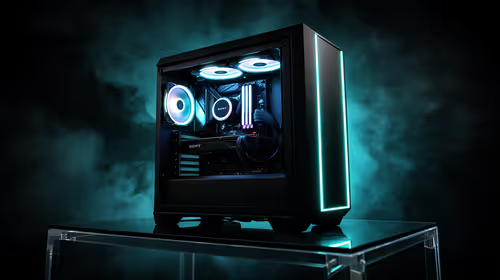
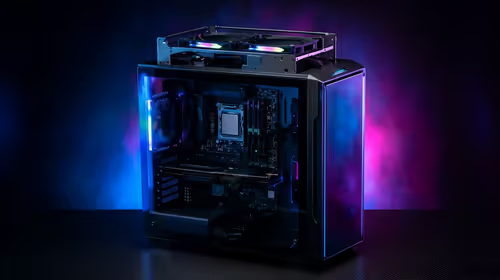
Don't underestimate your chassis. A well-designed case is the foundation for a quiet build. Look for:
- Good Airflow: Mesh front panels are fantastic for airflow, allowing fans to spin slower (and quieter) to achieve the same cooling.
- Build Quality: Flimsy side panels can vibrate and rattle. A sturdy case absorbs noise.
- Space: Ample room for cable management improves airflow, reducing the workload on your fans.
A solid case is critical for any build, including our popular PCs under R20k, where thermal performance is key to getting the most out of your hardware.
Cooling: Smarter Fans, Not Faster Fans
The stock cooler that comes with your CPU is… fine. But it's rarely quiet under load. A budget-friendly aftermarket tower air cooler (think brands like Cooler Master or Deepcool for under R1,000) can offer a massive improvement in both temperatures and noise levels. The larger heatsink and fan don't have to work as hard.
Silence Your Fans 🤫
Most motherboards let you set custom fan curves in the BIOS UEFI. Instead of letting them run at 70% speed for a minor temperature change, you can create a gentle slope. This keeps fans at a low, inaudible RPM during light tasks and only ramps them up when you're deep in a demanding game. It’s the single biggest free upgrade for a quiet gaming PC!
The Graphics Card (GPU): The Heart of the Noise
Your GPU is often the loudest component. When choosing a graphics card for your quiet gaming PC, look for models with dual or triple-fan coolers and a "0 RPM" or "fan stop" feature. This means the fans don't spin at all during idle or light tasks like browsing the web. This is a feature often seen in the cooling solutions on PCs above R20k, but it's becoming more common on budget cards too. ✨
Noise Tests: What to Expect from a Quiet Budget Build
So, what does a well-planned, quiet budget build actually sound like? While we don't have a soundproof lab, here are some real-world expectations based on our build experience.
- At Idle (Desktop/Browsing): With 0 RPM modes on the GPU and custom fan curves, the PC should be virtually silent. You might hear a faint hum from the power supply, but it will likely be drowned out by the ambient noise in your room.
- Light Gaming (e.g., Valorant, CS:GO): You'll hear a gentle 'whoosh' of air. 🌬️ The fans will be spinning, but at a low, unobtrusive speed. It’s quiet enough that you won't need to crank up your headset volume.
- Heavy Gaming (e.g., Cyberpunk 2077, Helldivers 2): This is the real test. You will definitely hear the fans working. However, instead of a high-pitched whine, it will be a lower-frequency rush of air. The sound character is much less distracting and is easily covered by game audio.
Putting It All Together for a Silent Rig
Building a truly quiet gaming PC South Africa requires balancing the acoustics of every single component. It's a holistic process. If you'd rather skip the hassle of component research and fan curve tuning, our team of experts meticulously balances noise and performance in all our best gaming PC deals. This balance is key across all our pre-built PC deals, where we prioritise a quality, distraction-free experience right out of the box.
Ready for a Distraction-Free Gaming Rig?
Building a quiet PC doesn't mean sacrificing performance or your wallet. With the right parts and expert assembly, you can achieve whisper-quiet operation for total immersion. Explore our massive range of gaming PCs and find the perfect silent beast to conquer your world.