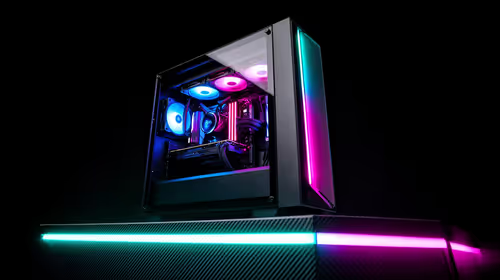
Staring at your FPS counter in a tense Warzone firefight, wishing it was just a little bit higher? We've all been there. For many South African gamers, a high-end rig is the dream, but the budget is reality. What if you could unlock extra performance from the PC you already own... for free? This safe overclocking guide is your key to boosting your budget PC, giving you a smoother, more responsive gaming experience without spending an extra Rand. 🚀
Understanding Overclocking: More Power, No Extra Cost
So, what exactly is overclocking? Think of it like tuning a car's engine. Your computer's processor (CPU) and graphics card (GPU) leave the factory set to a specific speed, a balance of performance and efficiency. Overclocking is the process of manually pushing those components to run faster than their official specifications.
The result? Higher frame rates in games and faster processing in creative apps. The trade-off is that your components will generate more heat and use more power. This guide will show you how to manage that trade-off safely. Many gamers start their journey with affordable budget gaming PCs and see overclocking as the perfect next step to maximise their investment.
Your Pre-Overclocking Safety Checklist
Before you dive into your PC's BIOS, a little prep work is essential for a safe and successful overclock. Rushing this step is where things can go wrong. Let's make sure your rig is ready for a performance boost.
The Right Hardware Foundation
Not all hardware is created equal. To overclock your CPU, you'll generally need an "unlocked" model (like Intel's "K" series or any of AMD's Ryzen CPUs) and a motherboard chipset that supports it (like Intel's Z-series or AMD's B- and X-series). While you can certainly tweak a great value machine under the R20k mark, motherboards in these systems may have basic power delivery, so modest overclocks are the goal.
Cooling is King ❄️
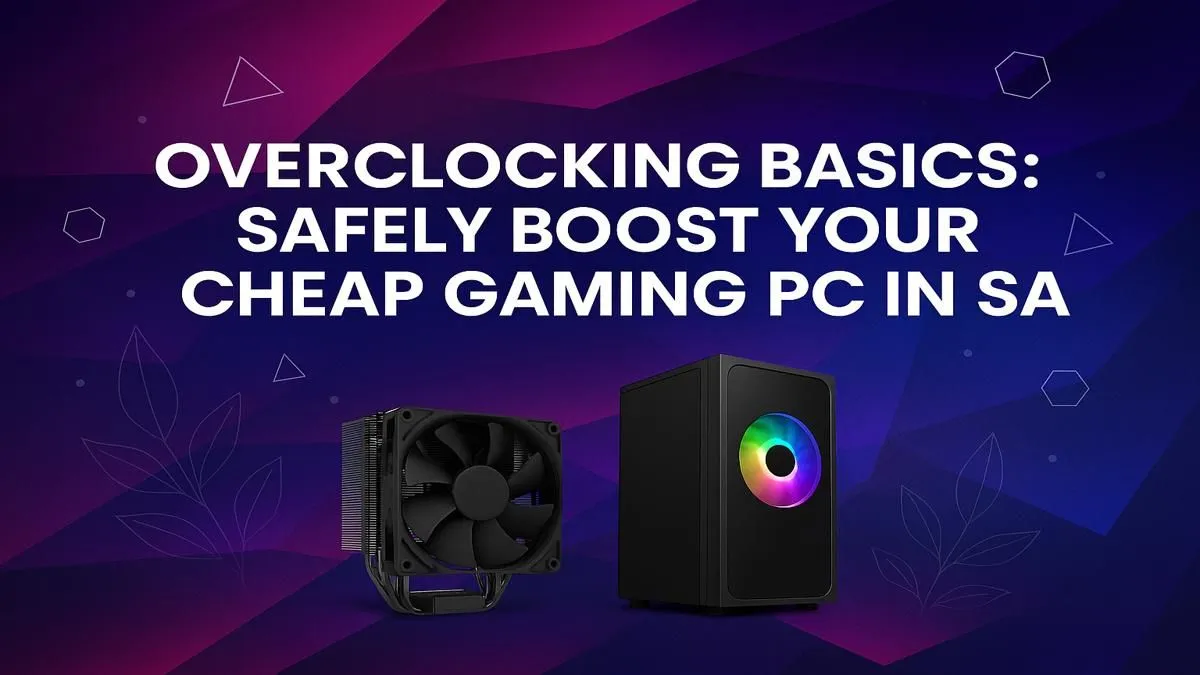
This is the most critical part of our safe overclocking guide. Pushing your CPU harder generates more heat. The stock cooler that came with your processor is often only designed for stock speeds. If your temperatures get too high (consistently over 90°C under load), you risk damaging your hardware. A good aftermarket tower air cooler or an All-in-One (AIO) liquid cooler is highly recommended.
Essential Software Toolkit
You'll need a few free tools to monitor your progress and test for stability:
- CPU-Z: To verify your clock speed and voltage in real-time.
- HWiNFO64 or HWMonitor: For detailed monitoring of temperatures, voltages, and fan speeds.
- Cinebench R23 or Prime95: Stress-testing software to push your CPU to its limit and ensure your overclock is stable.
A Step-by-Step Guide to Safe CPU Overclocking
Ready to begin? Remember the golden rule: make small, incremental changes and test thoroughly after each one. This patient approach is the secret to success.
- Establish a Baseline: Before you change anything, run a benchmark like Cinebench. Note down your score and your maximum temperature during the test. This is your starting point.
- Enter the BIOS/UEFI: Restart your PC and press the 'Delete' or 'F2' key repeatedly on startup to enter the BIOS.
- Find the Right Settings: Look for settings called "CPU Core Ratio," "CPU Multiplier," or "CPU Frequency." This is what you'll be adjusting.
- Make a Small Adjustment: Increase the multiplier by a small step. For example, if it's at '40' (representing 4.0GHz), try increasing it to '41' (4.1GHz). Save your settings and reboot.
- Test for Stability: Once back in Windows, run a stress test like Cinebench for 10-15 minutes. Watch your temperatures in HWMonitor. If it's stable and temps are well below 90°C, you're good to go back to the BIOS and try the next step up.
- Rinse and Repeat: Continue this cycle of small increases and testing until you experience instability (a crash or a blue screen) or your temperatures get too high. Once that happens, dial it back to the last stable setting. That's your sweet spot!
Voltage: Handle With Care! ⚡
While increasing voltage can help achieve higher, stable clocks, it also dramatically increases heat and risk. For beginners, stick to adjusting the multiplier first. If you do touch voltage, increase it in the smallest possible increments (e.g., 0.01v) and never exceed the safe limits recommended for your specific CPU model. A quick online search for your CPU's "safe voltage" is essential!
For gamers who prefer guaranteed performance without the manual tuning, exploring pre-built PC deals offers a fantastic plug-and-play alternative.
Troubleshooting Your Overclock
What happens if your PC won't boot after a change? Don't panic! This is usually easy to fix. Every motherboard has a way to reset the BIOS to its default settings. This is often done by shorting two pins on the motherboard called the "Clear CMOS" jumper (check your motherboard manual) or by simply removing the small, circular battery from the motherboard for a minute.
The peace of mind that comes with a professionally assembled and tested machine is why many enthusiasts eventually invest in powerful PCs over R20k, which are built from the ground up to handle demanding loads with rock-solid stability.
The Verdict: Is Overclocking Worth It for You?
For the hands-on South African gamer on a budget, absolutely. Following a safe overclocking guide can give you a tangible 5-15% performance boost, which can mean the difference between a choppy and a smooth gaming experience. It's a rewarding process that teaches you more about how your PC works. 🔧
However, it takes time, patience, and carries a small risk if done carelessly. If you'd rather spend your time gaming than tweaking settings in a BIOS screen, there's no shame in that. A professionally built system gives you optimised performance and peace of mind right out of the box.
Ready to Unleash Max Performance?
Whether you're fine-tuning your current rig or looking for a new powerhouse, performance is key. For a system built, tested, and optimised for you, explore the best gaming PC deals in South Africa and find the perfect machine to conquer your world.