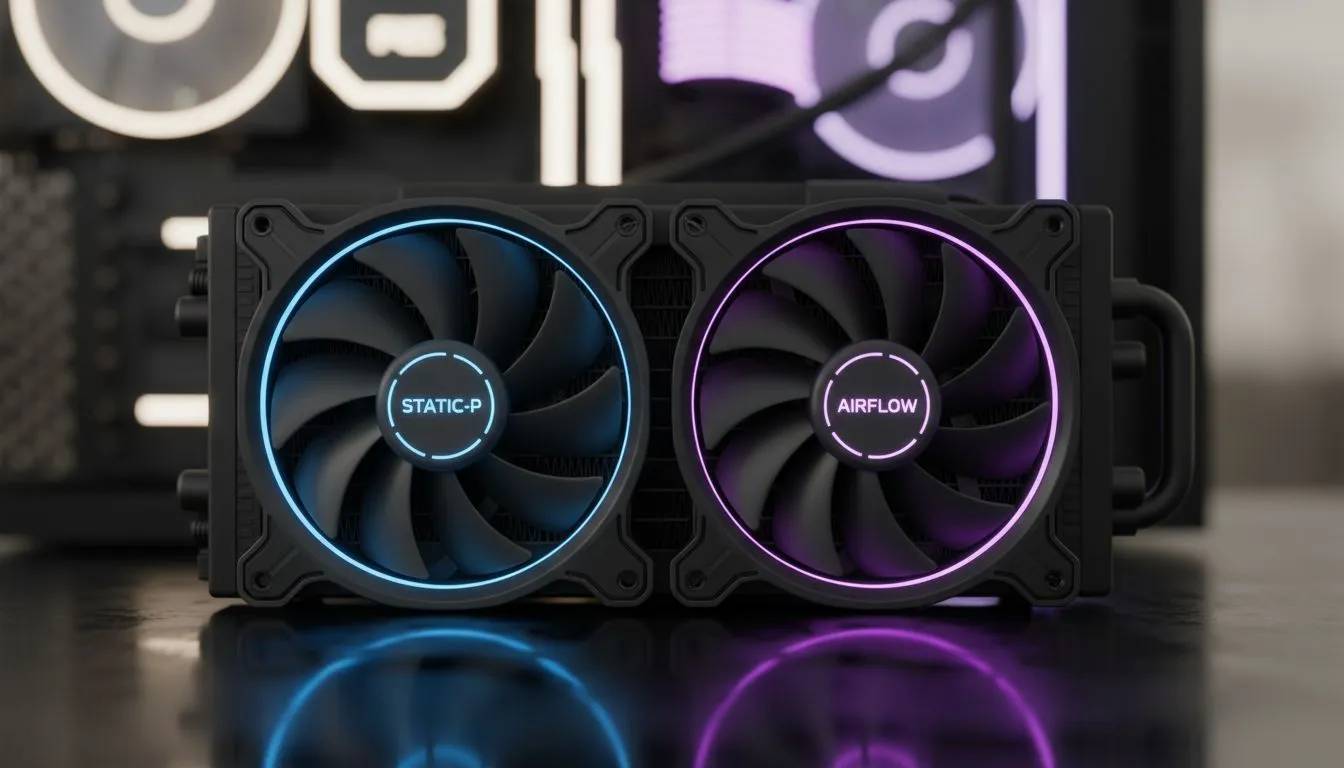
You’ve just unboxed a shiny new liquid cooler for your rig. The excitement is real... until you hit the fan specs. CFM? mmH₂O? Suddenly, you’re deep in a debate you didn’t ask for: static pressure vs airflow fans. It sounds technical, but making the wrong choice here, especially for a radiator, can seriously throttle your PC's performance. Let’s cut through the jargon and get your rig running cool and quiet.
What Are High Airflow Fans?
Think of high airflow fans as masters of moving large volumes of air in open spaces. Their blades are typically wider and less angled, designed to scoop up and shift as much air as possible with minimal resistance. 🌬️
Imagine opening a window on a breezy day... that’s an airflow fan. They are perfect for use as case fans, pulling cool air into your chassis or exhausting hot air out where the path is clear. However, their power fades dramatically when something gets in the way. While essential for overall ventilation, they often struggle when faced with the dense fins of a heatsink or radiator. Many top-tier Air Coolers still rely on good case airflow to function at their best.
What Are Static Pressure Fans?
Static pressure fans are the specialists. They are engineered to force air through tight, restrictive spaces. Their secret lies in the blade design, which is often more aggressive and channelled to build up pressure behind the fan. This pressure allows the air to push through obstacles like dust filters, drive cages, and most importantly, radiator fin stacks.
It’s like putting a nozzle on your garden hose. The volume of water doesn't change, but the focused pressure lets it travel further and with more force. That’s exactly what a static pressure fan does for air. When choosing from the wide world of CPU coolers, understanding this difference is crucial for getting the performance you paid for.
The Verdict: Static Pressure vs Airflow for Radiators
So, for the main event: which fan type is best for your radiator? The answer is clear and simple: static pressure fans are the undisputed champions for radiators. 🏆
A radiator is a wall of resistance. Its job is to maximise the surface area where heat can transfer from the liquid to the air, using dozens of tightly packed metal fins. An airflow-optimised fan will see that wall and falter. Much of the air it moves will simply bounce off the surface or escape out the sides, never properly cooling the liquid within.
A static pressure fan, however, has the muscle to force air directly through that dense fin stack, ensuring maximum heat dissipation. This is why nearly all premium AIO Liquid Coolers come bundled with static pressure-focused fans right out of the box.
Check The Specs 🔧
When shopping for fans, look for the 'Static Pressure' rating, measured in 'mmH₂O'. A higher number indicates a greater ability to push air against resistance. For a radiator, anything over 1.5 mmH₂O is good, and specs above 2.0 mmH₂O are excellent. Airflow is measured in 'CFM' (Cubic Feet per Minute), which is more important for case fans.
Building Your Perfect Cooling Setup
Optimising your PC's cooling is about using the right tool for the right job. Use high airflow fans for your case intake and exhaust, and mount high static pressure fans on any radiator or dense heatsink. This hybrid approach ensures a steady stream of cool air enters your case and that your most critical components get the focused cooling they need.
Top brands like Corsair often develop specific fan lines, like their SP (Static Pressure) and AF (Airflow) series, to make this choice easier. Whether you're cooling a compact 120mm AIO or a massive 360mm radiator, pairing it with the correct fans will make the difference between silent, cool operation and a system that sounds like a jet engine during your next gaming session.
Ready to Master Your Temps?
Choosing the right fan isn't just a spec... it's the key to unlocking performance. Explore our massive range of CPU coolers and find the perfect cooling solution to conquer your thermals.