Quick Answer
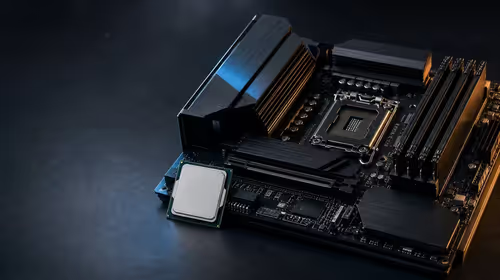
After a Windows update, a Ryzen 9 9950X3D build that is running hot is usually reacting to a reset driver, power profile, firmware setting or monitoring conflict, not a suddenly failed CPU. Use one repeatable test, record temperatures or logs, and keep the buying decision tied to evidence; for SA buyers this is the difference between a small fix and replacing parts in a R40,000-R90,000 creator-and-gaming build budget band. Anchor the check with a known part such as a Ryzen 9 9950X3D with an ASUS ProArt X870E-Creator or MSI MEG X870E ACE class board, a 850 W to 1000 W quality PSU, and a realistic target like excellent gaming 1% lows plus 16-core headroom for streaming, editing and compiling.
Log Heat Before Buying Cooling
Log CPU temperature, GPU core, hotspot and fan speed during the same 10-minute game loop. Clean filters, confirm front intake and rear/top exhaust direction, and check cooler mounting if temperatures jumped after a move. SA summer rooms can add 5-10 C to a marginal case. Gpu core below the low-80s c and cpu load below its normal boost limit are sensible targets. Keep the test short and repeatable: one game scene, one benchmark pass, or one desktop workload is enough to show whether the change helped.
Check Drivers, Firmware And Power
AM5 builds should also check BIOS/AGESA notes, DDR5 EXPO stability, chipset drivers and cooler mounting pressure. DDR5-6000 is a common target, but a troubleshooting run at default memory speed is useful if WHEA logs, freezes or stutter appear. Because the title mentions a Windows update, treat timing as evidence: record the KB number in Update history, then compare chipset, graphics and network drivers installed before and after that date. Do not remove random updates first; prove whether the fault follows the driver branch, power plan or reset setting. A broad SA price band matters here: a cable, fan kit or cooler may be a few hundred to a few thousand rand, while replacing the core part can move the repair into a much larger R40,000-R90,000 creator-and-gaming build budget band.
Decide What Is Worth Replacing
If the evidence points to cooling, compare case airflow, cooler size and fan quality before changing the processor or graphics card. An Arctic Liquid Freezer III 360, Noctua NH-D15 class air cooler, or a cleaner mesh-front case can be the right direction when temperatures and noise both improve under the same load. For a South African gaming desk in Johannesburg, Cape Town or Durban, also consider room temperature, fibre/Wi-Fi layout and monitor refresh rate because those local setup details can change the symptom without changing the main hardware.
FAQ
Is the Ryzen 9 9950X3D usually the direct cause of overheating?
Not first. The Ryzen 9 9950X3D name tells you the performance class, but case airflow, cooler contact, dust, fan curves, ambient room temperature and sustained power draw are more common first checks. Replace the core part only after logs, temperatures or repeated tests point there.
What should I check first after a Windows update?
Check Update history, the graphics or chipset driver version, the power plan and the exact time the fault started. Then run the same game scene once with stock settings so the result is comparable.
When is it time to buy a replacement part?
Buy only when the test names the weak link. If a R250-R900 cable, R800-R3,000 cooler, driver rollback or router placement fix solves it, that is better than replacing hardware inside a R40,000-R90,000 creator-and-gaming build budget band.
Practical check
log a 10-minute load test and compare core, hotspot and fan speed before buying cooling.