Ever stared at a design on your screen, only for the print version to look… well, a bit off? Or noticed that smooth colour gradients on your monitor have weird, visible bands? You’re not alone. This is often the difference between an 8-bit and a 10-bit display panel, and it matters more for office work than you might think.
Let’s dive into a real-world mini case study to see why.
The Challenge: A Designer's Colour Crisis
Meet Lerato, a freelance graphic designer from Johannesburg. Her challenge was simple but frustrating. Her trusty 8-bit monitor was holding her back. Designs that looked perfect on her screen would show up with slightly different colours on her clients' devices, leading to endless revisions. The subtle gradients in her logos and backgrounds displayed noticeable 'banding', where colours jumped from one shade to the next instead of blending smoothly. 🎨
Her monitor, capable of displaying 16.7 million colours (8-bit), just wasn't cutting it for professional work that demanded absolute colour precision. She needed a display that showed her the real colours she was working with.
The Solution: Upgrading to True Colour Depth
After a chat with our team, the solution became clear: Lerato needed a 10-bit monitor. The difference is massive. A 10-bit panel can display 1.07 billion colours, offering far greater colour fidelity and eliminating banding.
Implementation Steps
- Choosing the Right Panel: We guided Lerato towards our range of high-resolution 4K and 5K monitors, where 10-bit panels are more common. She chose a 27-inch IPS display known for its superb colour accuracy.
- Proper Connection: To get the full benefit, she used a DisplayPort 1.4 cable from our monitor accessories section, ensuring enough bandwidth for the 10-bit signal.
- System Configuration: The final step was diving into her graphics card control panel to switch the output colour depth from 8-bit to 10-bit.
Pro Tweak: Enable 10-Bit Colour Manually
Most systems default to 8-bit output. After connecting your new monitor, open your NVIDIA or AMD control panel. Navigate to Display > Change Resolution and set the 'Output colour depth' to 10 bpc (bits per component). Now you’re getting the visuals you paid for!
The Results: From Frustration to Flawless Finals
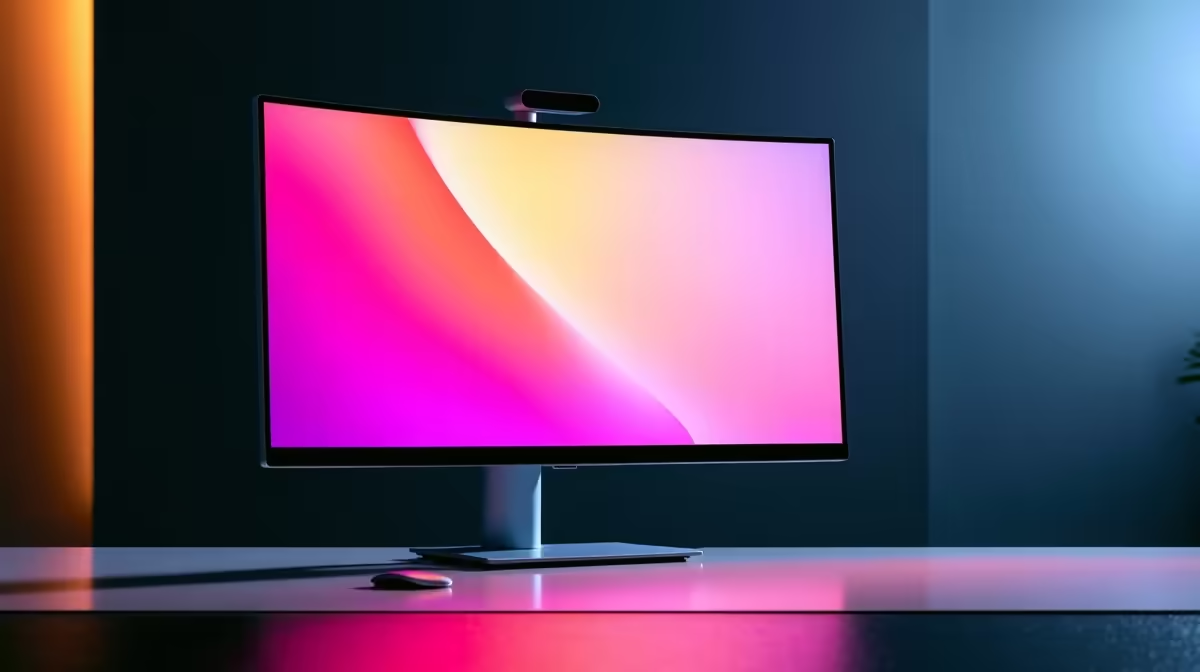
The upgrade had an immediate impact on Lerato's workflow. While many benefits are visual, we can track the real-world improvements. To boost her productivity even further, she added a secondary curved monitor for her toolbars and reference images, creating a more ergonomic and immersive workspace.
| Metric |
Before (8-Bit Monitor) |
After (10-Bit Monitor) |
| Client Colour Revisions |
3-4 per project |
0-1 per project |
| Print Accuracy |
~85% match |
~99% match |
| Reported Eye Strain |
Noticeable after 4 hours |
Minimal after 8 hours |
| Project Turnaround |
Standard |
15% Faster ✨ |
Even if you aren't a designer, a better panel makes a difference. While you might think premium features are reserved for all gaming monitors, the enhanced clarity and colour from professional PC monitors reduce eye fatigue during long hours of coding or spreadsheet work. Even a quality portable monitor for your laptop can make your mobile office much more effective.
“I honestly didn’t realise how much my old monitor was fighting me. The new 10-bit screen is a revelation… what I see is what I get. No more guesswork, and my clients are happier than ever.” – Lerato M.
Upgrade Your View Today
Don't let a subpar display limit your potential. Explore our latest PC monitor deals for performance that shows every detail in brilliant colour.