Quick Answer
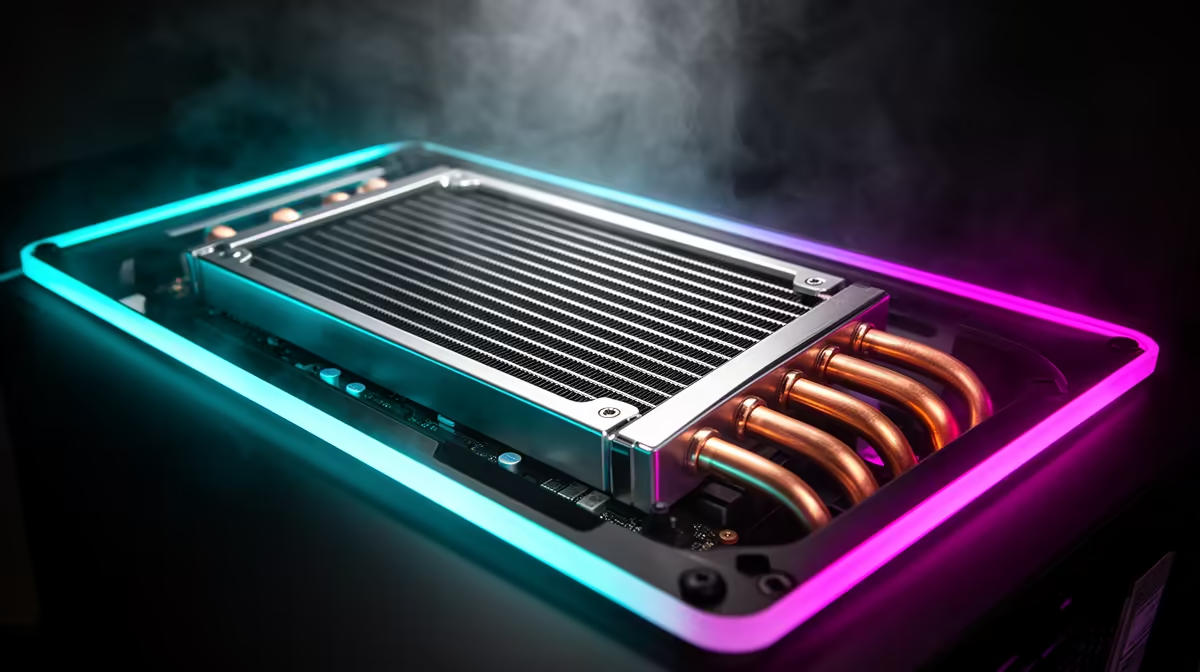
A 360mm AIO liquid cooler outperforms even the best dual-tower air coolers on sustained all-core loads above 150W, running five to fifteen degrees Celsius cooler at the CPU under gaming and productivity workloads. Air cooling is quieter at idle, simpler to install, and costs R800 to R1,500 less for comparable performance on CPUs up to 105W TDP. Choose the 360mm AIO when your CPU exceeds 125W TDP or your case prioritises a clean aesthetic.
Thermal Performance Compared Head-to-Head 🌡️
For a Ryzen 9 9900X running at around 120W sustained all-core, a quality 360mm AIO holds junction temperatures around 75 to 80 degrees Celsius, while a premium dual-tower air cooler like a 2x 140mm tower design sits around 85 to 92 degrees under the same load. The liquid cooler wins on sustained performance because the radiator has substantially more surface area than a tower fin stack for dissipating heat to the air. In burst workloads like gaming, where the CPU spikes briefly and then drops, the thermal mass of a large air cooler evens out peaks similarly well, and the difference narrows to five degrees or less in typical gaming scenarios.
Case Compatibility and Installation Differences 🔧
A 360mm AIO requires a case with explicit front or top mounting positions that accept a 360mm radiator footprint. Traditional compact mid-towers often top out at 240mm or 280mm AIO support, so the case selection narrows when you commit to a 360mm unit. By contrast, a large dual-tower air cooler fits in most mid-tower ATX cases but requires tall clearance above the CPU socket and can conflict with tall RAM modules. AIOs also present pump failure as a long-term risk that air coolers simply do not have. In South Africa, warranty replacements for failed AIO pumps go through local distributors, and typical turnaround is two to three weeks, during which your build is non-operational.
Noise, Dust, and Long-Term Ownership 📊
Dual-tower air coolers are effectively silent at low fan speeds, with no pump noise added to the system. An AIO pump produces a low hum that is generally inaudible at gaming distances but noticeable in a silent room at night. Dust accumulation on a radiator is harder to clean than on a tower heatsink: compressed air through radiator fins is effective but requires removing the fans first for full access. In dusty South African environments, radiator fin cleaning is a six-month maintenance task that air cooler users do not share. Over a five-year ownership period, the maintenance overhead of an AIO is slightly higher, balanced against its superior thermal ceiling.
Use CPU TDP as Your Decision Threshold ⚡
A 360mm AIO is the right choice when your CPU's TDP exceeds 125W or you plan to run an all-core workload like video rendering alongside gaming. Below that threshold, a quality large air cooler is thermally adequate and costs less. Use your CPU's rated TDP as the deciding number, not marketing claims about which cooler looks better.
FAQ
Does a 360mm AIO lower GPU temperatures compared to air cooling?
Yes, indirectly.
Which cooler lasts longer: AIO or air?
A quality air cooler with sealed bearings has no moving parts beyond its fan and can outlast the rest of the build. AIOs have a pump with a rated lifespan of 50,000 to 70,000 hours. High-end AIO pumps from reputable brands rarely fail within a five-year window, but the theoretical lifespan advantage belongs to air cooling.
What is the minimum case size for a 360mm AIO?
Most full ATX mid-tower cases with front-mounted 360mm support work, but verify the exact interior clearance spec. Cases that advertise 360mm front support but have a drive cage behind the front panel may restrict radiator thickness to 25mm, which limits you to thin radiators only.
Deciding between liquid and air cooling for your next build?
Evetech stocks a full range of 360mm AIOs and premium tower air coolers, browse the cooling category and compare specs to match your CPU's needs.