Quick Answer
If you are already committed to an AIO liquid cooler, prioritise 360mm radiator support. If you are undecided or leaning toward a high-end air cooler, prioritise CPU cooler height clearance (at least 165mm).
What 360mm Radiator Support Actually Requires 🔧
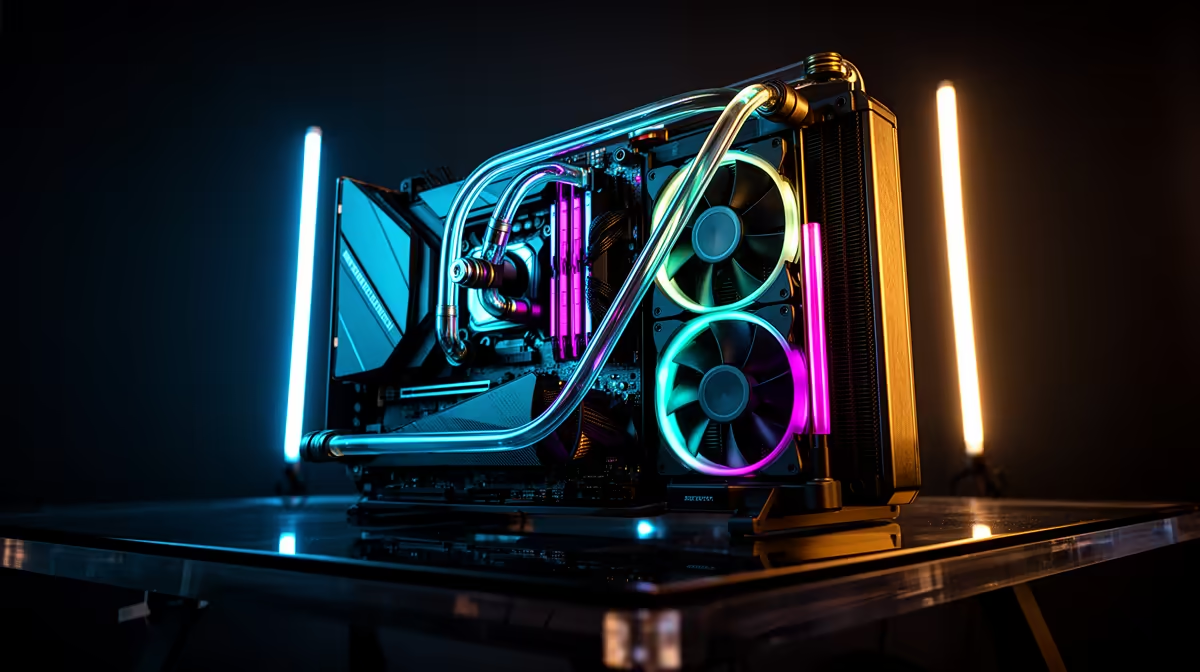
A case advertising 360mm radiator support must accommodate three 120mm fans plus the radiator itself in either the front or top panel position. This requires a front panel gap of at least 155mm (three fans side by side), sufficient depth between the front panel and motherboard tray to clear the radiator and fan stack, and fan mount holes at 120mm centres across the full 360mm span.
Air Cooling Clearance: Tower Coolers and Case Height 💨
High-end tower air coolers like the be quiet! Dark Rock Pro 5 and Noctua NH-D15 reach 167mm to 168mm in height. A case with a CPU cooler clearance of 165mm will technically conflict with these coolers, while 170mm clearance accommodates them. Cases designed primarily around AIO radiator support sometimes sacrifice CPU cooler height clearance to allow top radiator placement, which is a problem if you later switch to air cooling.
Cases That Offer Both 🖥️
The good news is that the mid-range case market in 2025 and 2026 has largely converged on designs that accommodate both 360mm front radiators and 165mm to 170mm CPU air coolers simultaneously. Brands like Corsair, Lian Li, DeepCool, and Phanteks in the R1,200 to R2,000 range offer this combination. The key is confirming the top panel does not also claim 360mm support, as top radiator placement is what most frequently conflicts with tall air coolers due to the reduced clearance between the top of the cooler and the radiator's underside fans. Choosing front-only radiator placement effectively removes this conflict entirely.
Download the Case Manual Before Buying ⚡
Manufacturer case manuals, available from brand websites and from distributor product pages, include the most accurate internal dimension drawings including exact radiator support positions, RAM clearance diagrams, and CPU cooler height specifications. These are far more reliable than the brief specification tables on retail listings, which sometimes contain errors or omit conflict warnings for simultaneous radiator and tall cooler configurations.
FAQ
Does a 360mm AIO always cool better than a top air cooler?
Not always. A high-end 120mm dual-tower air cooler like the Noctua NH-D15 performs within 2 to 4 degrees Celsius of many 280mm AIOs under gaming loads. A 360mm AIO outperforms air cooling under sustained all-core workloads, but for gaming-only use, a quality twin-tower air cooler is competitive and eliminates pump failure risk.
What happens if my CPU air cooler contacts the case side panel?
Contact between the cooler and the side panel prevents the panel from closing fully, which disrupts airflow and can stress both the cooler mounting and the panel. If your cooler is marginally too tall, some cases have slightly recessed side panels that give 5 to 10mm extra clearance. Otherwise, a shorter cooler or a wider case is required.
Can I run a 360mm AIO in a case that also has a tall RAM clearance restriction?
This depends on whether the radiator is front-mounted or top-mounted. Front-mounted 360mm AIOs have no impact on RAM slot access or clearance. Top-mounted 360mm AIOs in cases with restricted top clearance can conflict with tall RAM sticks or VRM heatsinks that extend above the standard 32mm RAM height. If running top-mounted, confirm the case's RAM clearance figure with a top radiator installed.
Not sure which cooling path to lock in first?
Check the full range of cases at Evetech that support both 360mm AIOs and tall air coolers, so your build stays flexible regardless of which cooling option you choose.