Quick Answer
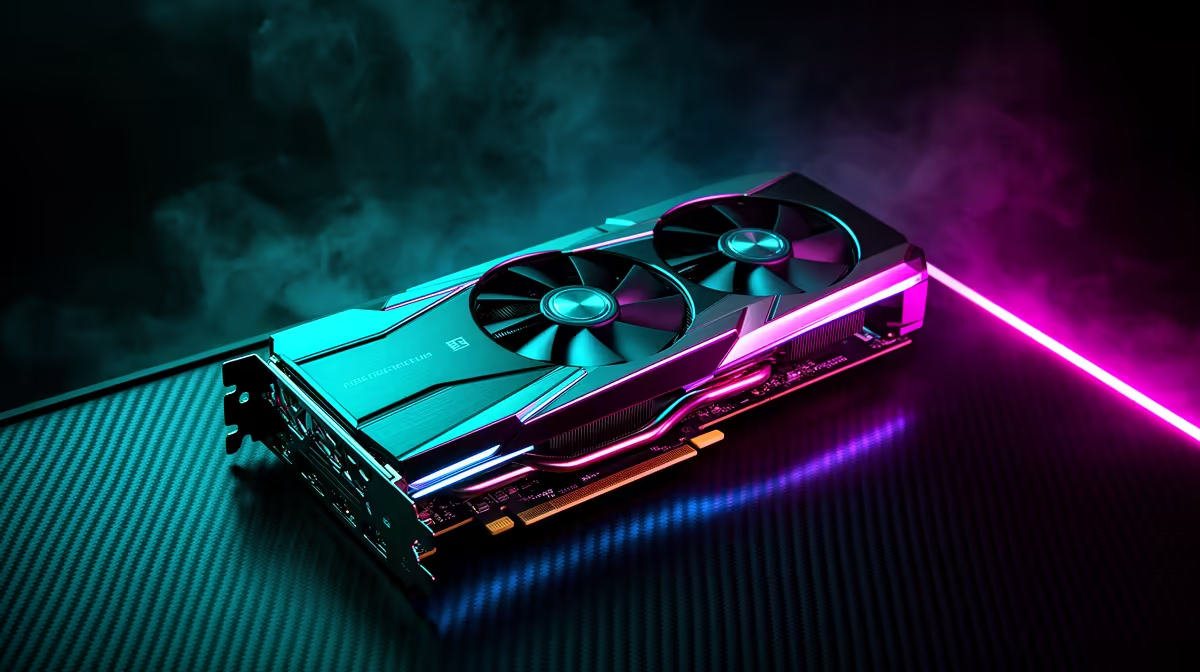
GDDR7 delivers roughly 1.5 to 1.8 times the memory bandwidth of standard GDDR6 at the same capacity. An 8GB GDDR7 card moves data faster than an 8GB GDDR6 card despite identical frame buffer size. At 1080p, that bandwidth uplift means smoother frame pacing and better texture streaming in asset-heavy scenes.
How GDDR7 Differs From GDDR6 and GDDR6X 💡
GDDR6 tops out at around 18 Gbps per pin on standard implementations. GDDR6X pushes to roughly 22 Gbps using PAM4 signalling. GDDR7 achieves 28 to 32 Gbps per pin on current RTX 50-series and RX 9000-series cards. The practical effect is a much wider effective memory pipe without increasing the physical bus width. An RTX 5060 with GDDR7 on a 128-bit bus delivers bandwidth figures that previously required a 192-bit GDDR6 bus, two generations ago.
For bandwidth-limited workloads at 1080p, including high texture quality and ray tracing scenes, GDDR7 closes a real performance gap versus same-capacity GDDR6 cards.
Does GDDR7 Help at 1080p or Is It Mainly a 4K Feature? 🖥️
Memory bandwidth becomes more important as resolution increases, but GDDR7 still makes a measurable difference at 1080p in texture-heavy or ray-traced titles. In Alan Wake 2 and Cyberpunk 2077 at 1080p Ultra settings, cards benefit from faster memory when loading high-resolution assets mid-scene. At 1080p Low settings where shader cores are the main bottleneck, the improvement is smaller.
DLSS 4 Multi Frame Generation on the RTX 5060 also benefits from GDDR7 because generated frames need to be read and written through VRAM at high speed. GDDR7 keeps that pipeline from becoming a constraint at 1080p with frame generation active.
GDDR7 and 8GB Capacity: Is the Amount Still Adequate? 🎮
GDDR7 is faster but does not change how much texture data sits in VRAM simultaneously. Some recent titles can brush against 8GB at 1080p Ultra with high-resolution texture packs. At 1080p High, 8GB covers virtually all current games comfortably. For SA gamers in the R8,000 to R12,000 price range, 8GB GDDR7 is the practical value choice for 1080p and extends the useful life of the frame buffer compared to same-size GDDR6 on older architectures.
Monitor VRAM Usage With GPU-Z During Gaming ⚡
Open GPU-Z and keep the Sensors tab visible during a gaming session. Watch the GPU Memory Used value in real time. If you regularly hit 7.5GB or above at your preferred settings, drop texture quality one step. On GDDR7 cards this adjustment is rarely needed at 1080p High.
FAQ
Can GDDR7 compensate for a narrower memory bus?
Partially. A 128-bit GDDR7 bus delivers bandwidth comparable to a 192-bit GDDR6 bus, so narrower bus designs are much less of a penalty than before. Very wide GDDR7 buses on higher-end cards still deliver more total bandwidth for 4K.
Will GDDR7 matter more in two or three years?
Yes. As games increase texture resolution and DLSS frame generation becomes more common, the bandwidth advantage of GDDR7 will extend the competitive lifespan of a card versus equivalent-capacity GDDR6.
Do I need to configure anything to get full GDDR7 performance?
No. GDDR7 operates at full speed by default. Keeping drivers current ensures the memory controller firmware is optimised, but no manual configuration is needed.
Ready to upgrade to GDDR7 bandwidth?
Evetech stocks GDDR7-equipped GPUs across the RTX 50-series and RX 9000-series. Browse the graphics card category to compare bandwidth-to-rand value for your resolution.