Quick Answer
A case with 360mm radiator support and 430mm GPU clearance covers all current high-end hardware combinations. The 360mm front or top radiator mount handles a 280W to 350W CPU load quietly, and 430mm GPU clearance fits every RTX 50-series and RX 9000-series card including the longest triple-fan RTX 5090 models at 366mm. Together these two specs define a case built for serious high-end builds rather than mid-range configurations.
360mm Radiator Support: What It Requires 💧
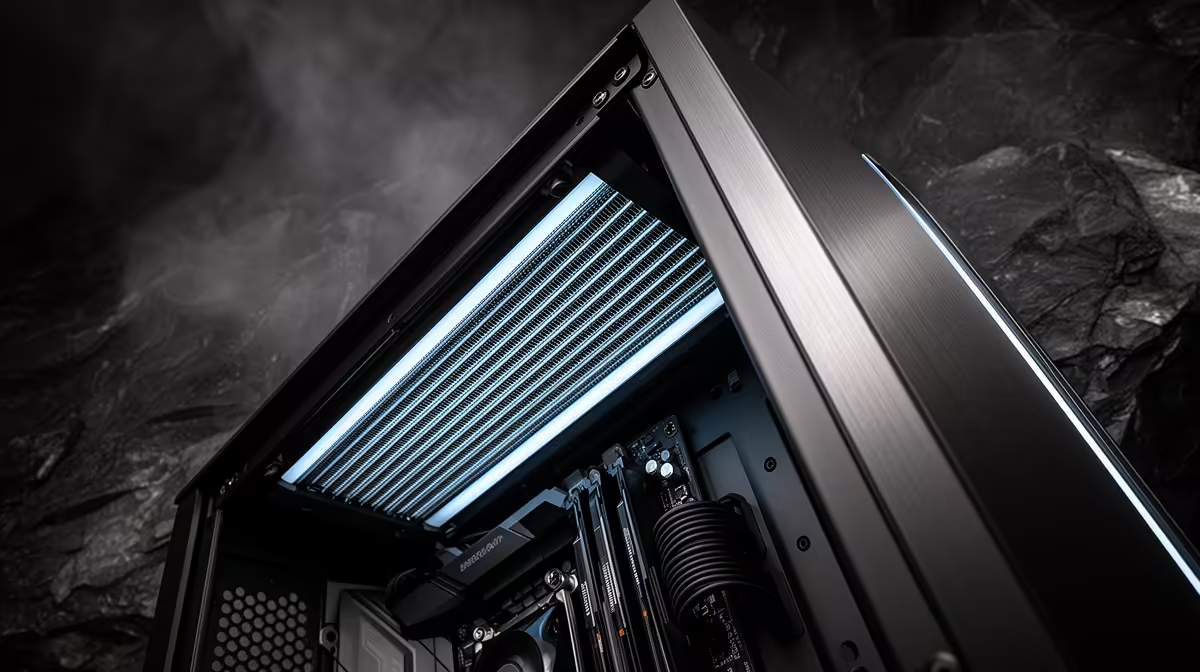
A 360mm radiator occupies three 120mm fan mount positions in a row, measuring 396mm in total length with fan mounts included. Fitting this at the front of a case requires the front bracket to be tall enough to clear the radiator height plus the fan blade depth (typically 25mm to 30mm). At the top, the motherboard must sit low enough that the top radiator bracket does not contact the RAM modules or the CPU power connector. Most ATX mid-towers from the R3,500 price point up accommodate 360mm at the front, and many also support 360mm at the top with the caveat that tall DDR5 heatsinks (over 45mm) may create clearance issues. Full towers eliminate this concern entirely by providing additional vertical space between the motherboard tray and the top panel.
GPU Clearance: Measuring What Actually Matters 🖥️
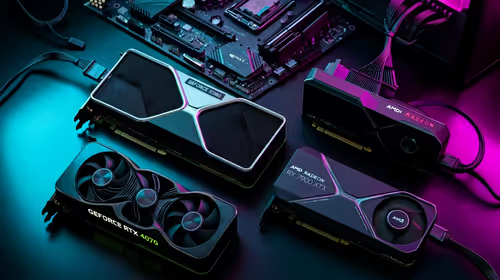
GPU clearance in a case specification sheet is measured from the inside of the rear panel (where the PCIe bracket slots mount) to the inside of the front panel or the nearest obstruction. However, several factors reduce effective GPU clearance: a drive cage behind the front bracket, a front radiator bracket positioned partially inside the GPU zone, or thick front cables routed without management. In practice, the effective GPU clearance with a 360mm radiator installed at the front and a drive cage removed is the figure that matters. Always check user-reported effective clearance rather than relying solely on the manufacturer specification.
When 360mm Meets 430mm: Identifying the Real Constraint 🔧
The critical check is whether a specific case delivers both specs simultaneously without one reducing the other. Some mid-towers rate 430mm GPU clearance with the drive cage removed and rate 360mm front radiator support separately, but not both at the same time with full GPU clearance. The only reliable verification is a case-specific build report or video showing a 360mm front radiator plus a 350mm-plus GPU installed together. Cases that deliver both specs simultaneously without compromise typically sit at R4,000 to R6,500 and are explicitly designed for high-end configuration.
Remove the Drive Cage First ⚡
Most ATX mid-tower cases include a removable 3.5-inch drive cage near the front intake. Removing this cage immediately increases effective GPU clearance by 20mm to 40mm and often makes a 360mm front radiator fit in cases where it otherwise would not. If you are not using traditional hard drives, the cage serves no purpose and its removal is a free upgrade.
FAQ
Can a 360mm top radiator replace a front 360mm for better GPU clearance?
Yes. Mounting the 360mm AIO at the top removes it from the front GPU clearance zone entirely, maximising the effective GPU clearance to the rated case spec.
Does 360mm radiator support at the top require a special case?
Not specially, but the case must have sufficient clearance between the motherboard and the top panel to fit the radiator plus fan stack. This distance is typically 40mm to 60mm, and cases with high-profile RAM modules or large VRM heatsinks may have conflicts.
What is the GPU clearance on the most popular ATX mid-towers in the SA market?
Most well-regarded ATX mid-towers stocked in SA rate GPU clearance at 380mm to 430mm. Premium showcase models push to 430mm or more.
Need a case that handles both a 360mm AIO and a triple-fan GPU?
Evetech stocks ATX gaming cases built for high-end hardware configurations with radiator and GPU clearance specs verified for flagship builds.