




IPS vs VA for Strategy and Sim Games in SA
IPS vs VA for strategy and sim games should be judged by fit, not a single winner. Compare compatibility, latency, capacity, upgrade path, cost planning, and South African setup needs.
Read moreAM5 dropped DDR4 entirely, moved to a soldered-pin socket and brought PCIe 5.0 to both the graphics slot and storage. That combination is why an older AM4 cooler may still fit while nothing else carries across.
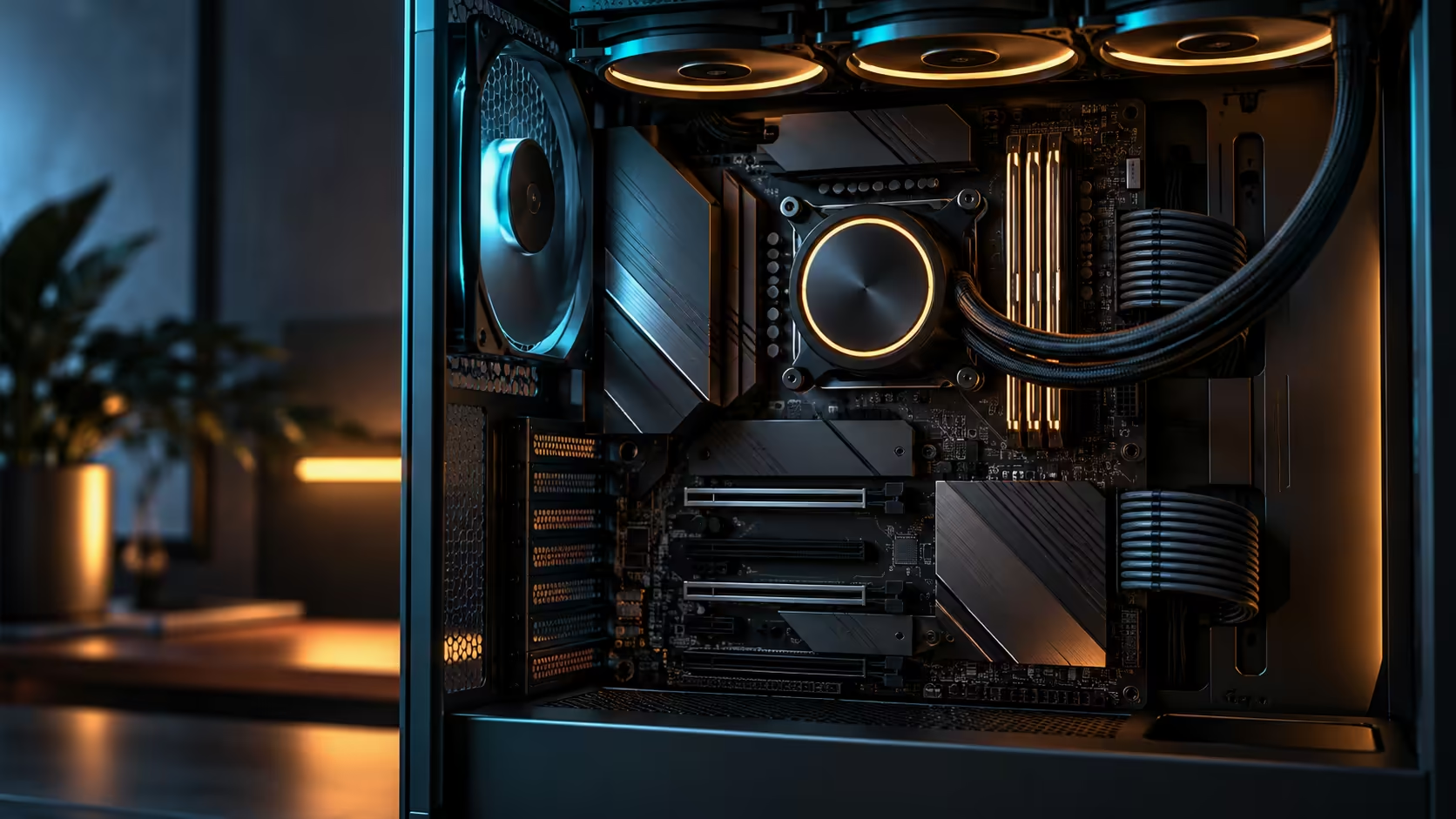
Socket changes in desktop PCs happen rarely enough that most builders only live through two or three of them, which is why the jump from AM4 to AM5 confuses people who last built a machine several years ago. The change was not cosmetic. AMD dropped DDR4 entirely, moved from pins on the CPU to pins in the socket, and brought PCIe 5.0 to both the graphics slot and storage at the same time, which is why some AM4-era parts carry across and others do not.
AM5 replaced AM4's pin-grid design with a land grid array socket, dropped DDR4 support in favour of DDR5 exclusively, and added PCIe 5.0 for both the primary graphics slot and at least one M.2 slot on capable boards. A cooler mounting bracket from many AM4 coolers still fits, because AM5 kept the same mounting hole spacing, but the CPU, motherboard and memory are all a clean break. On a flagship AM5 board such as the R54,999 ROG Crosshair X870E Edition 20, that break buys DDR5 8600+MT/s and two PCIe 5.0 x16 slots that no AM4 board could ever offer.
AM4 used a pin-grid array, where the CPU itself carries around 1,331 delicate pins that insert into holes on the socket. AM5 flipped that arrangement to a land grid array with roughly 1,718 contact pads instead, and the pins now live in the socket rather than on the chip. That single change is why an AM4 chip physically cannot go into an AM5 board and vice versa, regardless of how similar the two sockets look at a glance.
The socket's outer dimensions and mounting hole spacing stayed close enough that many existing AM4 cooler brackets bolt straight onto any current board in the AMD motherboard range, which is one of the few pieces of continuity across the whole platform change. Everything electrical underneath the bracket, however, is new.
AM4 boards spanned a long run of DDR4 speeds as the standard matured, from early kits well under 3000MT/s to late boards validating past 5000MT/s on tuned parts. AM5 does not offer a DDR4 option at any point in its lineup; every AM5 board, including budget models, takes DDR5 exclusively.
That is a real cost consideration for anyone upgrading rather than building fresh, since existing DDR4 kits have no path onto an AM5 board no matter how recently they were bought, and the DDR5 memory range is now the only place to shop for this platform. The upside is a much higher speed ceiling from day one: the Crosshair X870E Edition 20's own spec sheet states 8600+MT/s on DDR5, a figure no DDR4 platform ever reached in a validated, board-supported form.
Late AM4 boards eventually gained PCIe 4.0 across their primary slot and top M.2 socket, which was itself an upgrade over the PCIe 3.0 that most of the platform's life ran on. AM5 boards carry PCIe 5.0 as standard for the primary graphics slot on capable chipsets, and top-tier boards extend that to one or more M.2 slots as well.
Among the boards listed under AMD X870 motherboards, the ROG Crosshair X870E Edition 20 carries two PCIe 5.0 x16 slots, both capable of running at the platform's highest bandwidth rather than one full-speed slot and one stepped down, which is how many earlier boards handled a second physical x16 slot. Storage benefits too: a PCIe 5.0 M.2 socket roughly doubles the sequential throughput of a PCIe 4.0 socket, a jump that shows up clearly in large file transfers even though it does little for everyday responsiveness.
A cooler is the most likely survivor, thanks to the shared bracket spacing, though it is worth checking the specific cooler manufacturer's compatibility list rather than assuming every AM4 model qualifies. A case, a power supply and most storage drives are platform-agnostic and move across without issue, since none of those connect to the socket directly.
CPU, motherboard and memory are the three components with no bridge between platforms. Anyone weighing an AM5 upgrade against staying on AM4 should treat those three as one combined purchase, since buying just a new board without the matching CPU and DDR5 kit leaves the upgrade unfinished.
AM5 is the platform AMD is actively developing, with newer Ryzen generations landing on the same socket rather than requiring a fresh one each release, which was the pattern on AM4's later years too but is worth confirming holds again here. A board like the Crosshair X870E Edition 20, at R54,999 with its 24+2+2 power stages and bundled 360mm cooler, is built to carry a high-core-count chip through several CPU generations on the same socket rather than needing replacement at the next upgrade.
For someone still comfortably running an AM4 system on tasks it handles well, the case for moving now rests on DDR5 speed, PCIe 5.0 storage, and future CPU support rather than any immediate performance gap in games, where the difference is smaller than the platform change suggests.
Often yes, since the mounting hole spacing carried across, but confirm compatibility with the specific cooler model rather than assuming every AM4-era cooler will work.
No. Every AM5 board, regardless of price tier, takes DDR5 exclusively, so an existing DDR4 kit has no path onto the new platform.
The primary graphics slot on capable chipsets, yes, but M.2 slot support for PCIe 5.0 varies by board tier, so a specific model's own listing is what tells you, not the platform name alone.
Roughly double the sequential throughput of PCIe 4.0, most noticeable in large file transfers rather than everyday responsiveness or game load times.
The gaming difference between a well-specced AM4 system and a new AM5 one is usually smaller than the platform change implies; DDR5 speed and PCIe 5.0 storage matter more for creative and heavy multitasking work.
Ready to move onto a platform built for the next several years? Treat the CPU, board and memory as one combined decision, since none of the three bridges from the older platform.
Often yes, since the mounting hole spacing carried across, but confirm compatibility with the specific cooler model rather than assuming every AM4-era cooler will work.
No. Every AM5 board, regardless of price tier, takes DDR5 exclusively, so an existing DDR4 kit has no path onto the new platform.
The primary graphics slot on capable chipsets, yes, but M.2 slot support for PCIe 5.0 varies by board tier, so a specific model's own listing is what tells you, not the platform name alone.
Roughly double the sequential throughput of PCIe 4.0, most noticeable in large file transfers rather than everyday responsiveness or game load times.
The gaming difference between a well-specced AM4 system and a new AM5 one is usually smaller than the platform change implies; DDR5 speed and PCIe 5.0 storage matter more for creative and heavy multitasking work.
IPS vs VA for strategy and sim games should be judged by fit, not a single winner. Compare compatibility, latency, capacity, upgrade path, cost planning, and South African setup needs.
Read more
Gen 5 NVMe SSD guide for Bloemfontein gamers should be shortlisted around the job it must do. South African buyers should compare capacity, speed, thermals, and motherboard support, warranty path, and upgrade room before treating any pick as best.
Read more
Skip the RTX 5070 if your first-time builder budget needs better balance. Better SA picks can free room for the right CPU, PSU, case, monitor, storage, and cooling while still giving a strong first gaming PC experience this year in South Africa.
Read more
RTX 5080: weighing the pros and cons for SA should be shortlisted around the job it must do. South African buyers should compare GPU tier, VRAM, cooling, and PSU headroom, warranty path, and upgrade room before treating any pick as best.
Read more
Core i5-13400F gives South African PC builders a capable mid-range CPU choice with clear limits. Check its gaming fit, discrete GPU requirement, LGA1700 platform costs, and upgrade path before locking in your parts list.
Read more
Pros and cons of the Wi-Fi 7 routers for SA should be shortlisted around the job it must do. South African buyers should compare WiFi standard, coverage, latency, and device support, warranty path, and upgrade room before treating any pick as best.
Read more
Steam content servers unreachable needs a download-path check, not an immediate reinstall of every game. Restart the client, inspect download settings and compare another connection when practical. Clearing the download cache is separate from deleting installed games.

Keychron G6 HE has built-in and swappable battery versions with different weights. The product brief lists 42g and 46g respectively, each with a 3g tolerance. Choose by grip and battery preference before treating one headline weight as universal.

Corsair HS80 v2 MAX supports 2.4GHz wireless and Bluetooth. Its maximum battery figures use RGB-off conditions and differ by connection. Check microphone routing, comfort and the exact device support before assuming every wireless mode behaves alike.

Windows taskbar notification badges can be shown or hidden in Taskbar behaviours. This changes the small app indicators, not the underlying messages. Choose a calmer desktop while keeping a deliberate routine for checking important conversations and app updates.
Windows taskbar notification badges can be shown or hidden in Taskbar behaviours. This changes the small app indicators, not the underlying messages. Choose a calmer desktop while keeping a deliberate routine for checking important conversations and app updates.

Windows USB device in use can mean a program still has the drive open. Finish transfers and close files before retrying ejection. Better performance caching requires safe removal; a replacement drive is not the first fix for an open-file warning.

Windows Nearby Sharing not working starts with feature, Bluetooth and visibility checks on both PCs. My devices only depends on matching Microsoft accounts. Test a small harmless file before buying networking hardware or changing your home router.

Windows hardware reserved RAM is different from memory used by applications. Compare installed memory with firmware detection and the usable amount before buying modules. Reservations and reporting limits vary by system; no universal setting restores every byte.

Windows title bar window shake can minimise other open windows when you shake the active window by its title bar. Inspect the Multitasking setting and switch it off if that gesture interrupts your work. The preference costs R0 and does not require new hardware.

Windows Print Screen opens Snipping Tool when its keyboard preference is enabled. Change the option under Accessibility, Keyboard to choose another workflow. Test whether you need a clipboard image or a saved file.

Windows desktop icons missing may be a visibility setting. Right-click the desktop, choose View and inspect Show desktop icons. If only system icons are absent, use Desktop icon settings. Check the Desktop folder before assuming files were deleted.

Windows set time zone automatically greyed out calls for a location and device-policy check. Automatic time-zone selection relies on location services. A manual time-zone choice is separate from synchronising the clock; check both before replacing hardware.