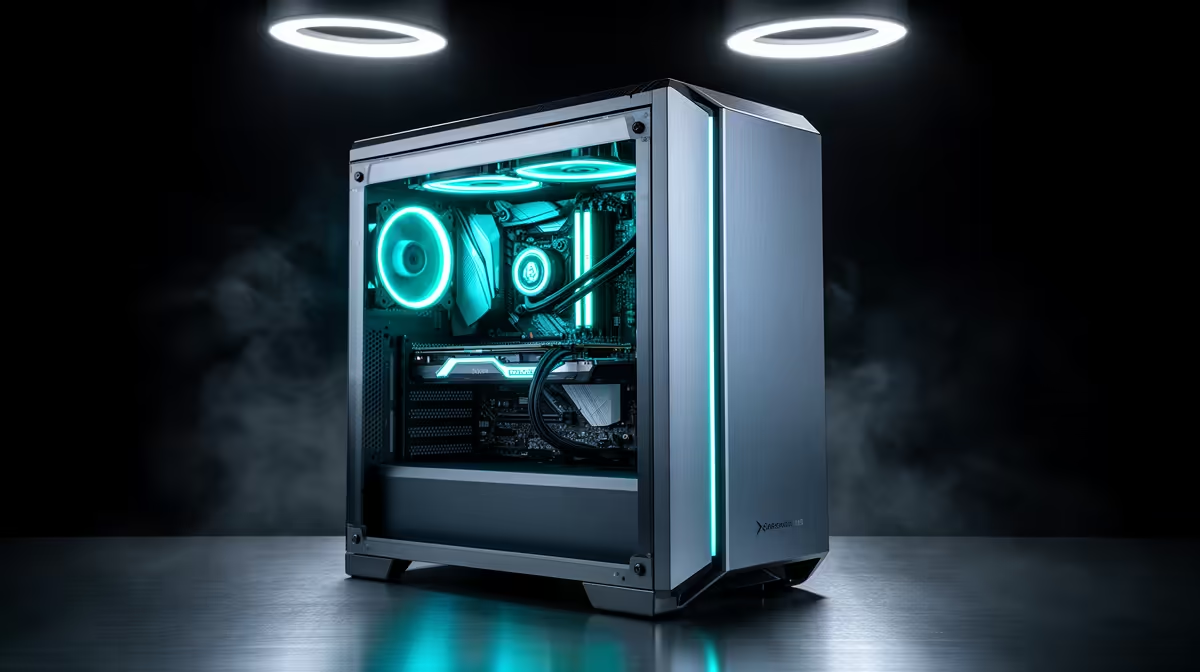
Board size confuses a lot of first builds because the case dictates what physically bolts in, not the other way around. Before ordering a motherboard, it pays to confirm the atx mid-tower case on the shopping list actually accepts that board's mounting pattern, since ATX, Micro-ATX, and Mini-ITX boards all use different standoff layouts even though several of them can share the same chassis.
Quick Answer
A case rated for ATX will almost always accept Micro-ATX and Mini-ITX too, since the smaller boards use a subset of the same mounting holes. The Antec NX410 fits all three standards at R1,199, applying the same 168mm CPU cooler height and 165mm PSU length limits no matter which board size goes in, since those clearances come from the case shell rather than the motherboard.
📐 How ATX, Micro-ATX and Mini-ITX Actually Differ
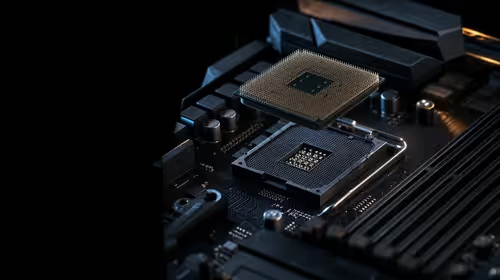
ATX boards measure roughly 305mm by 244mm and use the full set of standoff positions in a case rated for them. Micro-ATX trims that down to about 244mm square, dropping some expansion slots and standoff points but keeping enough overlap with ATX that both fit the same mounting pattern. Mini-ITX shrinks further still, to around 170mm square, built around a single expansion slot and a much smaller standoff footprint.
Because each smaller standard is really a subset of the ATX layout rather than a different one, a case built to fit full ATX boards, like the Antec NX410, accepts Micro-ATX and Mini-ITX simply by using fewer of the available mounting points. There is no separate size of case required for the smaller boards, only fewer standoffs used during installation.
🧰 CPU Cooler and PSU Clearance Don't Change With Board Size
This is the part that catches builders out: cooler height and PSU length limits come from the case's internal dimensions, not the motherboard. The Antec NX410's 168mm CPU cooler height allowance and 165mm PSU length limit apply identically whether the installed board is full ATX or a compact Mini-ITX. A smaller board does not buy extra clearance for a taller air cooler or a longer power supply, because the side panel and front panel positions that create those limits never move.
Where Mini-ITX Builds Actually Gain Space
The one place a smaller board does help is around the edges, since a Mini-ITX board leaves more open space around its standoffs for cable routing and airflow than a full ATX board crowding the same tray. That extra breathing room makes cable management noticeably easier, even though the hard clearance numbers for coolers and PSUs stay fixed.
🔩 Standoff Placement and Common Mounting Mistakes
Every board size uses a specific standoff pattern, and installing a standoff where the board has no corresponding hole risks a short against the motherboard's underside. Checking the manual for the exact standoff positions before mounting any board, rather than assuming every hole in the tray needs a standoff, avoids this entirely.
Expansion slot covers are another common mismatch. A Micro-ATX or Mini-ITX board uses fewer slot positions than the case has cutouts for, so leftover slot covers should stay in place over any unused rear openings to keep dust and stray cables out of the case.
Case Compatibility Beyond the Motherboard Tray
Front panel headers, USB connectors, and power switch wiring are standardised regardless of board size, so a smaller motherboard connects to the same front I/O described elsewhere on the Antec NX410's spec sheet without any adapter or workaround needed.
🌀 Fan and Radiator Positions Stay the Same Across Board Sizes
Fan mounting points, and the radiator support that goes with them, are also fixed by the case rather than the motherboard. The Antec NX410's support for up to six fans, plus its front and top radiator capacity, is available in full whether the installed board is ATX, Micro-ATX, or Mini-ITX, since those positions sit in the front, top, and rear panels well away from the motherboard tray. A Mini-ITX build in this case actually has an easier time populating every fan position, since there is less motherboard hardware nearby to route cables around.
Confirming exact compatibility before ordering parts is worth the extra few minutes. The Antec NX410 in white lists every supported board size directly on its product page, the broader Antec case lineup covers other sizes for builds with different board or clearance needs, and the case fan range helps fill out cooling for whichever board size ends up installed.
Frequently Asked Questions
Does an ATX mid-tower case also fit Micro-ATX and Mini-ITX boards?
Yes, cases rated for ATX generally accept both smaller standards too, since Micro-ATX and Mini-ITX use a subset of the same mounting holes.
Does a smaller motherboard allow a taller CPU cooler?
No, cooler height clearance is set by the case's internal dimensions, so the Antec NX410's 168mm limit applies the same way regardless of board size.
Does PSU length clearance change with a smaller motherboard?
No, the 165mm PSU length limit on the Antec NX410 comes from the case shell, not the board, so it stays fixed across ATX, Micro-ATX, and Mini-ITX builds.
What happens if I install a standoff in the wrong position?
An unsupported standoff can contact traces on the underside of the motherboard and cause a short, so always match standoffs to the exact holes specified for the installed board size.
Do unused expansion slot covers need to stay on a smaller board build?
Yes, leaving unused slot covers in place keeps dust out and prevents stray cables from working their way through open rear slots.
Is cable management easier with a smaller motherboard in the same case?
Generally yes, since a Mini-ITX or Micro-ATX board leaves more open tray space around its mounting points for routing cables compared with a full ATX board in the same chassis.
Do fan and radiator mounting positions change with a smaller motherboard?
No, fan and radiator positions sit in the front, top, and rear panels rather than on the motherboard tray, so the case's full six-fan support and radiator clearance stay available regardless of board size.
Can I move a build from Micro-ATX to full ATX later in the same case?
Yes, as long as the case supports ATX from the start, upgrading from a smaller board simply means using the additional standoff positions already present in the tray.
Ready to double-check board and clearance compatibility?
Go grab this white ATX case from Evetech's catalogue for R1,199, case only. Confirm it clears your chosen motherboard size before you buy anything else.