Quick Answer
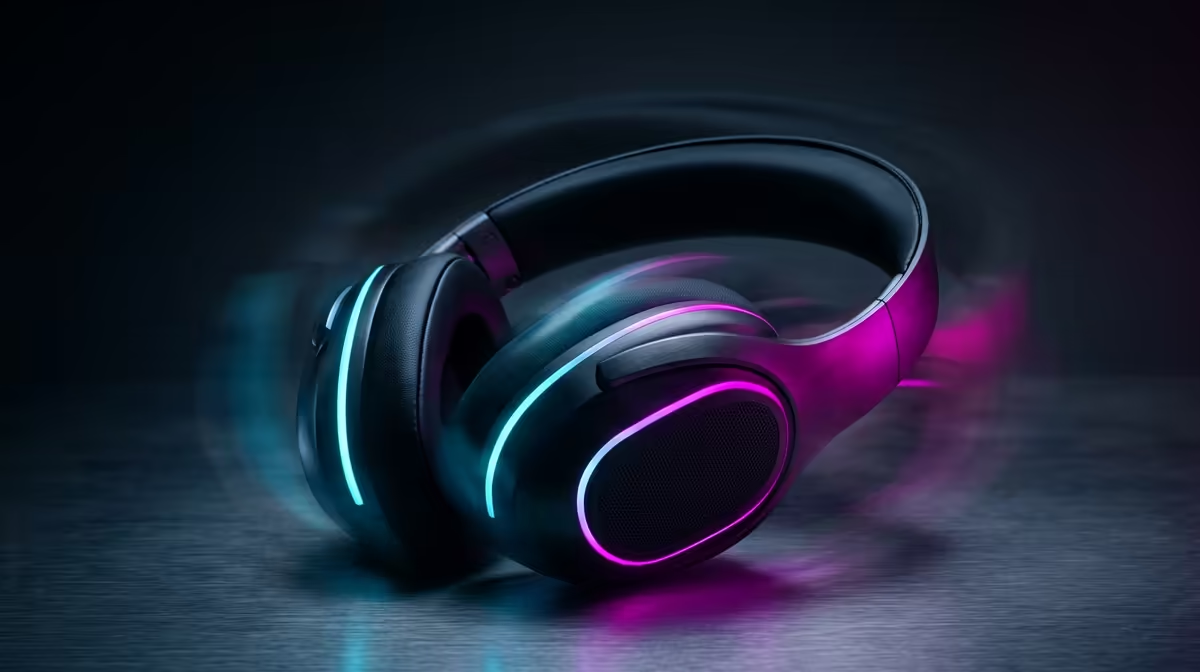
A 40-hour wireless gaming headset, used for 4 hours per day, lasts 10 days per charge. To consistently hit or exceed that rating: disable RGB, use Bluetooth instead of 2.4 GHz for non-gaming tasks, keep volume below 70 percent, and charge via USB-C to 80 percent rather than 100 percent to preserve long-term lithium-ion health.
Understanding What Cuts Battery Life Short 🔋
Manufacturers test battery life under ideal conditions: no RGB, moderate volume at around 50 percent, low polling rates, and often Bluetooth mode rather than 2.4 GHz. In real use, the combination of 2.4 GHz at 1,000 Hz polling, full RGB, and 80 percent volume can cut rated life by 35 to 50 percent. A headset advertised at 40 hours may deliver 22 to 28 hours under active gaming conditions with lighting enabled. The simplest fix is turning off RGB entirely: most gaming headsets burn 10 to 20 percent of battery on lighting that contributes nothing to audio performance. Switching to Bluetooth for study or movie sessions further extends runtime.
Charging Habits That Extend Long-Term Battery Health ⚡
Lithium-ion batteries degrade based on cumulative charge cycles and temperature exposure. Charging to 100 percent and storing plugged in accelerates cathode degradation; most battery experts recommend charging to 80 to 90 percent and not draining below 20 percent. Charge your headset when the indicator shows one or two bars rather than waiting for a shutdown. South African gamers who leave headsets on a USB dock continuously, particularly during warm December to February months, see faster capacity loss than those who charge intermittently. Some headsets include a charge-limit setting in the companion app; enable it if available.
Active Session Tips to Maximise Each Charge 🎮
Mute the microphone when not speaking: active beamforming mic processing consumes power even when no audio is being transmitted. Enable auto-sleep (typically 3 to 5 minutes of inactivity triggers power-down) to prevent the headset draining on the desk when you step away. At 40 hours rated, a South African student can game 4 hours per weekday and only charge the headset on the weekend. Combining these habits means an 8-hour Saturday session still leaves comfortable battery reserve.
Label Your Charge Days on Your Phone Calendar ⚡
Set a biweekly phone reminder labelled "Charge headset" rather than waiting for a low-battery warning during play. A mid-session shutdown at a critical game moment is avoidable with a simple scheduling habit. SA students who game after evening study sessions often forget peripherals; a calendar reminder costs nothing and eliminates the frustration entirely.
FAQ
Does playing at louder volumes drain the headset battery faster?
Yes. The amplifier driving the drivers consumes more power at higher output levels. At 90 to 100 percent volume, battery draw from the audio chain increases by roughly 20 to 30 percent compared to 50 to 60 percent, which is the setting used in most manufacturer battery tests.
Can I use a wireless headset while it is charging via USB-C?
Most modern wireless gaming headsets support gaming while charging via pass-through. Audio performance is not affected when plugged in. If the headset uses a proprietary charging port rather than USB-C, the cable must remain attached during play.
How many years should a wireless headset battery last before needing replacement?
Under normal charging habits and ambient temperatures under 30 degrees Celsius, a lithium-ion headset battery retains 80 percent of original capacity after approximately 400 to 500 full charge cycles, translating to roughly 8 years at one full cycle per week.
Looking for a wireless headset that genuinely lasts through your longest gaming sessions?
Browse Evetech's range of wireless gaming headsets, including models with 30 to 50 hour battery ratings, with delivery across South Africa.