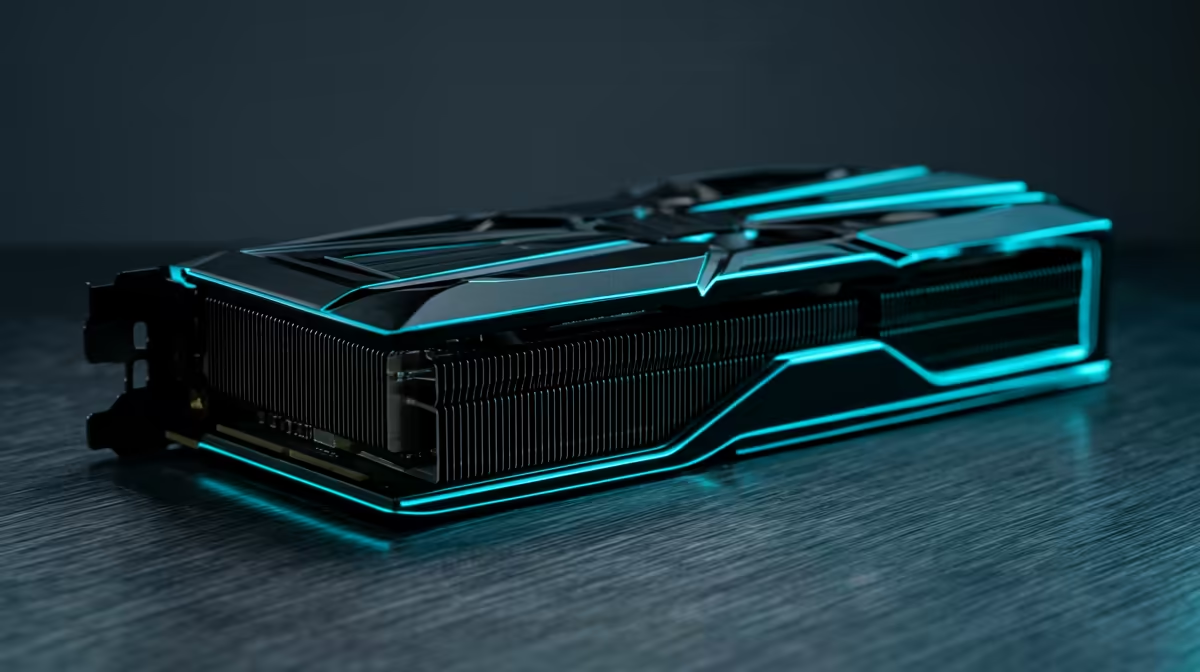
If the RTX 5070 has slipped out of stock or out of budget, the smart move for running local LLMs and Stable Diffusion at home is to shortlist cards that hit the same target without overspending.
Quick Answer
For running local LLMs and Stable Diffusion at home you want enough VRAM to load mid-size models without offloading to system RAM, and the RTX 5070 typically lands around R15,500. A RX 9070 XT or RTX 5070 Ti gets you there for similar money, so the right pick is the one whose 12GB matches your case and PSU. Expect the RTX 5070 near R15,500; a well-priced RX 9070 XT often matches it for running local LLMs and Stable Diffusion at home.
Where the RTX 5070 sits today
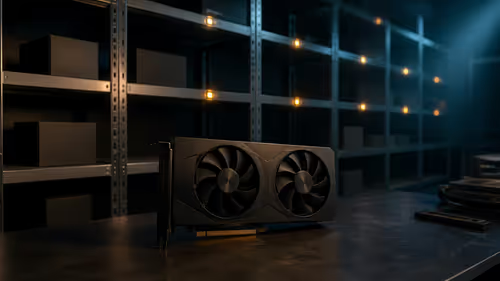
On a South African shelf the RTX 5070 usually carries a R14,500 to R17,500 ticket and a roughly 250W board power, paired with 12GB of VRAM. For running local LLMs and Stable Diffusion at home, local AI is bottlenecked by VRAM capacity, so memory beats raw gaming speed, so the question is whether a nearby card clears that bar more cheaply. The RX 9070 XT and the RTX 5070 Ti both sit close enough in raw performance that the deciding factors become price, cooler quality and how well the card fits your existing 650W PSU.
When to step up instead of sideways
Sometimes the honest answer is to spend a little more rather than sideways. If your local ai workloads genuinely needs enough VRAM to load mid-size models without offloading to system RAM, jumping to the RTX 5070 Ti can be the better long-term buy than squeezing the RTX 5070. But for most SA buyers focused on running local LLMs and Stable Diffusion at home, the nearby alternatives free up budget for a better monitor, more storage or a quieter cooler.
Matching the card to local ai workloads
Because local AI is bottlenecked by VRAM capacity, so memory beats raw gaming speed, the right alternative depends on what your local ai workloads actually demands. A card aimed at this use should comfortably deliver enough VRAM to load mid-size models without offloading to system RAM, and it should do so while leaving room for maximum VRAM per rand, since model size is gated by memory. Spending up to a flagship rarely pays off here unless the rest of your 1440p machine can use the extra grunt.
FAQ
What PSU do I need for these cards?
Plan for at least a 650W unit from a reputable brand. The 250W-class draw plus the CPU and drives needs that headroom to stay stable under load, especially during running local LLMs and Stable Diffusion at home.
How much VRAM is enough for local ai workloads?
The RTX 5070 ships with 12GB, which is the figure to match or beat. For local ai workloads, local AI is bottlenecked by VRAM capacity, so memory beats raw gaming speed, so do not drop below that buffer just to save a few hundred rand.
Is the RTX 5070 Ti a better long-term buy?
If your local ai workloads will grow more demanding, the extra headroom in the RTX 5070 Ti can pay off. For a steady running local LLMs and Stable Diffusion at home focus, though, the cheaper option usually serves just as long.
Set your running local LLMs and Stable Diffusion at home target first, then let the day's SA pricing on the RX 9070 XT and RTX 5070 Ti decide the winner.