Quick Answer
For a powerful editing and rendering PC, the most important case features are 420mm top radiator support for long-duration CPU cooling, a front USB-C 20Gbps port for fast media transfer, at least six drive mount positions for project storage, and GPU clearance of 380mm or more for multi-slot professional cards.
Thermal Architecture for Long Render Sessions 🔥
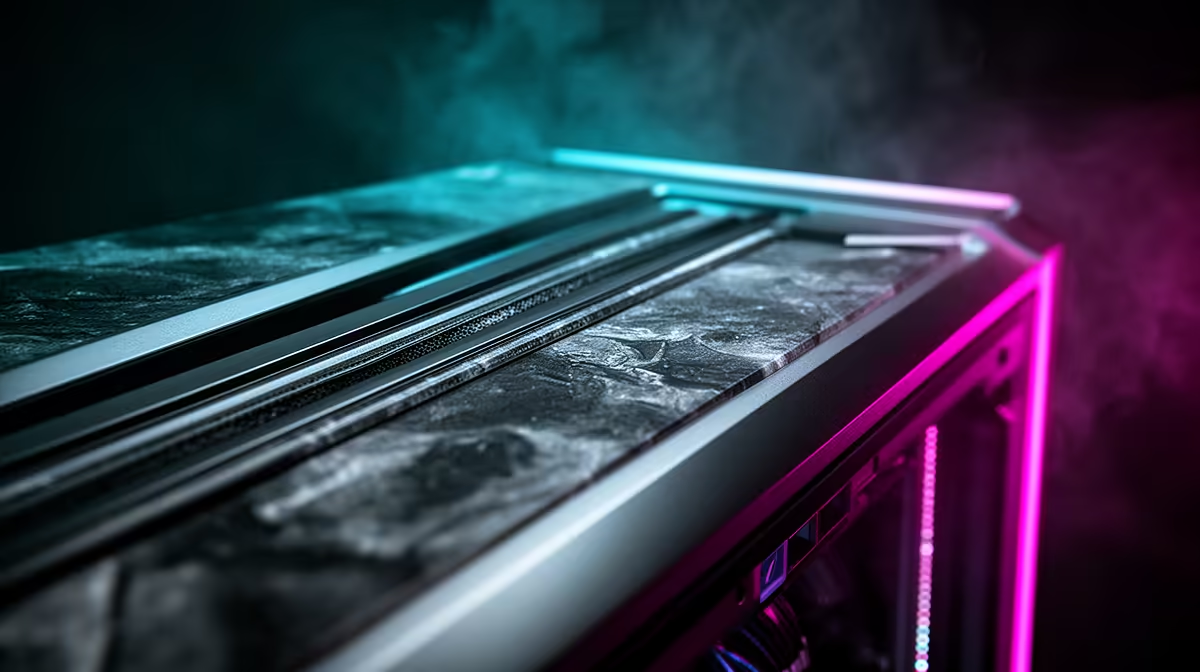
Content creators push CPUs harder and for longer durations than gamers. A 3D render in Blender or DaVinci Resolve colour grade at 8K can run a Ryzen 9 9950X or Core i9-14900K at sustained package power of 200 to 250W for hours. The case must support a 420mm AIO or provide enough vertical clearance for a 165mm tower cooler. Top panel airflow is critical: a reinforced top panel with at least 60 percent open mesh area that supports a 420mm radiator without restricting airflow is the standard to aim for. Cases with a solid stamped steel top panel and a small mesh insert are inadequate for this workload profile.
Storage Access and Front I/O for Creator Workflows 💾
Creator builds accumulate drives quickly. A working edit project may span multiple NVMe SSDs for fast scratch space, a primary SSD for the OS and applications, and several HDDs for archive storage. A case that only offers two 3.5-inch bays and two 2.5-inch trays fills up within one build. Six drive mounts minimum is the practical baseline. The front I/O matters as much as internal storage: a USB 3.2 Gen 2x2 Type-C front port at 20Gbps enables direct editing from an external NVMe. Paired with a quality NVMe enclosure, a SA video editor can ingest 200GB of 6K RAW footage from a camera card in under four minutes directly through the front panel.
GPU Clearance and PCIe Expansion 🖥️
Professional creator workloads increasingly use GPU compute alongside CPU rendering. A case supporting RTX 5090 or RTX 6000 Ada class cards at 380mm or more in GPU length avoids the frustration of a GPU that physically fits the slot but cannot seat the power connectors because the front panel is blocking access. For creators who also run a dedicated capture card or audio interface card, six expansion slots are the functional minimum. Check that the case's slot covers are toolless and retain individual slots since losing three consecutive slot covers to access PCIe lanes is a common annoyance in multi-card builds.
NVMe Over SATA in Creator Builds ⚡
For creator builds with multiple storage drives, prioritise NVMe M.2 over SATA SSDs wherever possible. Each NVMe drive eliminates two cables from the build, reducing clutter in an already cable-dense creator setup and improving airflow past the drive bays.
FAQ
Do creator builds need a different case than gaming builds?
Not categorically different, but creator builds prioritise sustained thermal performance, storage capacity, and front I/O over RGB aesthetics. A case excellent for both excels at thermal management and cable management with enough storage bays for a growing project archive.
How much should a creator budget for a PC case in South Africa?
For a serious editing and rendering build in the R25,000 to R60,000 range, a case budget of R3,000 to R6,000 is appropriate. This provides the 420mm radiator support, 20Gbps front USB-C, drive bay count, and GPU clearance a professional workflow demands.
Is a full tower necessary for a creator build, or will a mid tower suffice?
A quality ATX mid-tower is sufficient for most single-GPU creator builds. You only need a full tower for E-ATX platform builds like Threadripper, or if you require more than four 3.5-inch drive bays.
Putting together a creator workstation that handles anything you throw at it?
Evetech stocks a full range of PC cases with the storage, cooling, and I/O specs that serious editing and rendering setups demand. Browse the case selection today.