Quick Answer
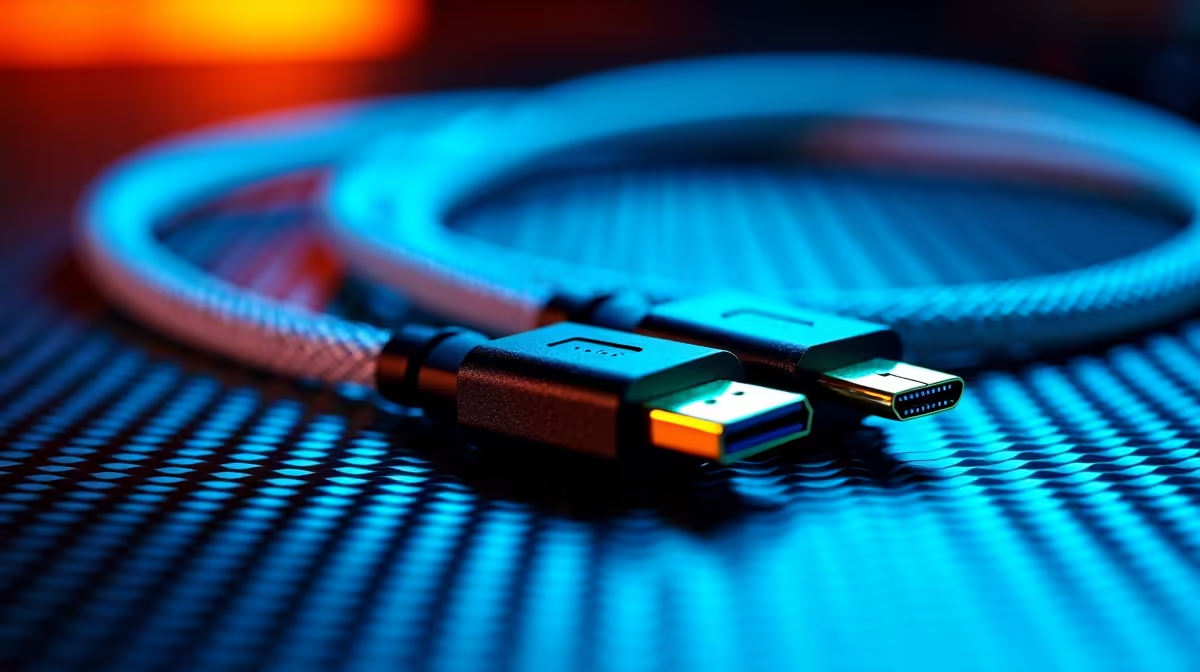
For a rand-conscious monitor upgrade in South Africa, a certified DisplayPort 1.4 (HBR3) passive cable at 1.8 metres gives the best value: it covers 4K/144Hz and 1440p/240Hz, costs R200 to R300, and will not be a bottleneck for any mid-range GPU including the RTX 5070 or RX 9070 XT.
The Key Specs and What They Mean for Your Budget 💰
Three specs define cable performance: DisplayPort version (determines max bandwidth), cable length (affects signal integrity), and passive versus active construction (determines whether a chip maintains signal over longer runs). For a typical South African monitor upgrade from 1080p/75Hz to 1440p/165Hz or 4K/60Hz, DP 1.4 passive is the target. DP 1.4 carries 32.4 Gbps (HBR3 across four lanes), enough for 4K/144Hz with Display Stream Compression (DSC) or uncompressed 1440p/240Hz. A certified 1.8 m passive DP 1.4 cable in the R200 to R300 range serves this use case perfectly.
When to Stretch the Budget Slightly 📈
If you are upgrading to a 4K/240Hz display, the R150 difference between a DP 1.4 and a DP 2.1 UHBR10 cable is worthwhile. A DP 1.4 cable can handle 4K/240Hz only with DSC enabled, which some monitors and GPUs handle differently, sometimes showing minor compression artefacts in very high-contrast scenes. A DP 2.1 UHBR10 cable at 77.4 Gbps carries 4K/240Hz uncompressed, eliminating any DSC concerns. For a R25,000 to R35,000 build centred on a high-refresh 4K display, spending R350 to R450 on the cable is sensible. For anything below 4K/240Hz, DP 1.4 is the money-smart choice.
Avoiding Spec-Washing in the South African Cable Market 🔍
Some cables sold in South Africa use marketing terms like "ultra high speed" or "premium 8K cable" without meeting VESA certification standards. Spec-washing is common in the accessory market because cables are not a regulated product category. The only way to verify a cable's spec is to look for the VESA-certified DisplayPort version marking on the product or packaging. A genuine DP 2.1 cable certified by VESA will say so explicitly. If the packaging only says "supports 8K" in large print with no version number, assume it is a DP 1.4 or even DP 1.2 cable dressed up with marketing language.
Upgrade Cable Before Monitor for a Smooth Transition ⚡
upgrading from an older monitor to a new high-refresh display, buy the correct cable at the same time. Trying to reuse an old DP 1.2 cable with a new 1440p 240Hz monitor means the first boot will disappoint: the monitor will negotiate down to 1440p 60Hz or 1080p. Having the right cable ready avoids a frustrating first session with your new screen.
FAQ
Does cable brand matter as much as cable spec for DisplayPort?
Spec and certification matter more than brand for short passive cables. A no-name cable that carries genuine VESA DP 1.4 certification will outperform a premium-branded cable that only carries DP 1.2 certification. For active cables (needed over 3 metres), the chip quality inside matters more, so a known brand with a warranty becomes more relevant.
Can a DP 1.4 cable future-proof me for a GPU upgrade?
A DP 1.4 cable future-proofs you for any GPU that outputs DP 1.4 or earlier, including all RTX 30 and RTX 40-series cards. Upgrading to an RTX 50-series card and running a DP 2.1 monitor will eventually require a DP 2.1 cable, but if your new monitor only goes to 4K/144Hz, a DP 1.4 cable continues to work indefinitely.
Are there DP 1.4 cables available locally in South Africa or only through imports?
Yes, DP 1.4 certified cables are stocked locally at Evetech and available without overseas import waits. Local stock means you get a verifiable local invoice for warranty and returns, which matters if you receive a cable that does not maintain its rated link speed.
Upgrading your monitor and need the right cable to match?
Browse Evetech's DisplayPort cable selection alongside the latest 1440p and 4K gaming monitors. Stocked locally for fast delivery across South Africa.