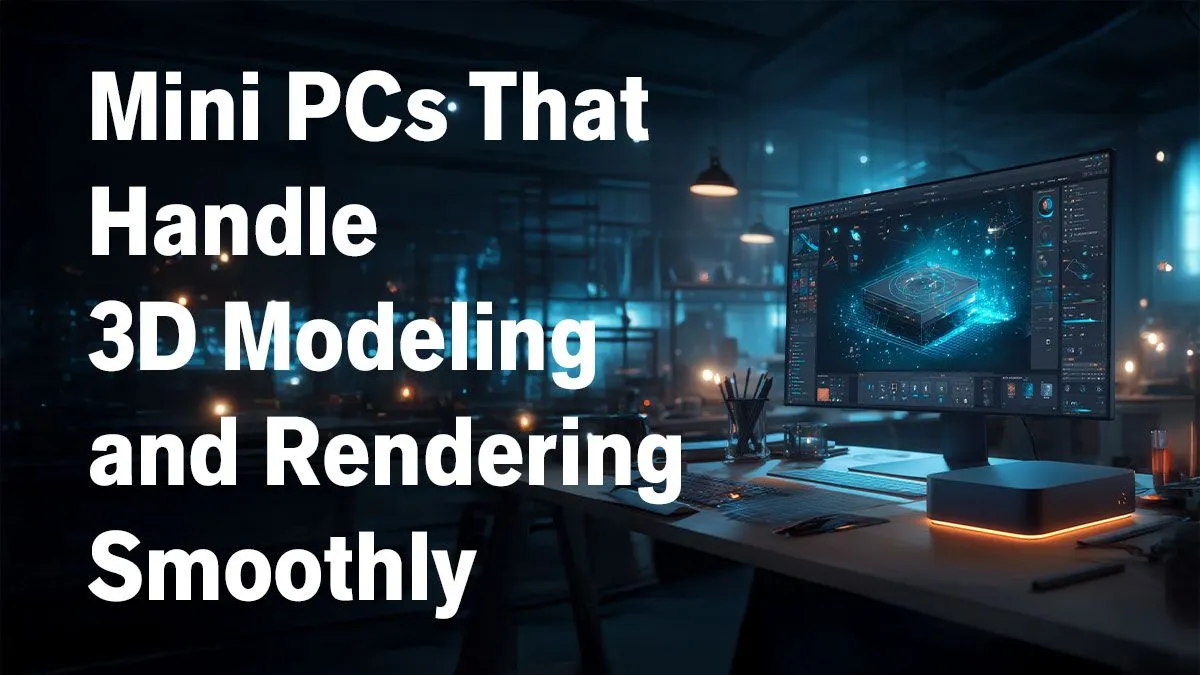
Tired of that massive tower hogging your desk space? For years, 3D artists and architects across South Africa believed a bigger PC meant more rendering power. But what if you could pack that workstation punch into a box smaller than a lunch tin? 🚀 The world of high-performance Mini PCs is here, and it’s delivering incredible results for creatives from Cape Town to Jozi. Let's dive into finding the best Mini PCs for 3D modeling and rendering.
Why Go Small for Big 3D Projects?
The days of Mini PCs being just for streaming media are long gone. Modern compact systems are now serious contenders for demanding creative workloads. The primary advantage is obvious: they reclaim valuable desk space. But the benefits don't stop there. They're also incredibly power-efficient, which is a welcome bonus with today's electricity costs, and their portability means you can take your workstation from the office to your home studio without breaking a sweat.
These tiny titans prove that you don't need a huge chassis to handle complex scenes in Blender, SketchUp, or Autodesk Maya.
Key Specs for the Best 3D Rendering Mini PCs
When you're hunting for a compact rig capable of handling intensive 3D tasks, the spec sheet is everything. Unlike a standard desktop, you have less room for upgrades, so getting it right from the start is crucial. Here’s what to prioritise.
The CPU: Your Rendering Engine 🧠
The processor is the heart of any rendering machine. For 3D modeling, clock speed matters for viewport performance, while for rendering, more cores mean more power. Look for models equipped with multi-core CPUs like the AMD Ryzen 7 and Ryzen 9 series or Intel's Core i7 and i9 processors. These chips are designed to chew through complex calculations, dramatically cutting down your render times. A powerful CPU is the first non-negotiable for any serious 3D modeling Mini PC.
Pro Tip: Optimise Your Software
Match your software settings to your hardware. In Blender, navigate to Edit > Preferences > System and ensure your CPU or GPU is selected for Cycles Render Devices. Small tweaks like adjusting render tile sizes can also significantly improve performance on specific hardware.
RAM: Breathing Room for Complex Scenes
3D assets, high-resolution textures, and complex lighting can consume a massive amount of memory. 16GB of RAM is the absolute minimum, but for a smooth, professional workflow, 32GB is the sweet spot. If you regularly work with massive scenes or high-poly models, aiming for a Mini PC that supports 64GB will ensure you never hit a memory bottleneck.
Graphics (GPU): The Visual Powerhouse ✨
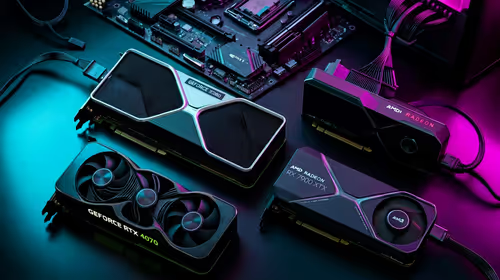
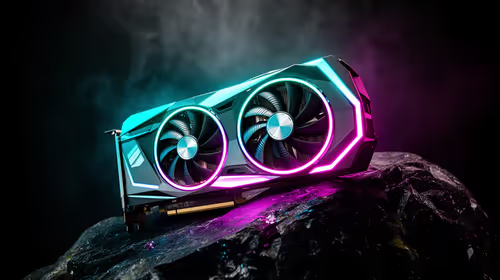
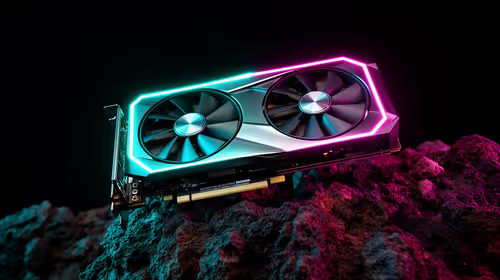
While the CPU does the heavy lifting in many rendering scenarios, a capable GPU accelerates your viewport, allowing you to manipulate models smoothly. It's also essential for GPU-based render engines like OctaneRender or Blender's Cycles. Many of the best Mini PCs for 3D modeling and rendering now feature powerful integrated graphics, like AMD's RDNA architecture, which are surprisingly capable. For even more grunt, look for models that support Thunderbolt for connecting an external GPU (eGPU).
Top Contenders and What to Look For
While specific models change rapidly, certain brands consistently deliver the performance needed for creative work. Brands like Minisforum, for example, have carved out a niche by packing desktop-grade processors into incredibly small form factors. When browsing, compare their different series; some are optimised for raw CPU power, while others offer a more balanced profile with stronger integrated graphics. Exploring the range of Minisforum Mini PCs is a great starting point to see what's possible in a small package.
Beyond the Box: Cooling and Connectivity
A powerful PC in a tiny box generates a lot of heat. A major differentiator between a good Mini PC and a great one is its cooling system. Look for reviews that mention thermal performance under load. A system that can stay cool will maintain its peak performance during long renders without throttling. 🔧
Finally, check the ports. Multiple USB-A ports, at least one USB-C (ideally Thunderbolt 4), and multiple display outputs (HDMI/DisplayPort) are essential for connecting your monitors, drawing tablets, and external drives. Having a solid selection of Mini PC components and options ensures you can build a complete, powerful, and compact workstation.
Ready to Shrink Your Workstation?
Free up your desk and unlock serious performance with a compact powerhouse. Explore our curated selection of high-performance Mini PCs at Evetech and find the perfect fit for your creative workflow.