Unlocking RTX 50 Power: Choosing Your Monitor's Refresh Rate ⚡️
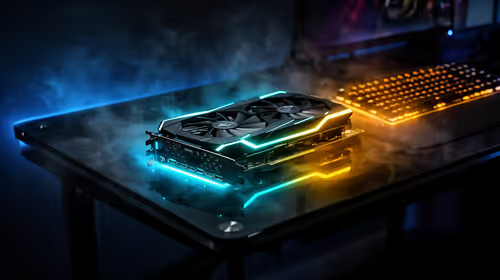
The next generation of NVIDIA's powerhouses, the RTX 50 series, is almost here, promising unprecedented gaming performance. But with all that raw graphical muscle, how do you ensure your monitor isn't the bottleneck? South African gamers face a crucial decision: what's the best monitor Hz for RTX 50? Is 144Hz still the sweet spot, or should you push for 240Hz to truly unlock your new GPU's potential? Let's dive into the refresh rate debate to optimise your visual experience.
Understanding Monitor Hz for Next-Gen Gaming
Before we pit 144Hz against 240Hz, let's quickly recap what 'Hz' (Hertz) means for your gaming. Simply put, it's how many times your monitor can refresh the image on screen per second. A higher refresh rate means smoother motion, less input lag, and a more fluid gaming experience, especially in fast-paced titles. For the upcoming RTX 50 series, this becomes even more critical, as these GPUs will be capable of pushing frame rates far beyond what older monitors can display.
The RTX 50 Factor: Why Your Monitor Matters
With the expected performance leap of the RTX 50 series, achieving ultra-high frame rates at resolutions like 1440p and even 4K will become more common. This means your monitor's refresh rate needs to keep up. A powerful GPU paired with a low-Hz monitor is like having a sports car stuck in traffic – you're simply not using its full capability. The key is finding the optimal monitor Hz for RTX 50 that balances performance, visual fidelity, and your budget.
144Hz Monitors: The Proven Performer for RTX 50
For many South African gamers, a 144Hz monitor remains an excellent choice, even with the advent of RTX 50 GPUs. It offers a significant upgrade over standard 60Hz displays, providing noticeably smoother gameplay without breaking the bank.
- Sweet Spot: 144Hz is often considered the sweet spot for competitive and immersive gaming. It's fantastic for most titles, from action-packed shooters to expansive open-world adventures.
- Resolution Balance: At 1440p, an RTX 50 card can comfortably push well over 144 FPS in many modern games, making a 144Hz monitor a perfect match. Even at 4K, if you’re targeting a consistent 100-120 FPS, 144Hz is more than adequate.
- Cost-Effective: Generally, 144Hz monitors are more affordable than their 240Hz counterparts, allowing you to allocate more of your budget to your RTX 50 GPU or other components. Whether you're building a new desktop rig or eyeing powerful gaming laptops, Evetech has you covered with incredible laptop specials for sale in South Africa.
Optimising Your Frame Rate
Even with an RTX 50, not all games will hit 240+ FPS. Use in-game settings to balance visual quality with frame rate. Aim for consistent frames over peak numbers to avoid stutter.
240Hz Monitors and Beyond: For the Competitive Edge 🚀
If you're a serious esports enthusiast or simply demand the absolute fastest response times, a 240Hz (or even 360Hz) monitor might be the ultimate pairing for your RTX 50 card.
- Unrivalled Fluidity: The jump from 144Hz to 240Hz is less dramatic than 60Hz to 144Hz, but it's still noticeable, especially in fast-twitch competitive games like CS:GO, Valorant, or Apex Legends. Every millisecond counts.
- Maximising RTX 50: For titles where an RTX 50 GPU can consistently push 240+ FPS at 1080p or even 1440p (especially in less graphically demanding esports titles), a 240Hz display truly lets your card stretch its legs.
- Future-Proofing: Investing in a higher refresh rate monitor now could offer a bit more longevity as games become more optimised and GPUs become even more powerful. For those who prefer portability without compromise, exploring the best gaming laptop deals can also yield a machine capable of driving these high-refresh displays, often via an external monitor.
Making Your Choice: 144Hz vs 240Hz for Your RTX 50 Rig ✨
Deciding on the best monitor Hz for RTX 50 boils down to a few factors:
- Your Games: Primarily competitive esports? 240Hz offers a tangible advantage. Mostly single-player, graphically intensive titles? 144Hz is superb.
- Resolution: At 1080p, an RTX 50 will easily hit 240+ FPS in many games, making 240Hz a strong contender. For 1440p, 144Hz is often a more balanced choice for consistent high frames across a wider range of games. For 4K, 144Hz is generally the practical maximum for now.
- Budget: Higher refresh rates come with a higher price tag. Consider your overall budget for your RTX 50 build.
- Panel Type: Don't forget panel type (IPS, VA, TN) and response time. A fast response time is just as crucial as a high refresh rate. And if you're an AMD enthusiast, don't miss out on the latest AMD laptops on special, offering fantastic performance for gaming and productivity. Similarly, Evetech's range of Intel laptops on special provides robust options that can pair perfectly with an external high-refresh monitor.
Ultimately, both 144Hz and 240Hz monitors are fantastic choices to pair with an RTX 50 series GPU. The "best" option depends on your specific gaming habits and priorities. For most South African gamers, 144Hz offers an incredible experience, while 240Hz is for those chasing every last frame and competitive edge.
Upgrade Your View, Conquer Your Game
Don't let your monitor hold back your RTX 50's true power. Find the perfect high-refresh display to match your next-gen GPU and elevate your gameplay. Shop now at Evetech for performance that leaves lag in the dust.