


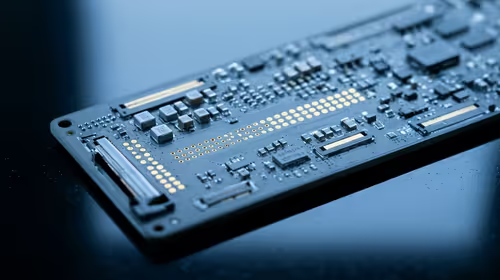
Hot-Swappable PCB Architecture in Modern Keyboards: Guide
Learn hot-swappable PCB architecture in modern keyboards—what it is, how sockets and traces work, and how to pick the right board. Speed up swaps, reduce risk, and upgrade faster 🔧⚡
Read moreChoosing the best OS for your gaming PC in South Africa is crucial for performance. This guide breaks down Windows 11, Windows 10, and Linux distributions like SteamOS to help you unlock maximum FPS and stability for your rig. Find your perfect match! 🎮🚀
So, you're building a new gaming rig in South Africa? Lekker. But before you spec out that shiny new GPU, there's a crucial choice to make: the operating system. For years, Windows was the only real answer. But now, with Linux making serious waves, the question is hotter than ever. Which platform truly is the best OS for a gaming PC in South Africa?
Let's plug in, boot up, and find the definitive answer for local gamers.
For the vast majority of PC gamers, Windows is the default choice for a reason. It’s the path of least resistance to pure, unadulterated gaming, and its dominance is built on a few key pillars.
The single biggest reason to stick with Windows is game support. Developers build their games primarily for Windows using tools like DirectX, Microsoft's own graphics API. This means virtually every new AAA title, from Helldivers 2 to the next Call of Duty, is guaranteed to run flawlessly on day one. There are no compatibility layers, no tinkering... you just install and play. This "it just works" philosophy is crucial when you just want to jump into a game after a long day.
NVIDIA, AMD, and Intel pour millions into optimising their graphics drivers for Windows. This ensures you get maximum performance, stability, and access to the latest features like DLSS, FSR, and ray tracing without any fuss. On Windows, you get official, manufacturer-supported software designed to squeeze every last frame out of your hardware, which is especially important for those running high-end rigs over R20k who demand peak performance.
Let's be honest, most of us grew up with Windows. Its desktop environment is intuitive and requires zero learning curve. Peripherals like controllers, headsets, and keyboards are typically plug-and-play. This simplicity is a massive advantage, letting you focus on your games, not on troubleshooting your operating system.
For years, gaming on Linux was a niche hobby for die-hard techies. That has changed dramatically, thanks largely to Valve, the company behind Steam.
The real hero of the Linux gaming story is Proton. It's a compatibility layer built by Valve that allows a massive number of Windows games to run on Linux, often with just a single click. It's not perfect, but its development has been rapid and impressive. Thousands of titles, including many popular ones, are now perfectly playable. This has transformed Linux from a non-starter into a viable gaming OS.
Before you commit to a Linux distro, check your favourite games on ProtonDB (protondb.com). This community-run website gives you real-world reports on how well Windows games run on Linux via Steam's Proton. A 'Platinum' rating means it runs perfectly out of the box, saving you a massive headache!
Linux is famous for being lightweight and customisable. A streamlined Linux distribution (or "distro") can use fewer system resources than Windows, potentially freeing up more RAM and CPU power for your game. Plus, it's completely free. That R2,000+ you might spend on a Windows licence could go towards a better CPU or more storage in one of our budget-friendly gaming PCs. The freedom to tweak every aspect of your OS is a huge draw for tinkerers.
So, how does this all stack up for a gamer in Mzansi? The choice really comes down to what kind of user you are.
If you want to build or buy a PC, install your games, and have everything work immediately with zero hassle, Windows 11 is the undisputed king. This applies to about 95% of gamers. You'll never have to worry if the latest blockbuster or, more importantly, a competitive shooter with aggressive anti-cheat (like Valorant or Rainbow Six Siege) will run. For a seamless experience, especially with one of our awesome pre-built PC deals, Windows is the way to go.
If you love customisation, enjoy problem-solving, and want total control over your machine, Linux is an incredibly rewarding option. You're willing to trade some convenience for freedom and a potentially leaner system. It’s a fantastic choice for players who stick to Steam's library and enjoy the process of optimising their setup. You can find many powerful PCs under R20k that become even more cost-effective when you skip the Windows licence.
While Linux has made incredible strides and is a fantastic project, for the overwhelming majority of gamers, Windows 11 remains the best OS for a gaming PC in South Africa.
Its unbeatable game compatibility, plug-and-play simplicity, and guaranteed driver support provide a frictionless experience that lets you focus on what matters most: playing your games. Linux is a superb choice for a specific type of user, but Windows is the champion for everyone else. When you explore the best gaming PC deals in SA, you'll find they are primed and optimised for the premier Windows gaming experience.
Ready for Your Perfect Gaming Setup? Choosing the right OS is a great first step, but it's the hardware that brings your games to life. Whether you're a Windows loyalist or a Linux adventurer, the perfect machine is waiting. Explore our massive range of gaming PCs and find the rig that will dominate your world.
For most new gaming PCs, Windows 11 offers features like DirectStorage and Auto HDR that provide a performance edge. However, Windows 10 remains a stable and powerful choice.
Absolutely! With tools like Proton and SteamOS, Linux for gaming performance has improved dramatically. Many top titles run flawlessly, offering a great, often free, alternative.
Most modern games require a 64-bit OS. For Windows 11, you'll need a compatible CPU and TPM 2.0. Always check the specific requirements of the games you intend to play.
Linux distributions like Pop!_OS or Nobara are excellent free operating systems for gaming. They come pre-configured with drivers and tools to make PC gaming seamless.
Yes, your OS can impact FPS. A well-optimized OS with the latest drivers, like Windows 11, can offer better performance, while a bloated system may reduce your frame rates.
SteamOS is a great choice if your PC is primarily for gaming through Steam. It provides a streamlined, console-like experience but may be less flexible for general desktop tasks.
Learn hot-swappable PCB architecture in modern keyboards—what it is, how sockets and traces work, and how to pick the right board. Speed up swaps, reduce risk, and upgrade faster 🔧⚡
Read more
Mechanical switch lifespan explained—what the 50 million keystroke rating really means, plus tips to extend switch life and reduce double-press issues 🔧⌨️
Read more
60-percent vs full-size mechanical keyboard layouts—learn what each layout includes, who it suits, and how to choose the right fit 🧩⌨️ for typing, gaming, and productivity.
Read more
Double injection keycaps last far longer than standard printed keycaps in most setups. Learn typical lifespan ranges, what shortens them, and how to maximize durability for smoother daily typing and gaming 😊⌨️
Read more
Full-key anti-ghosting: does it stop missed inputs during fast-paced gaming? We break down latency, polling, and key matrix limits so you can buy smarter 🎮⚡
Read more
Protect mechanical keyboard switches from South African dust and summer humidity with practical cleaning and storage habits. Keep your switches smooth, reduce failures, and extend lifespan. 🌬️💧
Read more
Wondering if a TKL wireless mechanical keyboard is worth it for everyday productivity? We break down latency, battery life, comfort, and workflow gains for real work. ⚡⌨️

Maximise battery life on a fanless 15-inch laptop using efficiency core architecture. Cut idle drain, tune power profiles, and improve thermals for longer runtime. 🔋⚙️
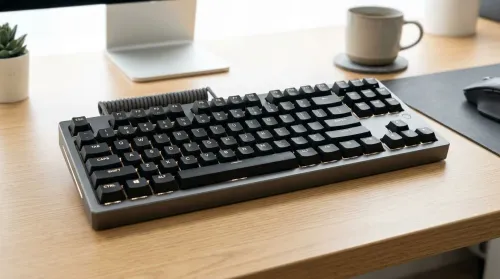
Learn how to reduce desk clutter with a TKL wireless keyboard using fewer cables, smart placement, and tidy essentials. Get a faster, calmer workspace with better ergonomics. ✅🧼
RGB keyboard lighting too distracting? Learn how to manage backlight modes, set brightness, and reduce distraction for focus and productivity 😌🖱️
Are themed gaming keyboards worth the extra cost? Compare build quality, switch options, features, and resale value to find the best fit for your setup 🎮⌨️
Full-Size vs Tenkeyless mechanical keyboards for gaming: find out if a smaller layout truly improves aim, speed, and comfort. We break down layout, desk space, latency-feel, and keybinds 🎮⌨️

Dedicated media rollers vs function key shortcuts: learn which setup gives you better workflow control, faster media access, and fewer mistakes. 🖱️🎧
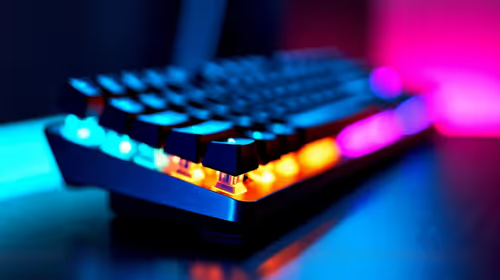
Best Mechanical Switch Type for Gaming: Clicky vs Linear vs Tactile. Find your feel, speed, and noise balance with practical guidance for FPS, MOBA, and productivity 😄🎮
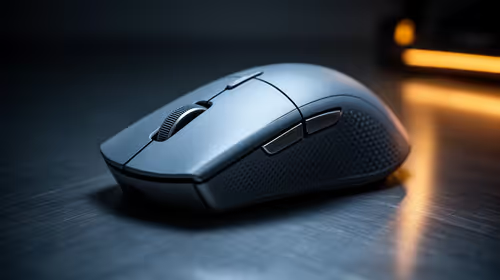
Direct mouse answer: Mouse not keeping up with your work? Everything that matters about dual-mode 2.4GHz + BT 5.0: DPI behaviour, channel switching, battery curves and per-app button mapping. Covers when 2.4GHz USB wins (low-latency desk) and when BT 5.0 wins (laptop, d
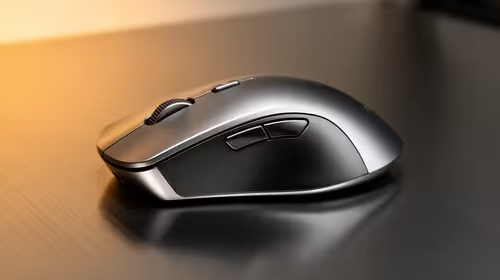
Plain wireless mouse guide: Mouse not keeping up with your work? Everything that matters about wireless productivity mouse: DPI behaviour, channel switching, battery curves and per-app button mapping. Includes DPI tuning tips, channel switch shortcuts, and ZAR-aware fea
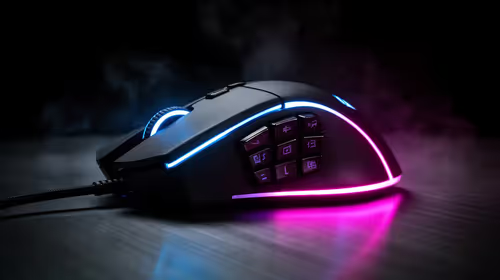
Real productivity numbers: Set up your wireless mouse in this order: everything that matters about wireless productivity mouse: DPI behaviour, channel switching, battery curves and per-app button mapping. Includes DPI tuning tips, channel switch shortcuts, and ZAR-aware

Pen not feeling like paper? Stylus lag and skipping usually trace to old drivers, dirty nibs, or display refresh mismatches, not the pen itself. Covers pressure curve tuning, tilt thresholds, nib swap timing, and SA pricing brackets.