Quick Answer
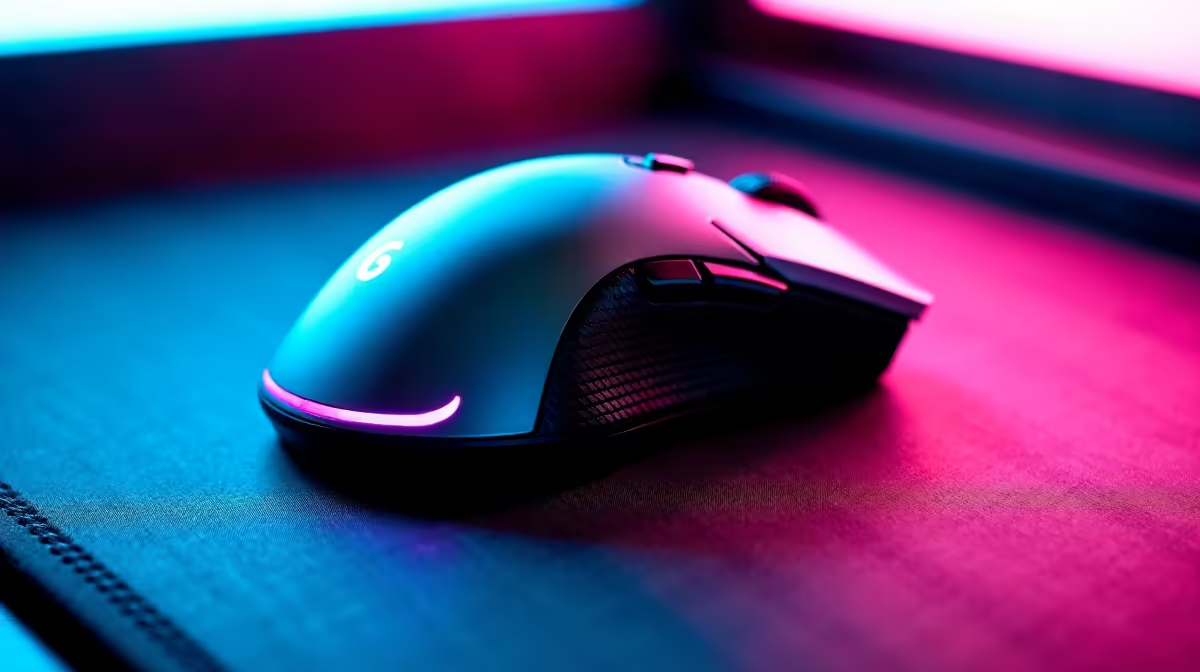
Use low-latency 2.4 GHz wireless for any gaming session where reaction time matters; use Bluetooth for productivity, casual use, and when battery life is a priority. The latency gap is real: 2.4 GHz low-latency modes sit below 1 ms, while Bluetooth ranges from 5 to 15 ms, significant in fast-paced FPS and battle royale titles.
The Latency Numbers That Actually Matter 🎮
Razer HyperSpeed, Logitech LIGHTSPEED, and similar 2.4 GHz protocols are purpose-built to minimise the wireless signal round-trip to under 1 ms. Bluetooth 5.0 and 5.3 were designed for energy efficiency, not gaming latency, and maintain connection intervals that introduce 5 to 15 ms of input lag. In a 100 fps game where each frame takes 10 ms to render, a 10 ms Bluetooth lag means your click input is consistently one frame behind your intended timing. In CS2 or Valorant, where professional reaction windows sit around 150 to 200 ms, that gap is a measurable competitive disadvantage. For casual gaming and desktop productivity, the Bluetooth lag is effectively invisible.
Battery Life: Where Bluetooth Wins Clearly 🔋
The flip side of Bluetooth's lower bandwidth is substantially reduced power draw. A dual-mode mouse like the Razer Orochi V2 runs to 950 hours on a single AA in Bluetooth mode versus 425 hours in HyperSpeed. For SA professionals and students using their mouse eight to ten hours daily for work, Bluetooth mode stretches battery life from two weeks to over a month. The practical recommendation for anyone with a dual-mode mouse is to switch to Bluetooth when working and switch to 2.4 GHz when sitting at the gaming desk.
Range and Interference in SA Home Setups 📡
Bluetooth has a theoretical range of 10 metres, but household interference from routers and smart TVs reduces effective range to four to six metres in densely populated SA flat environments. The 2.4 GHz USB receiver, placed within 30 to 60 cm of the mouse using a USB extension cable, maintains a stable signal even in heavily congested wireless environments. If you experience stuttering in Bluetooth mode in a busy Johannesburg or Cape Town flat, switching to 2.4 GHz typically resolves it immediately.
Keep Your USB Receiver Close to the Mouse ⚡
Plugging the 2.4 GHz receiver directly into the back of a desktop tower places it 50 to 80 cm further from your mouse. Use a short USB extension cable to position the receiver within 20 to 30 cm of your mousepad for the most stable connection, especially if your case sits on the floor.
FAQ
Can I game on Bluetooth and still get good results?
For casual gaming and single-player titles, Bluetooth latency is acceptable. For competitive multiplayer where sub-100 ms reaction times matter, the 5 to 15 ms Bluetooth lag is a real disadvantage.
Does Bluetooth interfere with my 2.4 GHz router?
Bluetooth 5.0 uses frequency hopping to minimise Wi-Fi interference, but the 2.4 GHz band is shared. If you experience Wi-Fi drops with a Bluetooth mouse, switching your router to the 5 GHz band resolves the conflict. Most SA ISP-provided routers support dual-band operation.
Is there a quality difference in cursor tracking accuracy between modes?
No. Tracking accuracy is determined by the mouse sensor, not the wireless protocol. Both modes transmit the same sensor data; the difference is purely in how quickly that data reaches the PC.
Need a mouse that handles both modes well?
Check out dual-mode wireless gaming mice at Evetech with Bluetooth and low-latency 2.4 GHz support for versatile home and work setups.