Quick Answer
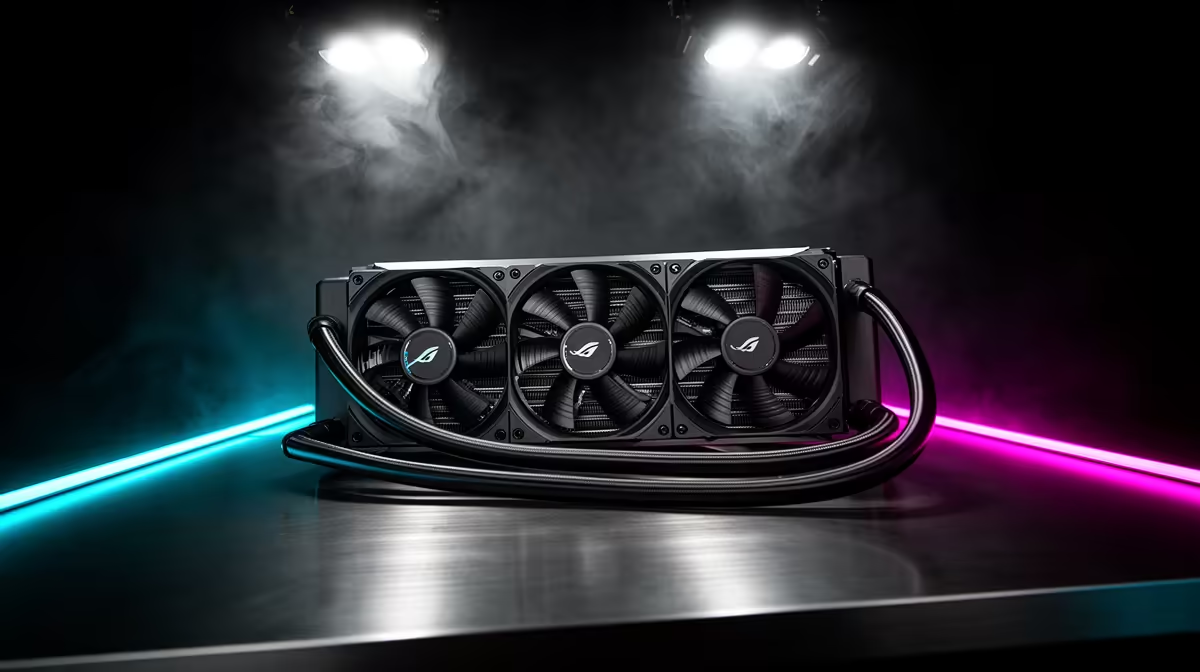
Yes, a 360mm radiator significantly reduces fan noise on high-end gaming PCs compared to 240mm or tower air coolers. Spreading the CPU's heat across three 120mm fans means each fan runs at a lower RPM to achieve the same cooling output, which directly reduces acoustic output. On a Ryzen 9 9950X under Cinebench R24 multi-core, a 360mm AIO typically runs its fans 200 to 400 RPM slower than a 240mm unit at identical temperatures, dropping noise output by 3 to 6 dB.
How Radiator Size Translates to Quieter Fans 🔧
Fan noise scales with RPM in a non-linear way: doubling the RPM more than doubles the noise in decibels because of the aerodynamic properties of the blade design. A 360mm radiator has 50 percent more surface area than a 240mm unit, which means it can dissipate the same thermal load with fans spinning at roughly 800 RPM versus 1,100 RPM. At 800 RPM, most 120mm radiator fans measure 22 to 26 dB(A); at 1,100 RPM the same fans climb to 28 to 34 dB(A). In an otherwise quiet system with a high-end GPU whose fans coast at low loads, this difference between a 240mm and 360mm AIO is the primary factor separating a nearly-silent PC from one you can hear across the room.
Matching the 360mm AIO to Your Case and Layout 💧
A 360mm radiator requires a case with either front or top mounting support for three 120mm fans. Most ATX mid-towers and full towers accommodate 360mm at the front, top, or both, but compact and Micro-ATX cases often cap at 240mm. For maximum quiet operation, mount the 360mm AIO as a front intake: this draws cool room air directly across the radiator before it enters the case, lowering the radiator inlet temperature and allowing fans to run even slower. Mounting at the top as exhaust is thermally similar but slightly louder because fans must overcome positive case pressure. In the SA market, quality 360mm AIOs from reputable brands sit between R2,000 and R4,500, with flagship liquid metal pump designs pushing above R5,000.
Does a 360mm AIO Help GPU Noise Too? 🖥️
Indirectly, yes. When a 360mm AIO keeps the CPU running at a lower thermal output, the case ambient temperature drops, which reduces the temperature the GPU fans must compensate for. A cooler case ambient means GPU fans can run 50 to 150 RPM slower at idle and during light gaming loads, adding another layer of acoustic benefit. On a showcase build with a sealed glass front, where case ambient can run 5 to 8 degrees Celsius above room temperature, a larger radiator's ability to lower that baseline matters more than it does in a mesh-front case.
Use Zero-RPM Mode at Desktop ⚡
Most AIOs and GPU coolers now support zero-RPM or semi-passive mode below 50 degrees Celsius. Enable this in BIOS fan curve settings or in the AIO's software. At desktop idle or light browsing, your build will run completely silent, with fans only spinning up when actual heat is generated during gaming.
FAQ
Is a 360mm AIO worth it for a Ryzen 7 9800X3D?
The Ryzen 7 9800X3D has a relatively modest 120W TDP and responds better to cooling than the Ryzen 9 series, which means a 240mm AIO is genuinely sufficient for it. A 360mm AIO is overkill for 9800X3D cooling but can still be chosen for its quieter fan operation and future-proofing if you plan to upgrade CPUs.
What fan speed target should I aim for with a 360mm AIO on a Ryzen 9 9950X?
Target 900 to 1,000 RPM under sustained Cinebench or rendering workloads while keeping CPU temps below 85 degrees Celsius. Under gaming loads (which stress the CPU less than rendering), fan speeds can stay below 800 RPM on most quality 360mm AIOs, resulting in near-silent operation.
Can I fit a 360mm AIO in an ATX mid-tower?
Yes, the majority of ATX mid-towers support a 360mm front or top radiator. Always confirm the specific case's radiator support spec in the product description, as some mid-towers are limited to 280mm or 240mm at the top even if they support 360mm at the front.
Want a quieter, cooler high-end gaming PC?
Shop Evetech's range of 360mm AIO coolers and compatible ATX cases to build a system that stays cool and quiet.