


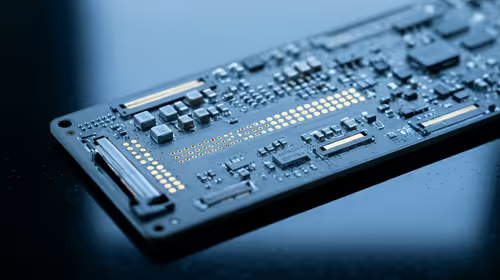
Hot-Swappable PCB Architecture in Modern Keyboards: Guide
Learn hot-swappable PCB architecture in modern keyboards—what it is, how sockets and traces work, and how to pick the right board. Speed up swaps, reduce risk, and upgrade faster 🔧⚡
Read moreLonger DisplayPort: triple-shielded cabling and gold contacts cut EMI dropouts on long Mini DisplayPort runs into modern 4K panels. Pricing, fit and feature trade-offs sit alongside straight technical answers. The breakdown stays practical and SA focused.
Yes, beyond the certified passive cable length limits, a longer DisplayPort cable can cause signal degradation that results in resolution drops, refresh rate fallback, or intermittent black screens. For DP 2.1 UHBR20, the safe passive limit is 2m. For DP 1.4, reliable passive operation extends to 3m. Beyond these limits, active cables are required.
DisplayPort signal attenuation increases with cable length. At the certified passive length limit, the signal level at the receiver (the monitor) sits at the minimum acceptable threshold for reliable link training. Extend beyond that limit and attenuation drops signal below the threshold, causing the GPU and monitor's link training protocol to negotiate down to the next lower bandwidth tier. At 8K resolution, a step-down from UHBR20 to UHBR10 forces the GPU into DSC mode. At 4K resolution, a DP 1.4 cable beyond 3m may drop from 4K/144Hz to 4K/60Hz, or flicker as the link renegotiates under dynamic GPU load. The degradation is not constant: signal may hold at desktop idle and fail under the sustained bandwidth demand of gaming at high resolution.
Active DisplayPort cables embed a signal repeater or amplifier circuit inside one connector housing. This circuit regenerates the signal to full strength before transmitting to the monitor, eliminating length-based attenuation entirely. Active DP 2.1 UHBR20 cables maintain 80 Gbps bandwidth to 5m or more. For SA gaming setups where the PC is in an adjacent room with a cable running through a wall, or standing desk installations with long under-floor cable routes, an active cable is the correct solution. Active 3m DP 2.1 cables cost from around R750 to R1,200 locally, compared to R500 to R750 for 2m passive cables. The directional nature of active cables is important: connect the amplifier end to the GPU output.
Standard desk with tower on surface: 1m to 1.5m is sufficient, 2m is comfortable. Tower on floor beside desk: 1.5m to 2m. Tower under L-desk corner: 2m to 2.5m. Tower in adjacent room: 3m to 5m active cable. Standing desk with cable spine routing: 2m to 2.5m passive or 3m active. Secondary monitor at desk end: 2m to 2.5m. Measure your actual cable path before ordering to confirm.
Before routing a 3m or longer cable through walls or under floors, test it on the surface first. Connect the cable between GPU and monitor at full length lying on the desk. Confirm the target resolution and refresh rate hold stable under gaming load. Only then route it permanently. Active cables are non-returnable once physically installed.
Very likely, yes. A 3m passive DP 1.4 cable sits at the edge of its reliable bandwidth limit. The cable handles 4K/60Hz easily but cannot sustain the bandwidth for 144Hz. Switching to a 3m active DP 1.4 cable or an active DP 2.1 cable should resolve the refresh rate cap.
No. Signal transmission speed through a copper cable at desktop distances is effectively instantaneous. The propagation delay difference between a 1m and a 3m cable is under one nanosecond, which is imperceptible to any measurement equipment, let alone human perception.
DisplayPort extender adapters exist but introduce additional signal processing steps that are not recommended for high-bandwidth connections. Buy the correct active cable length for your run rather than using a passive extension adapter at high bandwidth.
Need a longer cable run without sacrificing resolution or refresh rate? Evetech stocks passive and active DisplayPort cables in multiple lengths to cover any desk layout or room configuration. Explore the full range at Evetech.
Learn hot-swappable PCB architecture in modern keyboards—what it is, how sockets and traces work, and how to pick the right board. Speed up swaps, reduce risk, and upgrade faster 🔧⚡
Read more
Mechanical switch lifespan explained—what the 50 million keystroke rating really means, plus tips to extend switch life and reduce double-press issues 🔧⌨️
Read more
60-percent vs full-size mechanical keyboard layouts—learn what each layout includes, who it suits, and how to choose the right fit 🧩⌨️ for typing, gaming, and productivity.
Read more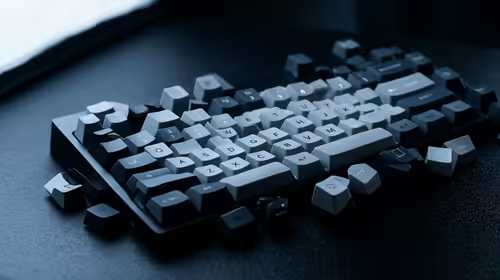
Double injection keycaps last far longer than standard printed keycaps in most setups. Learn typical lifespan ranges, what shortens them, and how to maximize durability for smoother daily typing and gaming 😊⌨️
Read more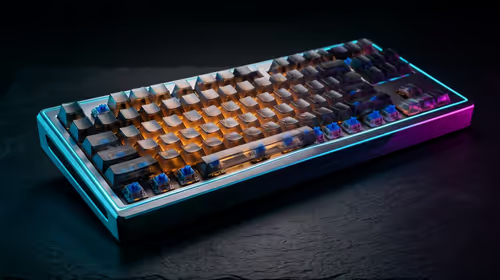
Full-key anti-ghosting: does it stop missed inputs during fast-paced gaming? We break down latency, polling, and key matrix limits so you can buy smarter 🎮⚡
Read more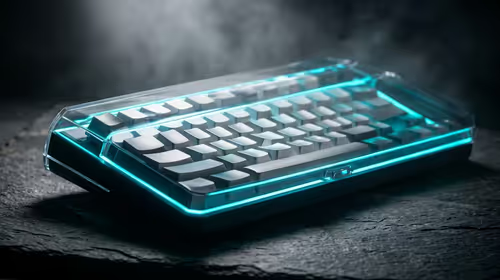
Protect mechanical keyboard switches from South African dust and summer humidity with practical cleaning and storage habits. Keep your switches smooth, reduce failures, and extend lifespan. 🌬️💧
Read more
Wondering if a TKL wireless mechanical keyboard is worth it for everyday productivity? We break down latency, battery life, comfort, and workflow gains for real work. ⚡⌨️

Maximise battery life on a fanless 15-inch laptop using efficiency core architecture. Cut idle drain, tune power profiles, and improve thermals for longer runtime. 🔋⚙️

Learn how to reduce desk clutter with a TKL wireless keyboard using fewer cables, smart placement, and tidy essentials. Get a faster, calmer workspace with better ergonomics. ✅🧼

RGB keyboard lighting too distracting? Learn how to manage backlight modes, set brightness, and reduce distraction for focus and productivity 😌🖱️

Are themed gaming keyboards worth the extra cost? Compare build quality, switch options, features, and resale value to find the best fit for your setup 🎮⌨️

Full-Size vs Tenkeyless mechanical keyboards for gaming: find out if a smaller layout truly improves aim, speed, and comfort. We break down layout, desk space, latency-feel, and keybinds 🎮⌨️

Dedicated media rollers vs function key shortcuts: learn which setup gives you better workflow control, faster media access, and fewer mistakes. 🖱️🎧

Best Mechanical Switch Type for Gaming: Clicky vs Linear vs Tactile. Find your feel, speed, and noise balance with practical guidance for FPS, MOBA, and productivity 😄🎮

Direct mouse answer: Mouse not keeping up with your work? Everything that matters about dual-mode 2.4GHz + BT 5.0: DPI behaviour, channel switching, battery curves and per-app button mapping. Covers when 2.4GHz USB wins (low-latency desk) and when BT 5.0 wins (laptop, d

Plain wireless mouse guide: Mouse not keeping up with your work? Everything that matters about wireless productivity mouse: DPI behaviour, channel switching, battery curves and per-app button mapping. Includes DPI tuning tips, channel switch shortcuts, and ZAR-aware fea

Real productivity numbers: Set up your wireless mouse in this order: everything that matters about wireless productivity mouse: DPI behaviour, channel switching, battery curves and per-app button mapping. Includes DPI tuning tips, channel switch shortcuts, and ZAR-aware

Pen not feeling like paper? Stylus lag and skipping usually trace to old drivers, dirty nibs, or display refresh mismatches, not the pen itself. Covers pressure curve tuning, tilt thresholds, nib swap timing, and SA pricing brackets.