


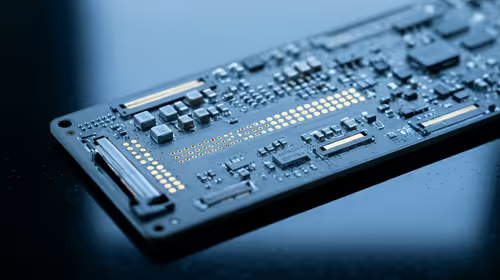
Hot-Swappable PCB Architecture in Modern Keyboards: Guide
Learn hot-swappable PCB architecture in modern keyboards—what it is, how sockets and traces work, and how to pick the right board. Speed up swaps, reduce risk, and upgrade faster 🔧⚡
Read moreExpect a modern PC case with gaming PC use to land in a clear price band for South African builds. Confirm compatibility, then balance performance against warranty and SA-stock availability. Compare picks against your CPU and case spec before paying.
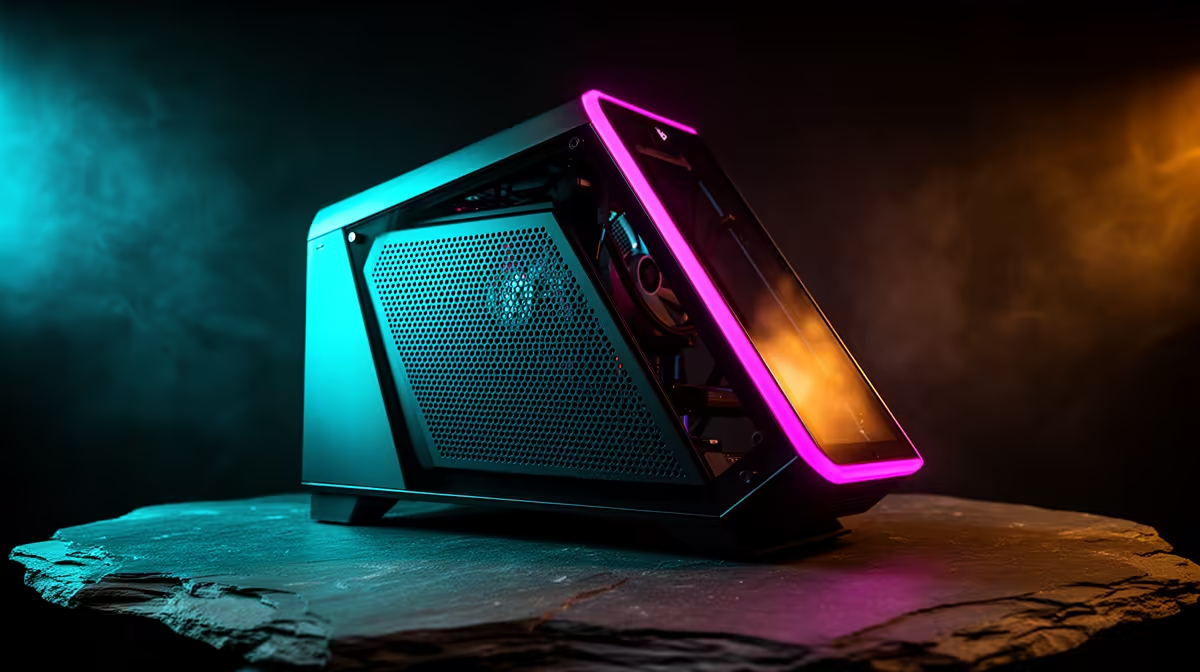
In South African gaming rooms where summer ambient temperatures regularly reach 26 to 32 degrees Celsius in inland regions like Gauteng, Limpopo, and Mpumalanga, prioritise a full-mesh or perforated front panel case over a glass-front design. Every additional degree of ambient temperature is added directly to your GPU and CPU temperatures, so removing intake restrictions is more impactful here than in a climate-controlled room.
PC component temperatures are not absolute values. They are always a fixed delta above ambient room temperature.
Full-mesh front panels reduce intake restriction to near zero, allowing fans to move the maximum possible volume of air into the case. Prioritise cases with at least 280mm of front mesh coverage across two 120mm or 140mm fan positions. The bottom intake, often below the PSU shroud through a ventilated floor panel, also contributes meaningfully in warm environments where heat rising from the floor adds to ambient.
Even the best case only manages the air available to it. If the room is 32 degrees Celsius, no case design eliminates that baseline. A desk fan directed at the PC intake zone can provide 2 to 4 degrees of effective cooling benefit by supplying slightly cooler air from further into the room rather than the air immediately adjacent to the PC. Gaming earlier in the day before peak afternoon temperature is also a practical SA-specific tip. For builds above R20,000 with RTX 5080 or higher GPUs, the investment in a small split-unit air conditioner or portable cooler for the gaming room pays for itself in component longevity and consistent performance by keeping ambient temperatures below 24 degrees Celsius.
In SA homes, west-facing walls absorb afternoon sun and radiate heat into the room for hours after sunset. Placing your gaming PC against or adjacent to a west-facing wall can add 3 to 5 degrees to the ambient temperature immediately around the case compared to placing it against a north or south-facing interior wall or in the middle of the room. This is a free thermal improvement requiring no hardware at all.
Dry air has slightly lower thermal mass than humid air, which means it absorbs heat marginally less efficiently in theory. In practice the difference is negligible for typical PC cooling applications. The dominant factor is ambient temperature, not humidity. Dust accumulation in dry, dusty inland regions is the more significant maintenance consideration, requiring more frequent filter cleaning than in coastal or humid climates.
During summer months, running intake fans at 70 to 80 percent of maximum RPM rather than a conservative 50 percent curve provides meaningfully lower temperatures at the cost of slightly increased fan noise. The noise trade-off is acceptable when it prevents CPU or GPU thermal throttling. Configuring a more aggressive fan curve in BIOS for the months from October to March and a quieter profile for the cooler winter months is a sensible seasonal adjustment.
Yes. The headroom a 360mm AIO provides over a 240mm unit, typically 5 to 8 degrees Celsius lower coolant temperature, is proportionally more valuable when ambient temperature is already elevated. In a 28-degree room, that extra thermal headroom from a 360mm unit can be the difference between a CPU throttling and sustaining peak clock speeds through an extended gaming session.
Gaming in a warm SA room this summer? Find full-mesh front panel cases at Evetech designed for maximum airflow and matched with compatible AIO coolers for the best thermal results in hot conditions.
Learn hot-swappable PCB architecture in modern keyboards—what it is, how sockets and traces work, and how to pick the right board. Speed up swaps, reduce risk, and upgrade faster 🔧⚡
Read more
Mechanical switch lifespan explained—what the 50 million keystroke rating really means, plus tips to extend switch life and reduce double-press issues 🔧⌨️
Read more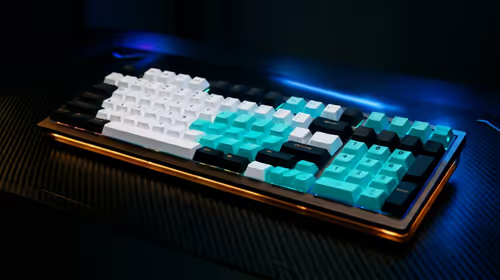
60-percent vs full-size mechanical keyboard layouts—learn what each layout includes, who it suits, and how to choose the right fit 🧩⌨️ for typing, gaming, and productivity.
Read more
Double injection keycaps last far longer than standard printed keycaps in most setups. Learn typical lifespan ranges, what shortens them, and how to maximize durability for smoother daily typing and gaming 😊⌨️
Read more
Full-key anti-ghosting: does it stop missed inputs during fast-paced gaming? We break down latency, polling, and key matrix limits so you can buy smarter 🎮⚡
Read more
Protect mechanical keyboard switches from South African dust and summer humidity with practical cleaning and storage habits. Keep your switches smooth, reduce failures, and extend lifespan. 🌬️💧
Read more
Wondering if a TKL wireless mechanical keyboard is worth it for everyday productivity? We break down latency, battery life, comfort, and workflow gains for real work. ⚡⌨️

Maximise battery life on a fanless 15-inch laptop using efficiency core architecture. Cut idle drain, tune power profiles, and improve thermals for longer runtime. 🔋⚙️

Learn how to reduce desk clutter with a TKL wireless keyboard using fewer cables, smart placement, and tidy essentials. Get a faster, calmer workspace with better ergonomics. ✅🧼

RGB keyboard lighting too distracting? Learn how to manage backlight modes, set brightness, and reduce distraction for focus and productivity 😌🖱️

Are themed gaming keyboards worth the extra cost? Compare build quality, switch options, features, and resale value to find the best fit for your setup 🎮⌨️

Full-Size vs Tenkeyless mechanical keyboards for gaming: find out if a smaller layout truly improves aim, speed, and comfort. We break down layout, desk space, latency-feel, and keybinds 🎮⌨️

Dedicated media rollers vs function key shortcuts: learn which setup gives you better workflow control, faster media access, and fewer mistakes. 🖱️🎧

Best Mechanical Switch Type for Gaming: Clicky vs Linear vs Tactile. Find your feel, speed, and noise balance with practical guidance for FPS, MOBA, and productivity 😄🎮

Direct mouse answer: Mouse not keeping up with your work? Everything that matters about dual-mode 2.4GHz + BT 5.0: DPI behaviour, channel switching, battery curves and per-app button mapping. Covers when 2.4GHz USB wins (low-latency desk) and when BT 5.0 wins (laptop, d

Plain wireless mouse guide: Mouse not keeping up with your work? Everything that matters about wireless productivity mouse: DPI behaviour, channel switching, battery curves and per-app button mapping. Includes DPI tuning tips, channel switch shortcuts, and ZAR-aware fea

Real productivity numbers: Set up your wireless mouse in this order: everything that matters about wireless productivity mouse: DPI behaviour, channel switching, battery curves and per-app button mapping. Includes DPI tuning tips, channel switch shortcuts, and ZAR-aware

Pen not feeling like paper? Stylus lag and skipping usually trace to old drivers, dirty nibs, or display refresh mismatches, not the pen itself. Covers pressure curve tuning, tilt thresholds, nib swap timing, and SA pricing brackets.