Quick Answer
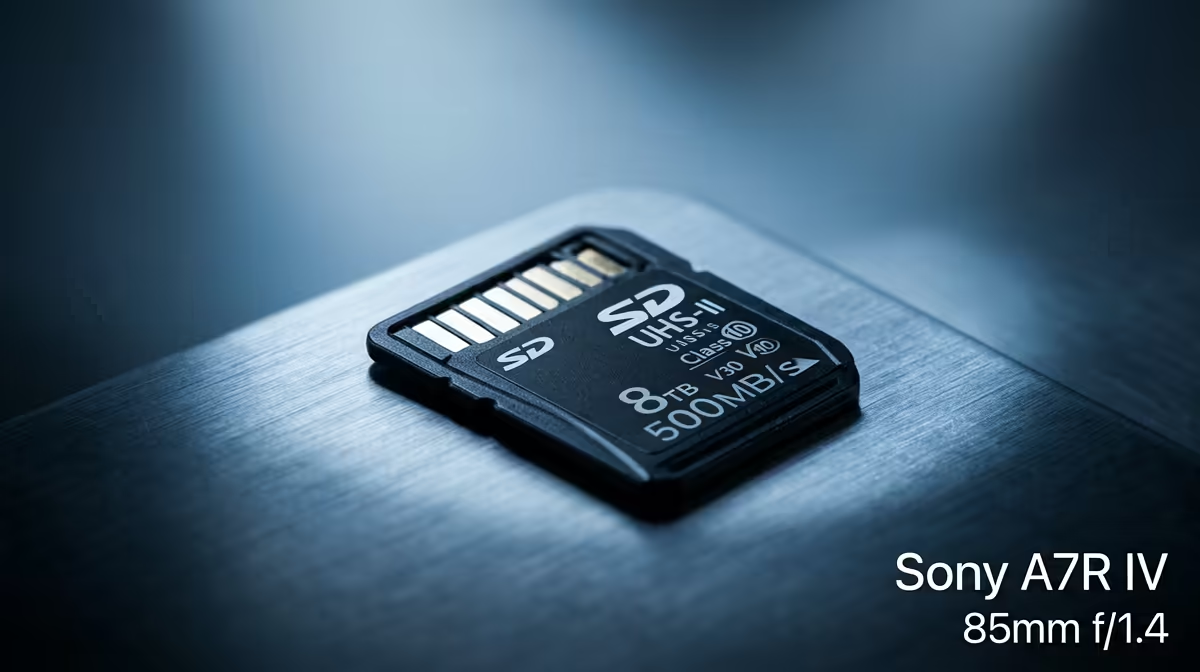
Class 10 guarantees a minimum of 10MB/s write speed (the C10 symbol). U3 guarantees a minimum of 30MB/s write speed (the U symbol with a 3 inside). V30 also guarantees 30MB/s minimum write speed but is tested specifically against video recording patterns, making it the more reliable spec for 4K video. For 4K recording, V30 is the minimum you should accept; Class 10 alone is insufficient.
Speed Class Symbols: A Plain-English Decoder 🔍
SD cards carry up to four overlapping speed symbols, which creates genuine confusion at the point of purchase. The Speed Class (C symbol: C2, C4, C6, C10) dates from the original SD standard and was designed for standard-definition and early HD video. C10 (10MB/s) was the ceiling of this system and remains the minimum for HD recording. The UHS Speed Class (U symbol: U1 at 10MB/s, U3 at 30MB/s) updated the floor for cards operating on UHS bus interfaces. The Video Speed Class (V symbol: V6, V10, V30, V60, V90) was added specifically for 4K and 8K recording; V30 maps to the same 30MB/s floor as U3 but is tested using video-specific sustained write patterns rather than generic benchmarks.
What Each Rating Means in Practical Recording Terms 🎬
Class 10 alone (C10 without U3 or V30) delivers 10MB/s minimum write. At 4K H.265 at 60Mbps (7.5MB/s write rate), a C10 card technically meets the mathematical requirement but has no sustained write headroom for bitrate spikes during high-motion scenes. In practice, cheap C10 cards that are not U3 or V30 certified frequently cause dropped frames during 4K recording because their write speed dips below 10MB/s under thermal load or variable write conditions. U3 guarantees 30MB/s minimum, providing 2.5 times the headroom for the same 60Mbps 4K stream. V30, tested against video-specific patterns including sustained sequential writes with overhead, provides the same 30MB/s floor with higher confidence that it will be maintained across a full recording session.
How to Read a Card Spec Sheet for Real-World Performance 📋
Beyond the class symbols, two other figures matter: the stated maximum sequential read speed and the stated maximum sequential write speed (both in MB/s on the front of the box). These are peak figures under optimal conditions, not guaranteed minimums. A card stating "read: 100MB/s, write: 30MB/s" with V30 certification delivers 30MB/s minimum sustained write (the V30 guarantee) and up to 100MB/s read through a compatible reader. Cards that show only a large read speed in prominent marketing text without clearly stating write speed are worth scrutinising.
The Fastest Card Is Not Always the Right Card ⚡
a V90 card for a drone or action camera with a UHS-I slot is overspending: the device cannot use UHS-II speeds and the V90 card functions identically to a V30 card in that slot during recording. Match the card to the device slot spec. Spend the saved budget on a second card for redundancy instead, which is more useful than unused speed.
FAQ
Why do some cheap cards labelled Class 10 fail during 4K recording?
Class 10 guarantees 10MB/s minimum write but does not specify how close to that minimum the card is allowed to perform during thermal stress or sustained recording. Many budget C10 cards without V30 or U3 certification drop to 8MB/s to 10MB/s under real-world recording conditions, which is exactly where 4K codecs operate at typical bitrates.
Is U3 or V30 better for a GoPro Hero 13 in South Africa?
GoPro recommends V30 for 5.3K recording on the Hero 13 Black. Both U3 and V30 meet the 30MB/s minimum, but V30 certification provides slightly more confidence for sustained video workloads.
Can I use a V60 or V90 card in a camera that only needs V30?
Yes. Higher Video Speed Class cards are fully backwards-compatible.
Confused by all the speed symbols on SD card packaging?
Evetech stocks SD and microSD cards with clear speed class specs across V30, V60, and V90. Browse the full range at Evetech to pick the right card for your camera or drone without guessing.