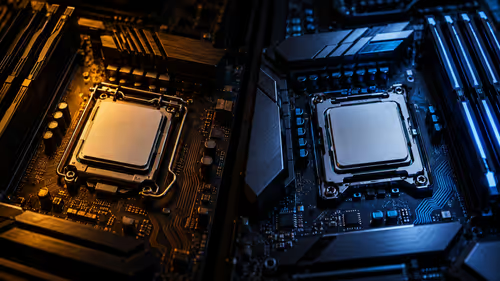
Ever stared at a CPU price list in South Africa and thought, "Sharp! Why does this tiny chip cost so much?" You're not alone. The price tag on that silicon heart of your gaming PC is the final stop on a wild global journey. From microscopic engineering in a multi-billion Rand factory to landing on our shores, every step adds to the cost. Understanding this journey is key to making a smart purchase for your next build. 🚀
From Sand to Silicon: The Global CPU Pipeline
Before a processor can power your late-night Valorant sessions, it starts as... well, sand. Highly purified silicon is grown into large cylindrical ingots, sliced into ultra-thin wafers, and shipped to a fabrication plant, or "fab".
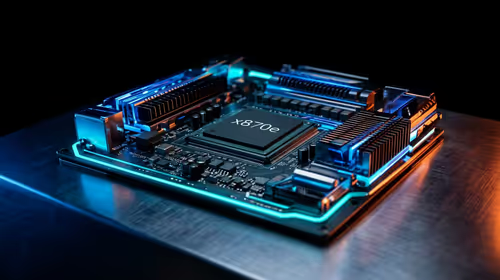
These fabs are among the most complex and expensive buildings on Earth. Companies like TSMC (who make chips for AMD) and Intel invest billions of dollars to create the sterile, high-tech environments needed to etch billions of microscopic transistors onto each wafer. This initial manufacturing cost is the bedrock of all CPU prices, whether you're in Johannesburg or Japan. The sheer complexity and low yield for cutting-edge chips mean the base cost is already significant before a single unit is shipped.
Nanometers, Cores, and the Intel vs. AMD Battle
You've seen the terms: 7nm, 5nm, 10nm. But what do they mean for your wallet? A nanometer (nm) refers to the size of the transistors on the chip. Smaller transistors are generally faster, more power-efficient, and allow manufacturers to pack more processing cores into the same space. The race to shrink this process node is fierce and expensive, directly influencing CPU prices in South Africa.
For years, this battle has been defined by two titans:
- Team Blue: Known for strong single-core performance, Intel CPUs have often been the go-to for pure gaming frame rates. Their massive in-house manufacturing capabilities give them huge scale.
- Team Red: With their innovative chiplet design and partnership with TSMC, AMD CPUs stormed the market, offering incredible multi-core performance that changed expectations for productivity and gaming.
This constant competition is actually great for us consumers. When one company launches a powerful new architecture, the other is forced to respond, often leading to better performance at more competitive price points across their entire product stack.
Budget Build Pro Tip ⚡
Don't overlook last-gen champions! When a new CPU generation launches, the previous generation often sees significant price drops. A high-end CPU from one or two years ago can still offer incredible gaming performance for a fraction of the cost of the latest release, giving you more budget for a better GPU.
The "Mzansi Factor": Why Local CPU Prices Differ
So, the chip is made. Why the extra jump in price when it lands here? Several local factors come into play, creating a unique landscape for CPU prices South Africa has to navigate.
The biggest player is the Rand-to-Dollar exchange rate. Since all these components are bought in US Dollars, a weaker Rand means we pay more. It's that simple. Add to that import duties, international shipping logistics, and local distribution costs, and you can see how the price builds up. This isn't a "tech tax"... it's the economic reality of importing high-value electronics to the tip of Africa. ✨
Understanding this helps you see the full picture. When you buy locally, you're not just getting a CPU; you're getting it delivered through a complex supply chain, with local warranties and support—something you can't get when importing directly. By weighing up all the options, from entry-level chips to high-performance beasts, you can find the perfect brain for your build without breaking the bank. A well-informed choice is always the most powerful one.
Ready to Power Up Your Rig?
Understanding the forces behind CPU prices helps you choose wisely. Whether you're building a budget beast or an ultimate 4K machine, the right processor is waiting. Explore our massive range of CPU processors and find the perfect heart for your PC today.