


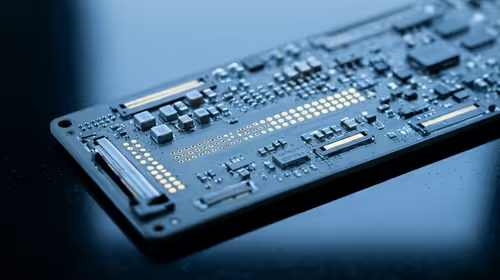
Hot-Swappable PCB Architecture in Modern Keyboards: Guide
Learn hot-swappable PCB architecture in modern keyboards—what it is, how sockets and traces work, and how to pick the right board. Speed up swaps, reduce risk, and upgrade faster 🔧⚡
Read moreThe tempered glass alone decides whether a modern PC case fits the build, more than RGB or branding. Confirm compatibility, then balance performance against warranty and SA-stock availability. Compare picks against your CPU and case spec before paying.
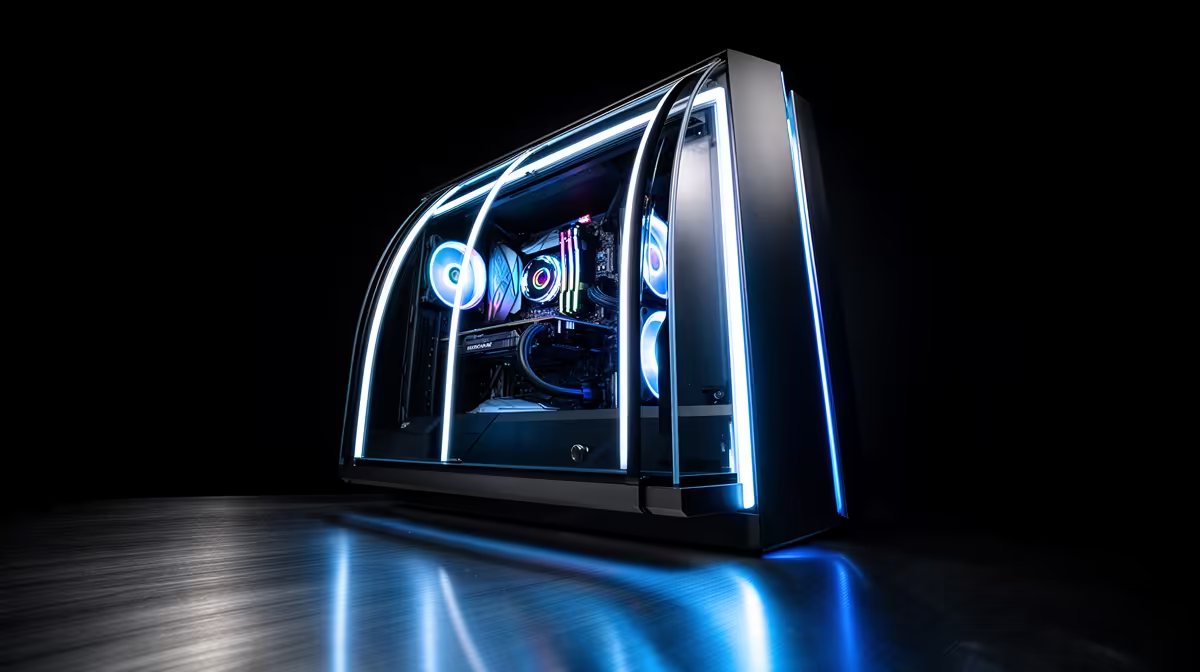
Flat tempered glass panels are the better choice for most builds: they are cheaper to replace, easier to source, offer the same visual transparency, and do not restrict internal component clearance. Curved tempered glass is a premium aesthetic feature that adds no functional benefit and costs R400 to R900 more per case.
Curved tempered glass side panels bow outward by 10mm to 25mm from the frame, creating a panoramic view of the interior. The Lian Li Lancool III and several Corsair 7000-series variants use this design. The structural trade-off is that curved glass requires a thicker frame rebate around the panel edge, which slightly reduces the visual window size at the corners. Manufacturing tolerances are tighter, so curved glass panels from off-brand cases are more likely to develop stress cracks over time, especially when removed and reinstalled repeatedly for cleaning.
Flat tempered glass panels are 4mm thick as standard, hinge or slide off without flex, and are universally available from case manufacturers as spare parts. They also lie perfectly flat against full-length foam strips or silicone grommets, providing a better vibration-dampening contact than the variable pressure points on curved glass. If you plan to mount a fan controller, hub, or cable tuck bracket on the inside of the side panel, flat glass gives you reliable adhesive contact. Nearly every mid-tower case under R2,000 at Evetech uses a flat panel design, which keeps total build costs predictable.
From a lighting perspective, curved glass acts as a gentle lens that softens ARGB lighting rather than containing it sharply. Flat glass gives you more defined light reflections and harder colour contrast between components, which many RGB enthusiasts prefer for a show-build. If your build uses ARGB fans and a lit CPU block, both panel types will look excellent at desk distance, but flat glass captures the geometry of fan blades and heatsink fins with more clarity. For SA esports setups or streaming backgrounds where the PC is visible on camera, the flat panel's sharper visual separation of components tends to photograph and broadcast better than the diffused glow of curved glass.
Use a clean microfibre cloth slightly dampened with isopropyl alcohol to clean both curved and flat tempered glass. Avoid paper towels or dry cloths as their micro-abrasion will dull the surface over time. Remove the panel from the case before cleaning to avoid bending pressure on the mounting clips.
Curved glass is slightly more resistant to perpendicular impact at the centre because the arch distributes force outward, but it is more vulnerable to edge impacts and temperature-induced stress cracking. The practical risk difference in a stationary PC case is negligible, but curved panels are harder and more expensive to replace if they do break.
In most designs, no. The outward bow is away from the components, and the internal clearance measurement in case specifications is taken from the motherboard tray to the panel frame, not the glass itself.
Lian Li, Corsair, and NZXT offer curved or panoramic glass variants in their premium lineups. These are stocked at Evetech and are typically R300 to R800 more expensive than the flat-glass version of the same case model.
Choosing between a show build and a practical build? Evetech stocks both curved and flat tempered glass cases from top brands. Browse the cases section to compare specifications and find the panel style that suits your build and budget.
Learn hot-swappable PCB architecture in modern keyboards—what it is, how sockets and traces work, and how to pick the right board. Speed up swaps, reduce risk, and upgrade faster 🔧⚡
Read more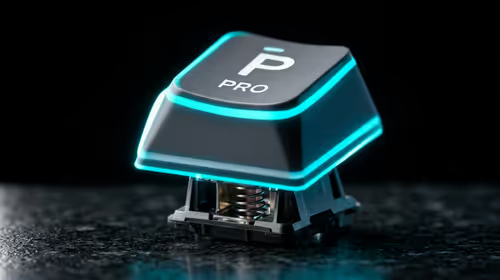
Mechanical switch lifespan explained—what the 50 million keystroke rating really means, plus tips to extend switch life and reduce double-press issues 🔧⌨️
Read more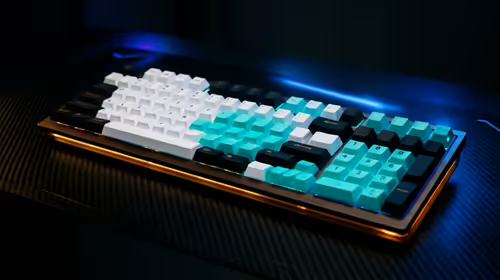
60-percent vs full-size mechanical keyboard layouts—learn what each layout includes, who it suits, and how to choose the right fit 🧩⌨️ for typing, gaming, and productivity.
Read more
Double injection keycaps last far longer than standard printed keycaps in most setups. Learn typical lifespan ranges, what shortens them, and how to maximize durability for smoother daily typing and gaming 😊⌨️
Read more
Full-key anti-ghosting: does it stop missed inputs during fast-paced gaming? We break down latency, polling, and key matrix limits so you can buy smarter 🎮⚡
Read more
Protect mechanical keyboard switches from South African dust and summer humidity with practical cleaning and storage habits. Keep your switches smooth, reduce failures, and extend lifespan. 🌬️💧
Read more
Wondering if a TKL wireless mechanical keyboard is worth it for everyday productivity? We break down latency, battery life, comfort, and workflow gains for real work. ⚡⌨️

Maximise battery life on a fanless 15-inch laptop using efficiency core architecture. Cut idle drain, tune power profiles, and improve thermals for longer runtime. 🔋⚙️

Learn how to reduce desk clutter with a TKL wireless keyboard using fewer cables, smart placement, and tidy essentials. Get a faster, calmer workspace with better ergonomics. ✅🧼

RGB keyboard lighting too distracting? Learn how to manage backlight modes, set brightness, and reduce distraction for focus and productivity 😌🖱️

Are themed gaming keyboards worth the extra cost? Compare build quality, switch options, features, and resale value to find the best fit for your setup 🎮⌨️

Full-Size vs Tenkeyless mechanical keyboards for gaming: find out if a smaller layout truly improves aim, speed, and comfort. We break down layout, desk space, latency-feel, and keybinds 🎮⌨️

Dedicated media rollers vs function key shortcuts: learn which setup gives you better workflow control, faster media access, and fewer mistakes. 🖱️🎧

Best Mechanical Switch Type for Gaming: Clicky vs Linear vs Tactile. Find your feel, speed, and noise balance with practical guidance for FPS, MOBA, and productivity 😄🎮

Direct mouse answer: Mouse not keeping up with your work? Everything that matters about dual-mode 2.4GHz + BT 5.0: DPI behaviour, channel switching, battery curves and per-app button mapping. Covers when 2.4GHz USB wins (low-latency desk) and when BT 5.0 wins (laptop, d

Plain wireless mouse guide: Mouse not keeping up with your work? Everything that matters about wireless productivity mouse: DPI behaviour, channel switching, battery curves and per-app button mapping. Includes DPI tuning tips, channel switch shortcuts, and ZAR-aware fea

Real productivity numbers: Set up your wireless mouse in this order: everything that matters about wireless productivity mouse: DPI behaviour, channel switching, battery curves and per-app button mapping. Includes DPI tuning tips, channel switch shortcuts, and ZAR-aware

Pen not feeling like paper? Stylus lag and skipping usually trace to old drivers, dirty nibs, or display refresh mismatches, not the pen itself. Covers pressure curve tuning, tilt thresholds, nib swap timing, and SA pricing brackets.