NVIDIA put the word Spark on two very different machines, and the confusion costs people thousands. The DGX Spark is a Linux-only AI developer appliance built around the GB10 Grace Blackwell superchip, while the RTX Spark takes that same silicon and recasts it for premium Windows-on-Arm PCs aimed at mainstream high-end buyers. Same chip family, opposite audiences.
Quick Answer
DGX Spark is a fixed-spec Linux AI appliance retailing at around 4,699 US dollars, built for developers prototyping and fine-tuning AI models. RTX Spark is a Windows-on-Arm consumer platform expected to land in a roughly 2,899 to 4,000 US dollar band from a wide set of OEM partners. Pick DGX Spark for serious AI development on Linux, RTX Spark for a high-end Windows machine with strong local AI capability.
The shared foundation: GB10 Grace Blackwell
Both products share the same GB10 chip as their foundation, which explains the common Spark branding. The GB10 marries a 20-core Arm CPU with a Blackwell-generation GPU, backing both from a 128GB shared memory pool rated for up to 1 petaFLOP of FP4 compute and 273 GB/s of bandwidth. That unified memory is the headline feature: it lets the GPU address a large model without the usual ceiling of discrete graphics VRAM, which is exactly what makes these machines interesting for AI work.
Where they diverge is everything around that chip: the operating system, the form factor, the target buyer and the price.
DGX Spark: the Linux AI appliance
What it is
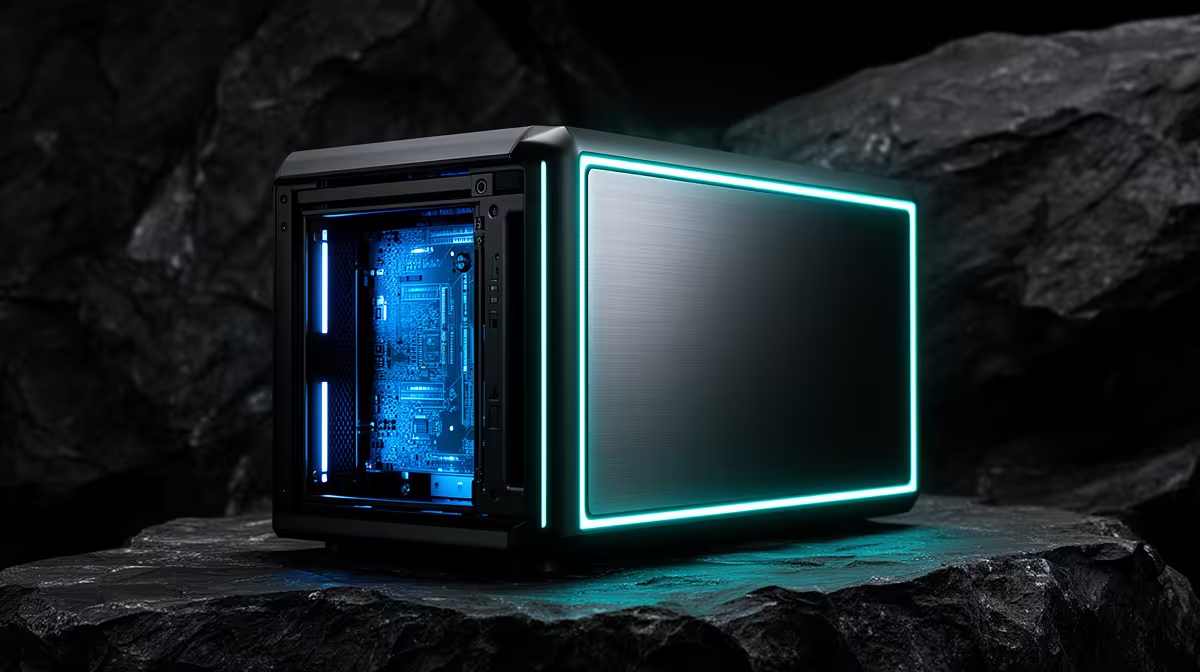
DGX Spark is a desktop AI supercomputer that ships as a fixed-configuration appliance: GB10 superchip, 128GB of LPDDR5x unified memory and a 4TB NVMe drive, running NVIDIA's Linux-based software stack. It is sold as a sealed product rather than a build-your-own PC. At roughly 4,699 US dollars it is positioned squarely at developers and researchers. An early 2026 software refresh pushed output to roughly 2.5 times the original rate, leveraging TensorRT-LLM tuning and speculative-decoding improvements, making the hardware materially stronger than early reviewers measured.
In South Africa, the DGX Spark is stocked locally by Evetech at around R70,000, which means local warranty cover and no import headache.
Who it is for
This is a tool for people building and fine-tuning AI models who want a personal box that mirrors the software environment of larger NVIDIA data-centre systems. The Linux-only nature is a feature, not a limitation, for that audience: it matches the tooling and frameworks AI developers already live in. Popular tools including PyTorch, Jupyter, Ollama and LM Studio are validated for the platform from day one. If your day is spent in CUDA, containers and model training, DGX Spark is built to feel familiar from the first boot.
Performance ceiling
A single DGX Spark runs inference on models up to about 200 billion parameters and fine-tunes up to around 70 billion parameters on one unit. Link two units over their 200 Gb/s aggregate interconnect and distributed inference reaches 405B-class models in FP4, treating the pair as a small on-desk cluster with 256 GB of combined unified memory.
RTX Spark: the Windows-on-Arm consumer platform
What it is
RTX Spark takes the GB10 hardware and puts it inside premium Windows-on-Arm PCs, with the first systems expected to ship in fall 2026 from the major OEM partners. The flagship N1X configuration combines a 20-core Grace CPU and 6,144-core Blackwell GPU drawing from a shared LPDDR5X pool of 128GB at 300 GB/s, housed in a laptop or compact desktop form factor. NVIDIA quotes 1440p gaming above 100 frames per second, support for local reasoning models up to around 120 billion parameters, and the ability to edit 12K video and render 90GB-plus 3D scenes.
Who it is for
This is the version for someone who wants a genuinely high-end Windows machine with serious local AI muscle, not a Linux developer appliance. You get a familiar Windows desktop, the Arm-based platform, and the ability to run local AI features without leaning on the cloud. It is aimed at premium buyers and professionals who want one capable Windows machine rather than a specialised AI box. The Windows-on-Arm trade-off is worth noting: native Arm apps and major creative tools run well, but older x86-only software runs through emulation and compatibility varies.
How to choose between them
The decision is mostly about your operating system and your work. If you develop AI models and want a Linux environment that mirrors data-centre tooling, DGX Spark is the match. If you want a powerful Windows PC that happens to be excellent at local AI, and you would rather have the flexibility of Windows-on-Arm than a sealed Linux appliance, RTX Spark is the one to wait for. The price gap is real but secondary to that fit. South African pricing on RTX Spark will reflect import duties and the exchange rate when those systems arrive, so treat the dollar figures as a guide to relative positioning. For locally stocked machines built around current Blackwell-generation graphics, the AI workstation range is the practical starting point while RTX Spark systems roll out, and the GPU best sellers show what high-end Blackwell cards are shipping in the meantime.
Frequently Asked Questions
Can DGX Spark run Windows?
No. DGX Spark is a Linux-only appliance running NVIDIA's own software stack, built for AI developers. If you need Windows, the RTX Spark platform is the version designed for it.
Do DGX Spark and RTX Spark use the same chip?
Yes, both share the same GB10 chip: a 20-core Arm CPU and Blackwell GPU drawing from a 128GB shared memory pool. The silicon is the same; the operating system, form factor and target market diverge completely.
Which one is cheaper?
RTX Spark flagship N1X systems start at roughly 2,899 US dollars, generally below the DGX Spark's 4,699 US dollar price. NVIDIA has noted that the top RTX Spark variants will not be inexpensive, so the gap narrows at the high end.
When can I buy an RTX Spark machine?
The first RTX Spark systems are expected to ship in fall 2026 from a broad range of OEM partners, rather than as a single NVIDIA-branded product.
Which handles larger AI models?
A single DGX Spark supports inference up to around 200B parameters, ahead of the RTX Spark's roughly 120B target. Two linked DGX Sparks reach 405B in FP4. DGX Spark's data-centre-class thermal headroom also means it sustains peak compute longer under continuous workloads.
While the Spark platforms roll out, you can build serious local AI capability today. Explore the AI workstation range at Evetech to see what current Blackwell-class hardware delivers for your workload.