


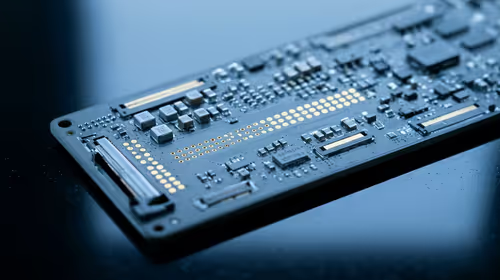
Hot-Swappable PCB Architecture in Modern Keyboards: Guide
Learn hot-swappable PCB architecture in modern keyboards—what it is, how sockets and traces work, and how to pick the right board. Speed up swaps, reduce risk, and upgrade faster 🔧⚡
Read moreDisplayPort 2.1a UHBR20 carries 4K 240Hz at 10-bit RGB without DSC; HDMI 2.1 only hits 4K 240Hz with DSC enabled, so DisplayPort is the cleaner path for flagship builds. Use a VESA-certified DP 2.1a UHBR20 cable so 4K 240Hz at 10-bit RGB passes without DSC compression.
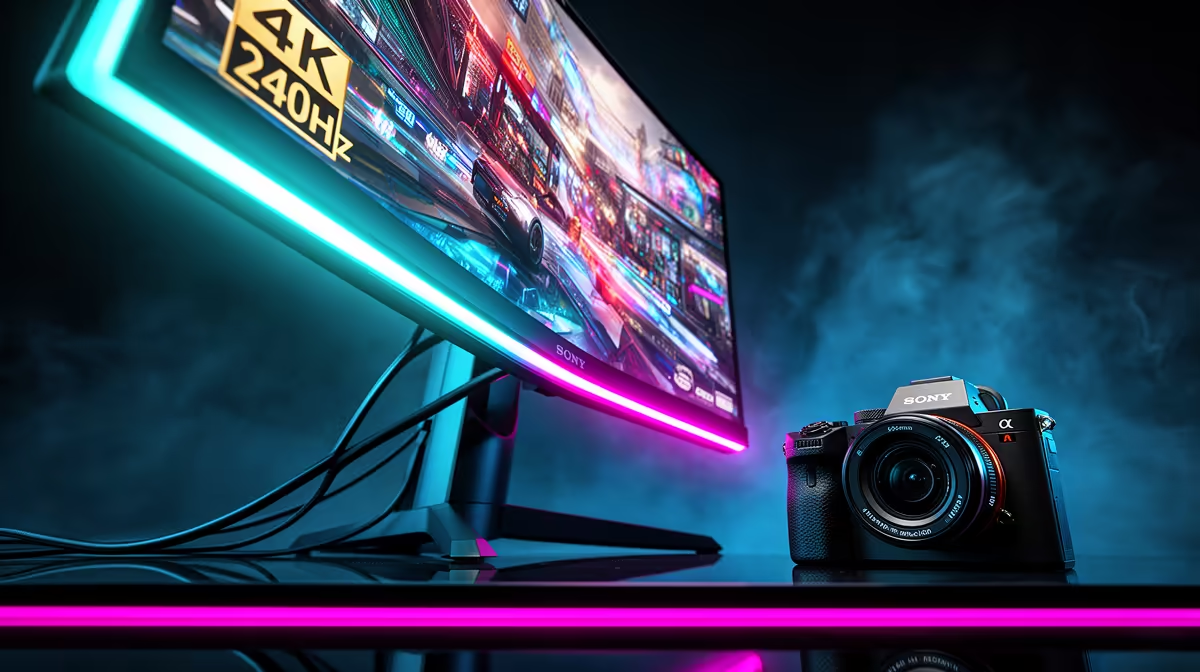
For 4K 240Hz gaming on a PC, DisplayPort 2.1a UHBR20 is the correct choice, providing up to 80 Gbps of bandwidth for uncompressed 4K 240Hz output. HDMI 2.1 tops out at 48 Gbps, which supports 4K at 144Hz uncompressed or 4K at 240Hz only with Display Stream Compression. HDMI is the better choice for connecting a PS5 or Xbox Series X.
DisplayPort 2.1a UHBR20 delivers 77.4 Gbps of usable throughput after encoding overhead. HDMI 2.1 delivers 42.6 Gbps of usable throughput. Uncompressed 4K at 240Hz at 8-bit colour with no chroma subsampling requires approximately 63 Gbps. This means DP 2.1a UHBR20 clears the threshold without compression, while HDMI 2.1 falls short by around 20 Gbps. HDMI 2.1 can carry 4K at 240Hz using Display Stream Compression, which is visually lossless, but it does require the compression codec to be active. For pure signal fidelity, DisplayPort 2.1a is the technically superior connection for 4K 240Hz.
For a PC gaming setup, use DisplayPort 2.1a from your GPU to the monitor. Most RTX 50-series and RX 9000-series GPUs include DP 2.1a outputs. Use HDMI 2.1 from a console to the monitor's HDMI port if the panel includes dual inputs. Many 4K 240Hz monitors now include two HDMI 2.1 ports alongside one or two DisplayPort 2.1a ports, allowing a multi-device desk setup without a switch. For SA buyers connecting a PS5 for family or social gaming alongside a PC, this dual-port setup eliminates the need for a separate TV or KVM switch.
For DisplayPort 2.1a UHBR20 speeds, purchase a cable explicitly certified for UHBR20 or 80 Gbps throughput. Standard DP 1.4 cables have the same physical connector but cannot carry UHBR20 signal speeds and will force a lower link rate fallback. Passive UHBR20 cables are practical at lengths of 1m to 1.5m; beyond 2m, active optical cables are required and significantly more expensive. For HDMI 2.1, use a certified Ultra High Speed HDMI cable rated to 48 Gbps. These are widely available locally and are more forgiving of cable length than DP 2.1a, with passive cables reliably working at 2m and certified cables available at 3m.
Not every DisplayPort on a 4K 240Hz monitor is DP 2.1a. Many models include one DP 2.1a port and additional DP 1.4 ports for multi-monitor daisy-chaining. The primary DP port for maximum bandwidth is usually labelled DP 2.1 or marked as the main input in the monitor's spec sheet. Plugging into a DP 1.4 port limits you to 144Hz or forces DSC engagement.
Only if the USB-C port on your GPU or laptop outputs DisplayPort 2.1a Alt Mode at UHBR20 speeds. Most USB-C ports on current laptops are limited to DP 1.4 or Thunderbolt 4 (which tops out at UHBR10). Desktop GPU USB-C ports vary by model, so check your GPU's specification sheet.
Yes. HDMI 2.1 includes Variable Refresh Rate (VRR) as part of its specification. It works with both G-Sync Compatible and FreeSync monitors over HDMI on supported devices. However, the VRR range over HDMI may differ from the monitor's rated VRR range over DisplayPort on some models.
Yes, from 2025 onward, flagship 4K 240Hz monitors from ASUS, LG, and Samsung sold locally include DP 2.1a inputs. Mid-range 4K monitors at 144Hz to 160Hz still commonly use DP 1.4 with DSC, which is entirely adequate for those refresh rates.
Building a 4K 240Hz PC or console setup? Evetech stocks 4K 240Hz monitors with DisplayPort 2.1a and HDMI 2.1 inputs, alongside RTX 50-series GPUs to drive them. Browse the Evetech monitor and GPU sections to configure your bandwidth-ready display stack.
Learn hot-swappable PCB architecture in modern keyboards—what it is, how sockets and traces work, and how to pick the right board. Speed up swaps, reduce risk, and upgrade faster 🔧⚡
Read more
Mechanical switch lifespan explained—what the 50 million keystroke rating really means, plus tips to extend switch life and reduce double-press issues 🔧⌨️
Read more
60-percent vs full-size mechanical keyboard layouts—learn what each layout includes, who it suits, and how to choose the right fit 🧩⌨️ for typing, gaming, and productivity.
Read more
Double injection keycaps last far longer than standard printed keycaps in most setups. Learn typical lifespan ranges, what shortens them, and how to maximize durability for smoother daily typing and gaming 😊⌨️
Read more
Full-key anti-ghosting: does it stop missed inputs during fast-paced gaming? We break down latency, polling, and key matrix limits so you can buy smarter 🎮⚡
Read more
Protect mechanical keyboard switches from South African dust and summer humidity with practical cleaning and storage habits. Keep your switches smooth, reduce failures, and extend lifespan. 🌬️💧
Read more
Wondering if a TKL wireless mechanical keyboard is worth it for everyday productivity? We break down latency, battery life, comfort, and workflow gains for real work. ⚡⌨️
Maximise battery life on a fanless 15-inch laptop using efficiency core architecture. Cut idle drain, tune power profiles, and improve thermals for longer runtime. 🔋⚙️
Learn how to reduce desk clutter with a TKL wireless keyboard using fewer cables, smart placement, and tidy essentials. Get a faster, calmer workspace with better ergonomics. ✅🧼
RGB keyboard lighting too distracting? Learn how to manage backlight modes, set brightness, and reduce distraction for focus and productivity 😌🖱️
Are themed gaming keyboards worth the extra cost? Compare build quality, switch options, features, and resale value to find the best fit for your setup 🎮⌨️
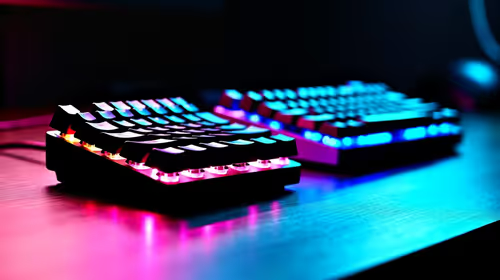
Full-Size vs Tenkeyless mechanical keyboards for gaming: find out if a smaller layout truly improves aim, speed, and comfort. We break down layout, desk space, latency-feel, and keybinds 🎮⌨️
Dedicated media rollers vs function key shortcuts: learn which setup gives you better workflow control, faster media access, and fewer mistakes. 🖱️🎧
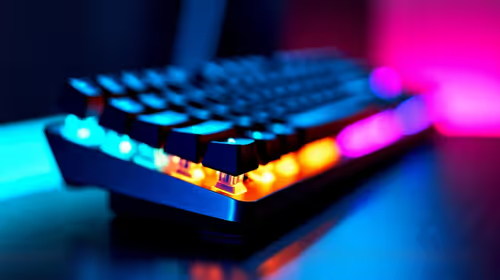
Best Mechanical Switch Type for Gaming: Clicky vs Linear vs Tactile. Find your feel, speed, and noise balance with practical guidance for FPS, MOBA, and productivity 😄🎮
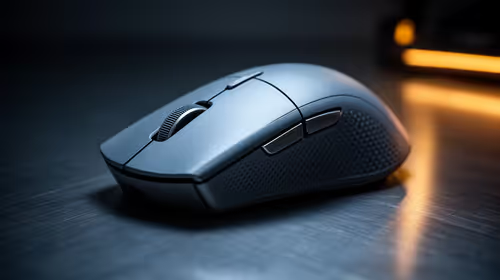
Direct mouse answer: Mouse not keeping up with your work? Everything that matters about dual-mode 2.4GHz + BT 5.0: DPI behaviour, channel switching, battery curves and per-app button mapping. Covers when 2.4GHz USB wins (low-latency desk) and when BT 5.0 wins (laptop, d
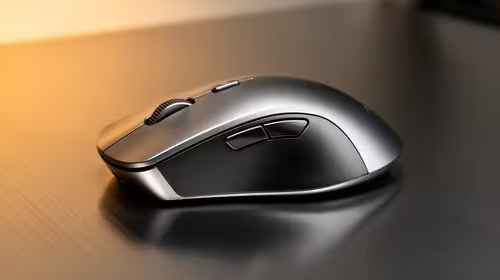
Plain wireless mouse guide: Mouse not keeping up with your work? Everything that matters about wireless productivity mouse: DPI behaviour, channel switching, battery curves and per-app button mapping. Includes DPI tuning tips, channel switch shortcuts, and ZAR-aware fea
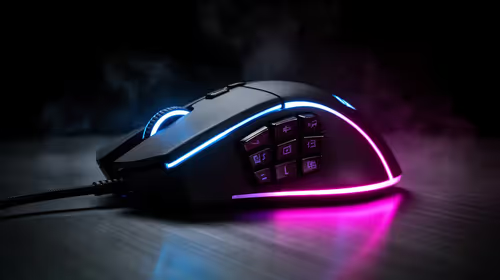
Real productivity numbers: Set up your wireless mouse in this order: everything that matters about wireless productivity mouse: DPI behaviour, channel switching, battery curves and per-app button mapping. Includes DPI tuning tips, channel switch shortcuts, and ZAR-aware
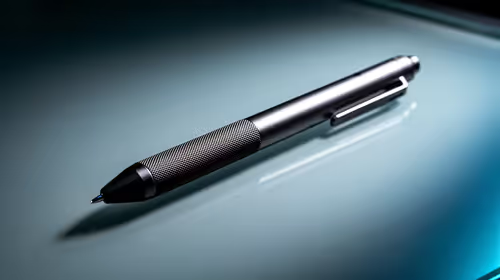
Pen not feeling like paper? Stylus lag and skipping usually trace to old drivers, dirty nibs, or display refresh mismatches, not the pen itself. Covers pressure curve tuning, tilt thresholds, nib swap timing, and SA pricing brackets.