Quick Answer
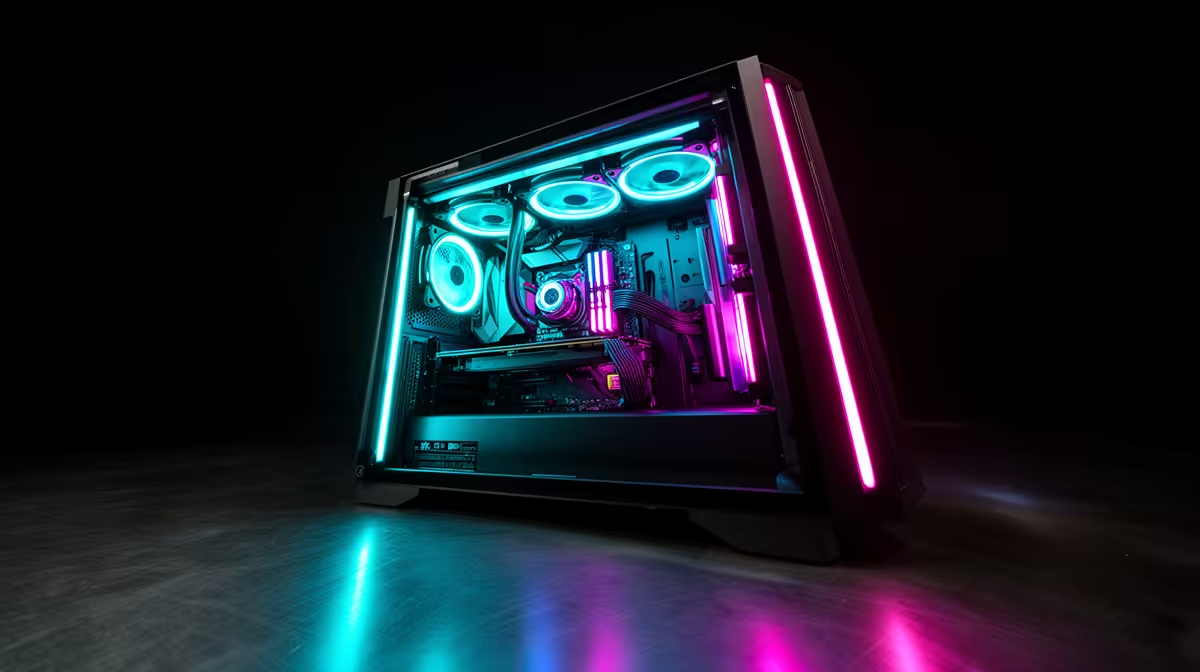
The extra space in an E-ATX case gives you room for wider motherboards (up to 330mm vs 305mm wide for ATX), additional PCIe slots for multi-card or capture card setups, longer GPU clearance, more radiator mounting options, and generally better cable management volume. For pure gaming, standard ATX cases are sufficient.
What E-ATX Motherboards Actually Offer Over ATX 🖥️
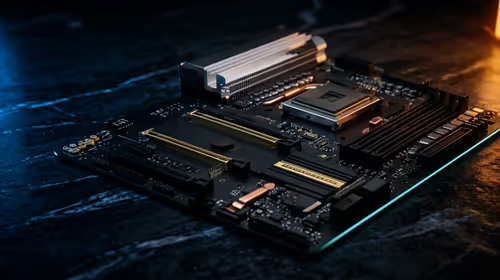
Standard ATX motherboards measure 305mm x 244mm. E-ATX boards start at 305mm x 264mm and can go up to 305mm x 330mm.
For creators who need 128GB to 256GB of RAM for 3D rendering, video production at 8K, or running large language model inference locally, E-ATX on platforms like AMD Threadripper Pro is the only viable option. Gaming-only builders on standard AM5 or LGA1851 platforms do not benefit meaningfully since those mainstream CPUs only support four DIMM slots regardless of board size.
Practical Case Size Differences for SA Builders 📏
E-ATX cases are physically larger than ATX cases, typically adding 50mm to 120mm in width and depth. A standard ATX mid-tower like the Fractal Design Define 7 measures around 240mm wide. An E-ATX full-tower runs 280mm to 310mm wide. On a SA desk with limited space, that extra width matters. Measure your desk or PC station space before committing to an E-ATX chassis.
E-ATX cases in South Africa price from R2,200 at the budget end to R7,000 for premium full-tower options. Standard ATX mid-towers in equivalent quality tiers cost R1,200 to R4,500. The premium for E-ATX support is roughly R500 to R1,500 depending on brand and feature set.
Cooling and Upgrade Space: Where E-ATX Wins 🌬️
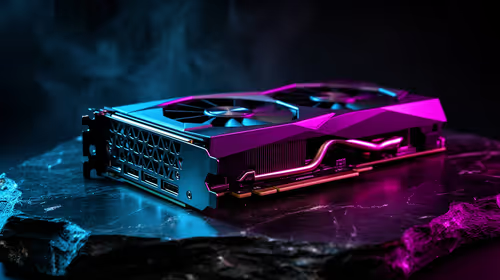
The additional volume in an E-ATX case directly benefits cooling. More case volume means more air moving between components before it needs to exit. E-ATX cases more commonly support 420mm radiators, triple-fan GPU clearances above 380mm, and additional fan mounts (some E-ATX towers support seven or more fans simultaneously). For an RTX 5090 system that demands serious thermal management, the extra E-ATX case volume provides measurable headroom.
Upgrade space also extends to drive bays. If you plan to expand storage with multiple 3.5-inch HDDs alongside NVMe SSDs, E-ATX cases typically include three to six 3.5-inch bays compared to two to three in most ATX mid-towers.
ATX Case with E-ATX Support ⚡
Several premium ATX mid-towers explicitly list E-ATX support up to a specific board width, usually 272mm to 285mm. If your board falls within that range, you can get E-ATX board support in a physically smaller case footprint, saving desk space and potentially R500 to R1,000 on case cost. Always verify the maximum supported board width in the spec sheet.
FAQ
Can I use an ATX case for an E-ATX build?
Only if the ATX case explicitly lists E-ATX support and your board width falls within the stated maximum. Never assume: measure your board width and compare directly to the case's spec sheet. A mismatch results in the board not fitting, standoffs misaligning, or the case side panel not closing.
Do E-ATX cases always have better airflow than ATX cases?
Not automatically. Airflow depends on the case's fan placement, front panel design (mesh vs glass), and fan count. E-ATX cases have more internal volume which generally helps, but a well-designed ATX mesh mid-tower can outperform a poorly ventilated E-ATX full-tower.
Is E-ATX worth the extra cost for a gaming-focused creator who also streams?
For streaming only, no: ATX is fine. If your workflow includes video editing, 3D rendering, or AI-assisted content tools that benefit from 128GB+ RAM or multiple PCIe cards (capture card plus GPU), the E-ATX platform investment pays off. Otherwise, invest the premium into a better GPU or faster NVMe storage instead.
Choosing between ATX and E-ATX for your next build?
Compare the full range of ATX and E-ATX PC cases at Evetech, with detailed specs so you match the right chassis to your components.