Quick Answer
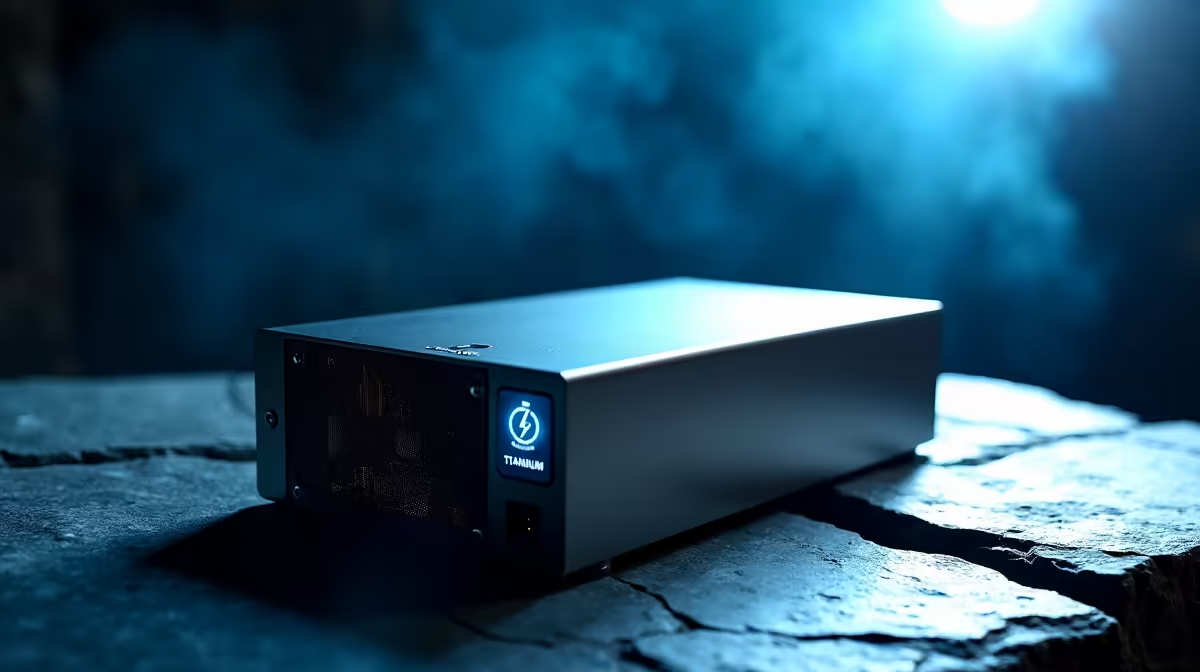
A Titanium certified PSU running a typical gaming system at 50% load achieves around 96% efficiency, compared to 85% for a Bronze unit. At South African Eskom tariffs around R3.50 to R4.20 per kWh (2025 to 2026 rates), upgrading from Bronze to Titanium on a system that games four hours daily saves roughly R500 to R900 per year depending on system power draw.
Calculating Your Actual Electricity Saving 💰
To find your potential saving, you need three numbers: system watt draw at typical gaming load, hours of use per day, and your local electricity tariff. A common South African gaming build with an RTX 5080 and Ryzen 9 9900X draws around 350W to 450W during gameplay. At 400W system draw for four hours daily, a Bronze PSU at 85% efficiency pulls 471W from the wall (400W divided by 0.85). A Titanium unit at 94% efficiency pulls 426W. The difference is 45W per session, or 180Wh per day. At R4.00 per kWh, that is R0.72 per day, or about R263 per year. On a higher-draw system with an RTX 5090 at 650W system load gaming six hours daily, the saving grows to R600 to R900 annually.
South Africa's Eskom Tariff Context 🔌
Eskom's residential tariff has increased significantly over the past five years, and prepaid electricity users in Gauteng and Tshwane now pay between R3.40 and R4.50 per kWh depending on municipality and block. Cape Town (City Power) and Johannesburg (City Power) tariffs differ from direct Eskom supply areas. In all cases, the trend is upward, meaning efficiency investments made today return more value over time as tariffs rise. Titanium PSUs purchased in 2025 to 2026 will generate increasing savings through their 10-year warranty period as electricity costs compound annually.
Choosing the Right Titanium PSU for Gaming 🎮
Not every Titanium-rated PSU suits a gaming rig. For single-GPU gaming systems with RTX 5080 or below, a 1,000W Titanium unit is the practical choice: it provides ample headroom (typically running at 40% to 60% load where Titanium efficiency peaks), includes ATX 3.1 compliance for next-gen GPUs, and costs around R4,500 to R6,500 locally. The ASUS ROG Thor 1000W Titanium and Seasonic Prime TX-1000 are examples stocked at Evetech. For RTX 5090 builds, step up to 1,200W to 1,600W Titanium to maintain the efficiency-sweet-spot load range without straining the unit during transient spikes.
Monitor Your Real Consumption ⚡
Plug a smart power meter (available from local hardware stores for R150 to R400) into the wall socket between your surge protector and the wall. It measures real kWh consumed, giving you accurate before-and-after data when you upgrade your PSU. This is more reliable than calculator estimates and shows the true impact on your electricity bill.
FAQ
Is a Titanium PSU worth it on a casual gaming rig that runs 1 to 2 hours daily?
At low usage the savings are small (under R150 per year), but the longer warranty and better build quality still protect your other components. For casual rigs, Platinum is usually the best value point.
Do Titanium PSUs also reduce heat output?
Yes. Every percentage point of efficiency converts directly to less heat inside the case. A Titanium unit dissipates roughly 40% to 50% less heat than a Bronze unit at the same load, which can reduce case temperatures by 3 to 6 degrees C.
Can I check if my current PSU is causing high electricity usage?
Yes. Plug a power meter into the wall and run your normal gaming session. Then use a PSU calculator to estimate what your system should draw at your GPU and CPU's TDP. If the wall reading is significantly higher, your PSU's efficiency is lower than rated, suggesting it may be aging or was never high-efficiency.
Want to cut your electricity bill without cutting your gaming performance?
Browse Evetech's Titanium and Platinum certified PSU range, designed to deliver maximum efficiency at South African gaming load levels and pay for themselves over time through reduced electricity costs.