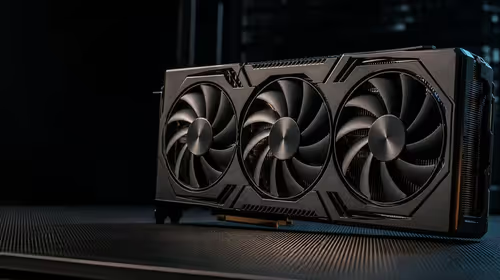
A fan listing crams four or five acronyms into a couple of lines and expects shoppers to already know what each one changes about how the part performs in practice. Getting case fan specs explained properly means walking through what CFM, dBA, PWM, and wattage each measure individually, then seeing how all four line up on one real product listing.
Quick Answer
This 120mm model, priced at R249, covers all four core case fan specifications at once: 82.9 cubic feet per minute of maximum airflow, a decibel ceiling of 40.7 dBA, PWM speed control, and a draw of 3 watts. Reading those four figures together gives a full picture of how the fan performs before it is even out of the box.
📊 CFM: Measuring Airflow Volume
What the Figure Actually Represents
CFM stands for cubic feet per minute, the volume of air a fan can shift under unobstructed conditions. This fan's 82.9 CFM rating sits well above the roughly 50 CFM many mid-range builds need per position, leaving margin for cases with restrictive front panels or dust filters that pull real-world airflow below the number on the box.
Why Rated CFM Rarely Survives Installation
No fan hits its full rated CFM once mounted behind a mesh panel, filter, or radiator, since each of those adds resistance the motor has to push against. Choosing a fan with headroom above the bare minimum, rather than one that only just clears it on paper, accounts for that gap between lab conditions and an actual case.
Airflow Versus Static Pressure
CFM measures open-air movement, but a fan working through a tight radiator fin stack or a dense dust filter is fighting resistance that a pure airflow figure does not capture; that scenario is better described by a separate static-pressure rating, which some fans quote and others do not. For a fan mounted in open case positions rather than against a radiator, CFM alone remains the more relevant number to weigh.
🔈 dBA: Measuring Perceived Noise
How Decibels Translate to Real Sound
dBA is a decibel measurement weighted to match how human hearing perceives different frequencies, making it a closer match to actual perceived loudness than a raw decibel figure would be. This fan's 40.7 dBA maximum sits roughly at the level of a quiet conversation, and crucially, that number is a ceiling reached only at full PWM speed.
Why Noise Figures Are Always Quoted at Maximum
Manufacturers list dBA at full speed because it is the easiest fixed point to test and compare across models, but it rarely reflects how a fan sounds during typical use. With PWM scaling speed to temperature, actual noise during light tasks sits well under that maximum figure most of the time.
⚙️ PWM: How Speed Gets Controlled
The Fourth Pin Explained
Standard three-pin fans vary speed by changing voltage, which struggles to hold steady at very low speeds. PWM fans add a fourth pin carrying a dedicated control signal, letting the motherboard pulse power on and off rapidly rather than adjusting voltage, giving smoother control across a wider range, including near-silent idle speeds.
What Happens Without a PWM Header
A PWM fan plugged into a plain three-pin header will usually still spin, but loses automatic speed scaling since the control signal has nowhere to go. Confirming a motherboard has a spare PWM-capable header is worth doing before buying a fan specifically for its speed-control range.
🔋 Wattage: Measuring Power Draw
Where 3 Watts Sits Among Case Fans
Power draw for 120mm case fans typically ranges from around 2W up to 5W or more, depending on motor design and top speed. This fan's 3W figure sits comfortably in that range, translating to a negligible impact on total system power even across several units running continuously.
Why Wattage Rarely Decides a Purchase
Because case fan power draw is so small next to a graphics card or processor pulling hundreds of watts under load, wattage differences between fan models almost never move a monthly electricity bill in any noticeable way. It matters more as confirmation of a fan's overall efficiency than as a deciding factor on its own.
Reading a Full Spec Sheet in One Pass
Once all four figures are understood individually, reading a listing becomes a matter of checking each against the build's actual needs: CFM against case restriction, dBA against how quiet the build needs to run, PWM against motherboard header support, and wattage mostly as reassurance the fan is not unusually power-hungry. Treating the four specs as a checklist rather than a single combined score avoids over-weighting any one figure at the expense of the others.
Frequently Asked Questions
Which spec matters most when choosing a case fan?
It depends on the build's priority. Airflow-focused builds should weight CFM most heavily, while noise-sensitive setups should focus on dBA at typical, not maximum, operating speed.
Can two fans with the same CFM sound different?
Yes, since dBA depends on more than airflow volume alone, including blade design and bearing type, so matching CFM does not guarantee matching noise levels.
Does PWM control affect the maximum CFM a fan can reach?
No, PWM only changes how speed is controlled, not the physical maximum airflow, which stays fixed regardless of control method.
Is a lower wattage fan always quieter?
Not necessarily, since wattage reflects motor power draw rather than noise output directly, though very low-power fans are often designed for quieter running as well.
How do I know if my motherboard supports PWM fans?
Check the header specifications in the motherboard manual, since most modern boards include at least one PWM-capable header, typically labelled for CPU or case fans.
Are these four specs enough to fully judge a case fan?
They cover the core performance picture, though bearing type and expected lifespan are worth checking too for a complete comparison between models.
Why do some listings only show CFM and skip the rest?
Cheaper or less detailed listings sometimes omit dBA, PWM support, or wattage, which makes a fan harder to judge fully before buying, so a complete spec sheet like this one is worth valuing.
Is there an ideal balance between all four specs?
There is no universal ideal, since the right balance depends on whether a build prioritises silence, raw cooling, or general all-round use, but this fan's figures suit a fairly broad range of typical builds.
Full specifications for this exact model, alongside current pricing, are on the product listing. For a side-by-side spec comparison against other fans, see Evetech's case fan category, and if you are shopping for a case to match, Einarex's case selection is worth a look too.
Ready to decode every case fan spec before you buy?
Study Evetech's Einarex EX12A case fan at R249 at Evetech, as a real-world example of CFM, dBA, PWM and power.