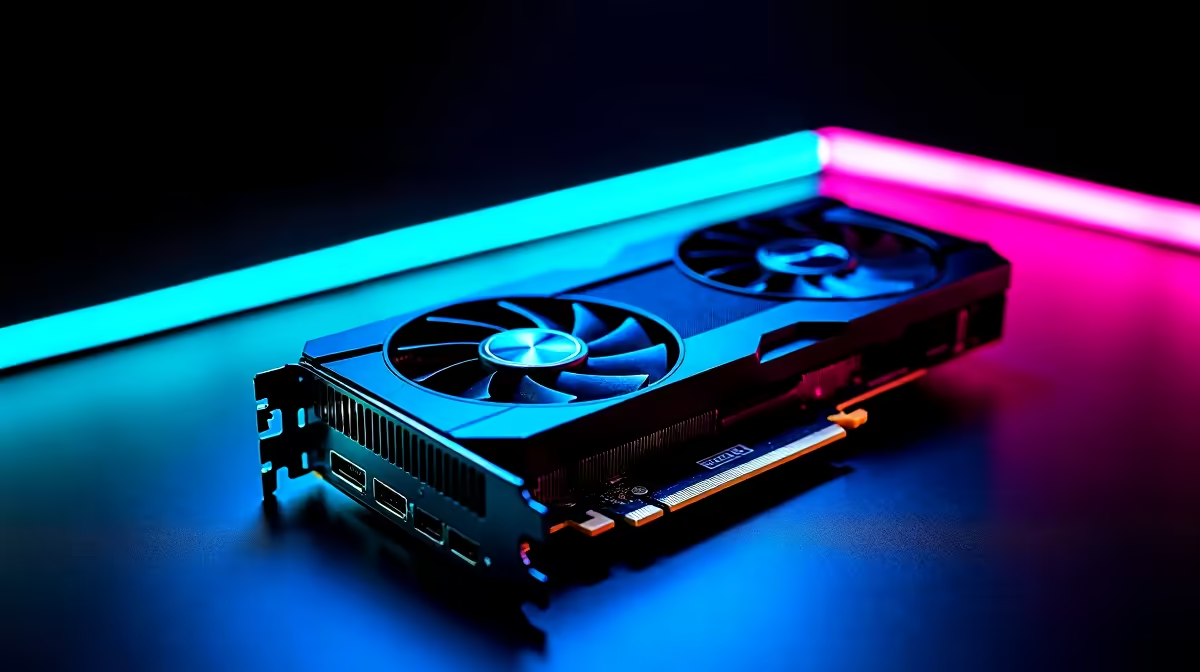
For decision-makers buying Intel Arc, whether for a single rig or a fleet, the useful view is a feature grid: what each model offers across VRAM, encoding, ray tracing, power, and platform requirements. This brief focuses on the trade-offs that drive a confident choice.
Quick Answer
On a feature grid, Intel Arc's strengths are 12GB VRAM on the B580, excellent AV1 and HEVC hardware encoding, solid ray tracing, and competitive price-per-frame, set against a dependency on Resizable BAR and the value of keeping drivers current. For a value-led decision under R8,000, the Arc B580 is the clear pick; choose otherwise only for specific software ecosystem needs.
Reading the Arc feature grid
Five columns decide it. VRAM: 12GB on the B580 is comfortable for 1440p, 8GB tiers suit 1080p. Encoding: Arc's AV1 and HEVC hardware encoders are excellent for streaming and content work. Ray tracing: Arc handles it well for its class. Power and cooling: check the card's draw and length against your PSU and case. Platform: Resizable BAR support is required for full performance, so confirm the motherboard handles it. These five rows cover almost every decision.
Making the call for a build or a fleet
For a single value build, the B580 with 12GB, a quality PSU, and a ReBAR-capable board is a confident choice. For multiple machines, standardise on one Arc model and one driver version so support stays simple, and verify each host has Resizable BAR enabled. Arc's AV1 encoding is a genuine differentiator for any build that streams or transcodes. Where the deciding factor is the widest game-day driver support, weigh NVIDIA; where it is price-per-frame and encoding, Arc leads.
Arc across several PCs, lock to one driver version and confirm Resizable BAR on every board, consistency prevents per-machine performance surprises.
FAQ
What are Intel Arc's standout features?
12GB VRAM on the B580, excellent AV1 and HEVC encoding, capable ray tracing, and strong price-per-frame. Its main caveat is the need for Resizable BAR and current drivers.
Is Intel Arc a safe choice for multiple PCs?
Yes, if you standardise on one model and driver version and enable Resizable BAR on every board. Consistency keeps support simple and performance predictable.
How much VRAM does an Arc card need?
8GB suits 1080p, while 12GB on the B580 is the comfortable choice for 1440p and texture-heavy modern games. Match VRAM to your target resolution.
Use the VRAM, encoding, and ReBAR rows to decide, then standardise on the right Arc model at Evetech.