


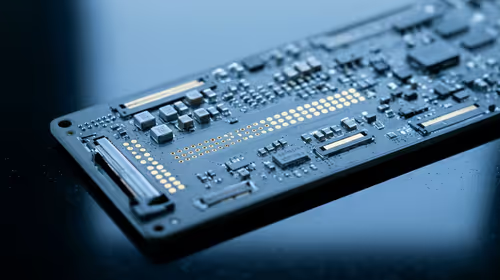
Hot-Swappable PCB Architecture in Modern Keyboards: Guide
Learn hot-swappable PCB architecture in modern keyboards—what it is, how sockets and traces work, and how to pick the right board. Speed up swaps, reduce risk, and upgrade faster 🔧⚡
Read moreFast IPS panels hit 0.3ms grey-to-grey at 240Hz and above, while standard IPS sits around 1-4ms at 60-180Hz, so motion clarity and colour at high frame rates differ noticeably. Match specs to your build and use case before you commit to the upgrade.
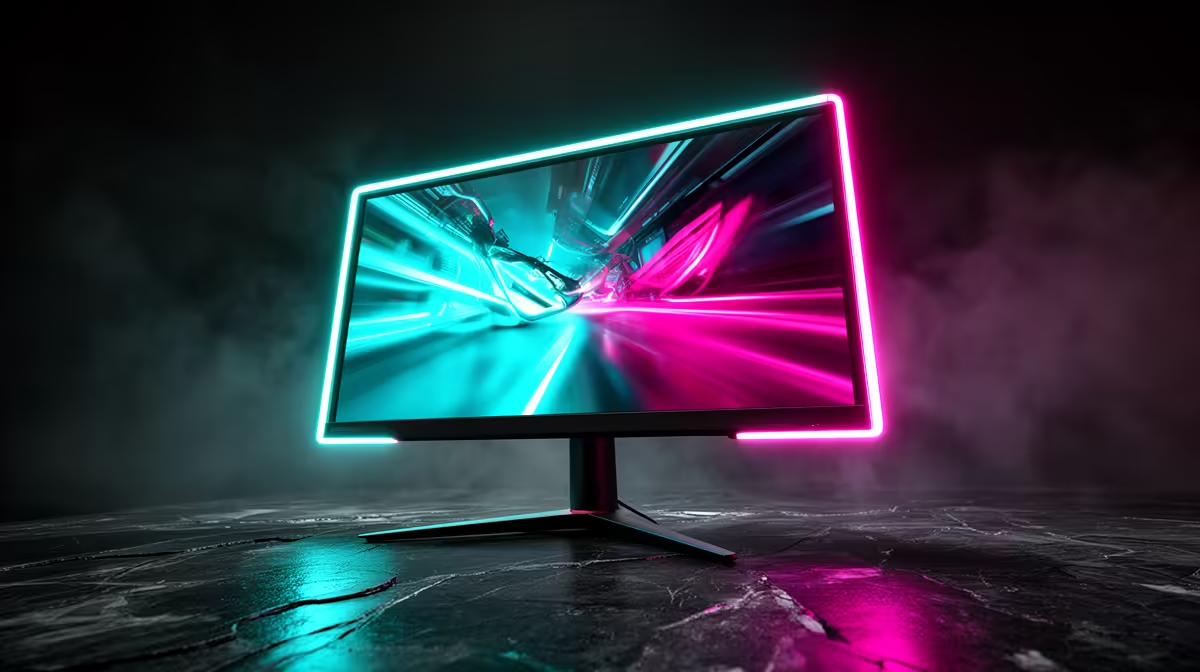
Fast IPS panels offer 0.3ms to 1ms GTG response times versus 4ms to 6ms on standard IPS, producing visibly sharper motion in fast games. Colour accuracy is comparable between the two, but Fast IPS units typically cover 95% or more of DCI-P3, making them strong choices for both gaming and content creation.
GTG (grey-to-grey) response time measures how quickly a pixel transitions between two mid-luminance values. On a standard IPS panel at 6ms GTG, a pixel mid-transition is still partially lit from the previous frame when the next frame arrives at 160Hz (6.25ms per frame). This residual state is the root cause of IPS ghosting. On a 0.3ms Fast IPS panel, the transition completes well before the next frame at any current refresh rate, eliminating the artefact. At lower refresh rates like 60 to 100Hz, even a 4ms standard IPS panel performs cleanly; the Fast IPS advantage is most apparent above 144Hz where frame windows shrink below 7ms.
Both Fast IPS and standard IPS use the same liquid crystal alignment, so wide viewing angles and accurate colour are common to both. Aggressive overdrive, which enables 0.3ms GTG, can introduce inverse ghosting: a bright halo ahead of a fast dark object. Premium Fast IPS panels manage overdrive carefully enough that inverse ghosting only appears at the most extreme preset. For colour accuracy, both types typically land within 2 to 3 delta-E of the sRGB standard out of the box. HDR contrast ratios stay near 1,000:1 on entry-level IPS panels without local dimming, fast or standard.
In South Africa, Fast IPS monitors command a premium of roughly R1,500 to R3,500 over comparable standard IPS panels at the same size and resolution. For a gamer whose library skews toward competitive titles at 144Hz or above, that premium is justified by cleaner target tracking. For someone who plays primarily at 60 to 100fps in story-driven games, standard IPS at 4ms delivers clean motion with limited additional benefit from Fast IPS. Content creators who export video or work in Lightroom benefit from the wider DCI-P3 coverage many Fast IPS panels include. The R8,000 to R12,000 bracket now includes Fast IPS options that would have cost R18,000 or more three years ago.
When first setting up a Fast IPS monitor, cycle through the monitor's overdrive presets in the OSD while playing a fast-motion video. The preset just below where inverse ghosting first appears is your ideal setting. The Standard or Fast preset is usually the safest starting point for South African gaming conditions.
Fast IPS sits between VA and OLED. VA panels offer higher native contrast (3,000:1 versus 1,000:1 for IPS) but slower response causing smearing in dark scenes. OLED delivers near-infinite contrast and sub-0.1ms response at a higher price. Fast IPS is the practical choice for most SA gamers who want balanced response speed, colour accuracy, and price.
Fast IPS technology applies to desktop monitor panels. Laptop displays marketed as Fast IPS may draw marginally more power due to overdrive circuitry but the difference is minimal compared to GPU and display backlight consumption.
Yes. Many Fast IPS monitors support hardware calibration with a colorimeter and include factory calibration reports. Panels covering 95% DCI-P3 are used professionally in photography and video editing. Confirm the monitor has a wide colour gamut mode and an sRGB clamp for web-targeted colour spaces.
Looking for a monitor that handles both gaming and creative work? Evetech stocks Fast IPS gaming monitors across multiple size and resolution tiers, all with local warranty and delivery across South Africa.
Learn hot-swappable PCB architecture in modern keyboards—what it is, how sockets and traces work, and how to pick the right board. Speed up swaps, reduce risk, and upgrade faster 🔧⚡
Read more
Mechanical switch lifespan explained—what the 50 million keystroke rating really means, plus tips to extend switch life and reduce double-press issues 🔧⌨️
Read more
60-percent vs full-size mechanical keyboard layouts—learn what each layout includes, who it suits, and how to choose the right fit 🧩⌨️ for typing, gaming, and productivity.
Read more
Double injection keycaps last far longer than standard printed keycaps in most setups. Learn typical lifespan ranges, what shortens them, and how to maximize durability for smoother daily typing and gaming 😊⌨️
Read more
Full-key anti-ghosting: does it stop missed inputs during fast-paced gaming? We break down latency, polling, and key matrix limits so you can buy smarter 🎮⚡
Read more
Protect mechanical keyboard switches from South African dust and summer humidity with practical cleaning and storage habits. Keep your switches smooth, reduce failures, and extend lifespan. 🌬️💧
Read more
Wondering if a TKL wireless mechanical keyboard is worth it for everyday productivity? We break down latency, battery life, comfort, and workflow gains for real work. ⚡⌨️
Maximise battery life on a fanless 15-inch laptop using efficiency core architecture. Cut idle drain, tune power profiles, and improve thermals for longer runtime. 🔋⚙️
Learn how to reduce desk clutter with a TKL wireless keyboard using fewer cables, smart placement, and tidy essentials. Get a faster, calmer workspace with better ergonomics. ✅🧼
RGB keyboard lighting too distracting? Learn how to manage backlight modes, set brightness, and reduce distraction for focus and productivity 😌🖱️
Are themed gaming keyboards worth the extra cost? Compare build quality, switch options, features, and resale value to find the best fit for your setup 🎮⌨️
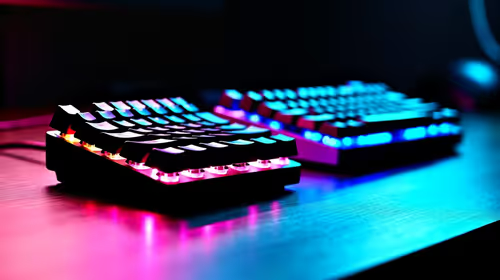
Full-Size vs Tenkeyless mechanical keyboards for gaming: find out if a smaller layout truly improves aim, speed, and comfort. We break down layout, desk space, latency-feel, and keybinds 🎮⌨️
Dedicated media rollers vs function key shortcuts: learn which setup gives you better workflow control, faster media access, and fewer mistakes. 🖱️🎧
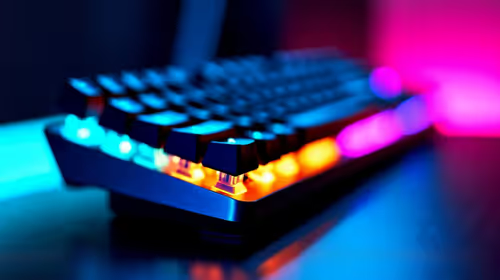
Best Mechanical Switch Type for Gaming: Clicky vs Linear vs Tactile. Find your feel, speed, and noise balance with practical guidance for FPS, MOBA, and productivity 😄🎮
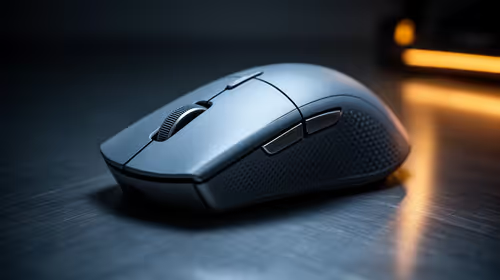
Direct mouse answer: Mouse not keeping up with your work? Everything that matters about dual-mode 2.4GHz + BT 5.0: DPI behaviour, channel switching, battery curves and per-app button mapping. Covers when 2.4GHz USB wins (low-latency desk) and when BT 5.0 wins (laptop, d
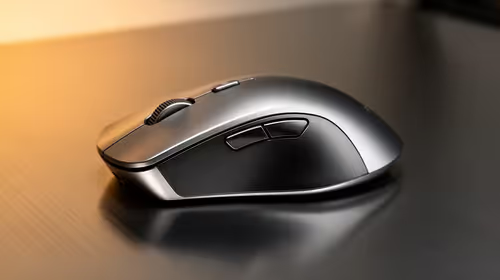
Plain wireless mouse guide: Mouse not keeping up with your work? Everything that matters about wireless productivity mouse: DPI behaviour, channel switching, battery curves and per-app button mapping. Includes DPI tuning tips, channel switch shortcuts, and ZAR-aware fea
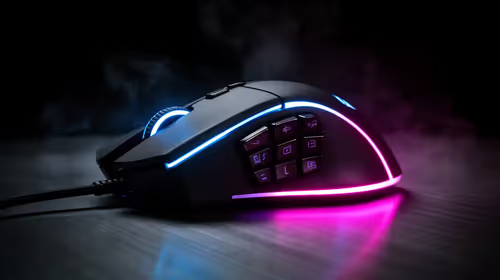
Real productivity numbers: Set up your wireless mouse in this order: everything that matters about wireless productivity mouse: DPI behaviour, channel switching, battery curves and per-app button mapping. Includes DPI tuning tips, channel switch shortcuts, and ZAR-aware
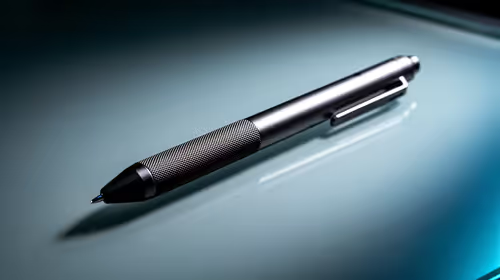
Pen not feeling like paper? Stylus lag and skipping usually trace to old drivers, dirty nibs, or display refresh mismatches, not the pen itself. Covers pressure curve tuning, tilt thresholds, nib swap timing, and SA pricing brackets.