


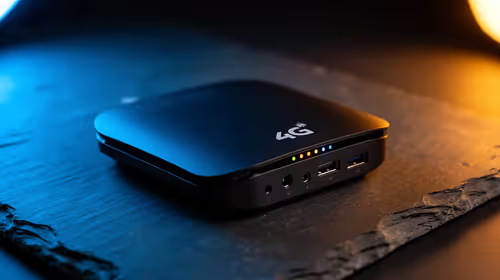
How to Use a Nano SIM 4G Router for Reliable Home Internet
Master using a Nano SIM 4G router as your primary internet solution. Get stable speeds and seamless connectivity for gaming and streaming at home! 🌐🚀
Read moreCooling not behaving as expected? Real difference for builders: Fluid Dynamic Bearings vs Sleeve Bearings for PC Fan Lifespan and Noise comes down to airflow, noise floor and case fit for gamer rigs. Walks through FDB oil reservoirs, MTBF claims (60,000+ hours typical)
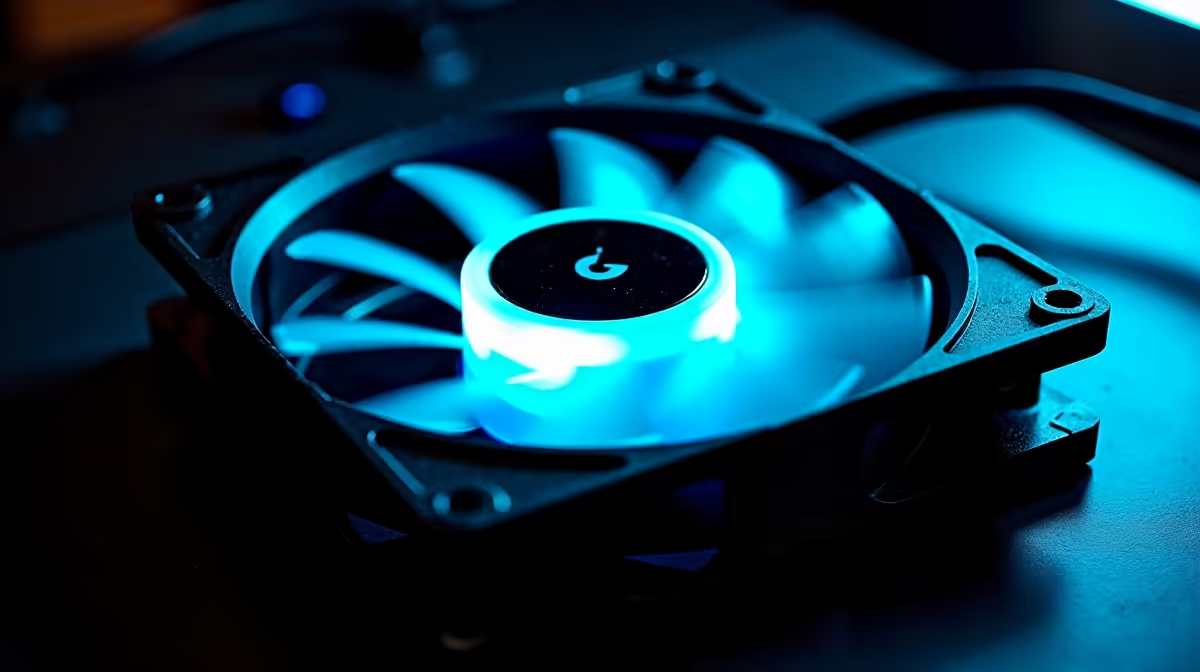
Fluid dynamic bearings (FDB) last significantly longer than sleeve bearings: rated MTBF figures of 150,000 hours versus 30,000 to 50,000 hours are common. FDB fans are also quieter at all operating speeds. For any build intended to run for three or more years, FDB fans are the clear choice.
A sleeve bearing is a bronze or polymer bushing surrounding the fan shaft. Oil lubricates the contact surfaces but migrates or evaporates over time, especially in warm SA environments, causing metal-on-metal contact, friction, and audible noise. Most sleeve bearing fans show noise increase after 18 to 36 months in warm cases. Fluid dynamic bearings use hydrodynamic fluid held in precision grooves. As the shaft rotates, the groove geometry generates a self-sustaining pressure film keeping the shaft centred with no physical contact. This near-zero friction mechanism is why FDB fans remain quiet across their full lifespan.
SA summer ambient temperatures of 30 to 38 degrees Celsius in Gauteng, the Western Cape, and KwaZulu-Natal accelerate oil evaporation in sleeve bearing fans. A fan rated at 30,000-hour MTBF under standard conditions may effectively last 20,000 to 25,000 hours in SA's warmer regions, roughly two to three years of continuous operation. FDB fans rated at 150,000-hour MTBF retain far more margin against temperature-accelerated degradation: even under warm SA conditions, lifespans of six to ten years are achievable. For SA PC builders who seldom replace components, FDB fans represent an investment in build longevity rather than a premium over-spec purchase.
At low RPM (below 800 RPM), both bearing types are functionally inaudible. The difference becomes clear between 1,000 and 1,500 RPM, where sleeve bearing fans begin to produce a faint hiss or irregular whirr as the oil film thins under centrifugal stress. FDB fans in this RPM range maintain a smooth, consistent acoustic profile within 1 to 3 dBA of their low-speed noise floor. At high RPM (above 1,500 RPM), worn sleeve bearings rattle or produce a rhythmic ticking as shaft wobble increases; FDB fans remain smooth. Builders aiming for builds priced between R15,000 and R30,000 who expect the system to last five or more years should budget R150 to R400 per FDB 120mm fan rather than R80 to R150 for sleeve bearing units.
Most 120mm fans list the bearing type on the retail product page or spec sheet. If the listing says 'hydraulic bearing', that is usually a sleeve variant. 'FDB', 'fluid dynamic bearing', or 'rifle bearing' (a variant of FDB) all indicate the superior type. Ball bearings are a third option with similar longevity to FDB but slightly higher noise at low RPM.
No. The two bearing types have entirely different physical architectures. Oiling a sleeve bearing fan extends its life briefly, but the bushing design cannot replicate the hydrodynamic film of an FDB. Once a sleeve bearing begins to rattle, replacement is the correct approach.
The weight difference is negligible (typically under 10 grams per fan) and has no practical effect on mounting, case vibration, or system weight.
Listen for smoothness across the RPM range. An FDB fan experiencing fluid film degradation will produce an irregular whirring or slight grinding before complete bearing failure. Monitoring software detecting unexpected RPM variation under constant PWM signal is also an early indicator of bearing wear.
Building or upgrading a long-lasting gaming or workstation PC? Evetech stocks FDB and rifle bearing 120mm fans from quality brands, with delivery across South Africa.
Master using a Nano SIM 4G router as your primary internet solution. Get stable speeds and seamless connectivity for gaming and streaming at home! 🌐🚀
Read more
Confused by Cat4 vs Cat6 LTE routers? 🌐 We break down the technical differences to help you choose the right router for faster gaming and streaming. Get the speed you deserve today! 🚀
Read more
Learn how to setup a VPN server on your 4G LTE router to secure your remote access. Protect your data and browse safely from anywhere with our easy guide! 🌐🔐
Read more
Choosing the best 4G LTE router for South Africa ensures reliable internet when fibre is unavailable. Discover top connectivity tips for rural and urban areas. 🌐📶
Read more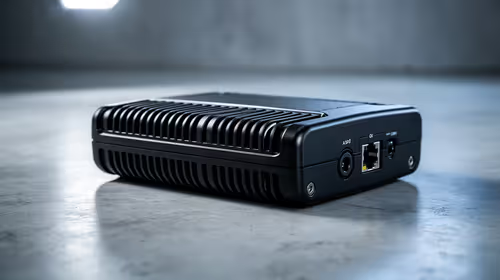
Discover what is passive PoE and how it streamlines outdoor router installations. Eliminate messy cabling and simplify your network setup with this efficient power delivery method. ⚡🌐
Read more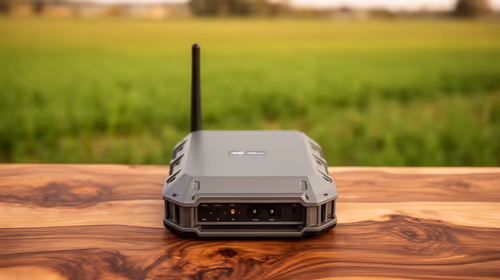
Need to extend internet coverage to outbuildings or farms? 📡 An outdoor 4G router is the ultimate solution for stable, high-speed connectivity in remote locations. Discover how to boost your range and stay connected anywhere on your property. 🌐
Read more
Wondering if a TKL wireless mechanical keyboard is worth it for everyday productivity? We break down latency, battery life, comfort, and workflow gains for real work. ⚡⌨️

Maximise battery life on a fanless 15-inch laptop using efficiency core architecture. Cut idle drain, tune power profiles, and improve thermals for longer runtime. 🔋⚙️

Learn how to reduce desk clutter with a TKL wireless keyboard using fewer cables, smart placement, and tidy essentials. Get a faster, calmer workspace with better ergonomics. ✅🧼

RGB keyboard lighting too distracting? Learn how to manage backlight modes, set brightness, and reduce distraction for focus and productivity 😌🖱️

Are themed gaming keyboards worth the extra cost? Compare build quality, switch options, features, and resale value to find the best fit for your setup 🎮⌨️

Full-Size vs Tenkeyless mechanical keyboards for gaming: find out if a smaller layout truly improves aim, speed, and comfort. We break down layout, desk space, latency-feel, and keybinds 🎮⌨️

Dedicated media rollers vs function key shortcuts: learn which setup gives you better workflow control, faster media access, and fewer mistakes. 🖱️🎧

Best Mechanical Switch Type for Gaming: Clicky vs Linear vs Tactile. Find your feel, speed, and noise balance with practical guidance for FPS, MOBA, and productivity 😄🎮

Direct mouse answer: Mouse not keeping up with your work? Everything that matters about dual-mode 2.4GHz + BT 5.0: DPI behaviour, channel switching, battery curves and per-app button mapping. Covers when 2.4GHz USB wins (low-latency desk) and when BT 5.0 wins (laptop, d

Plain wireless mouse guide: Mouse not keeping up with your work? Everything that matters about wireless productivity mouse: DPI behaviour, channel switching, battery curves and per-app button mapping. Includes DPI tuning tips, channel switch shortcuts, and ZAR-aware fea

Real productivity numbers: Set up your wireless mouse in this order: everything that matters about wireless productivity mouse: DPI behaviour, channel switching, battery curves and per-app button mapping. Includes DPI tuning tips, channel switch shortcuts, and ZAR-aware

Pen not feeling like paper? Stylus lag and skipping usually trace to old drivers, dirty nibs, or display refresh mismatches, not the pen itself. Covers pressure curve tuning, tilt thresholds, nib swap timing, and SA pricing brackets.