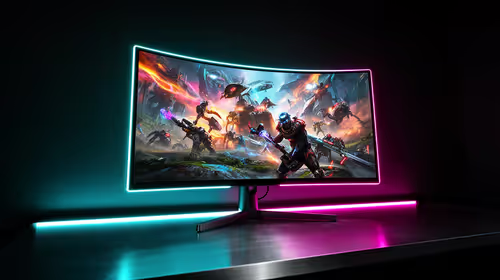
Stuttering gameplay and ugly screen tearing can ruin a perfect headshot or a beautiful open-world vista. It’s a massive frustration for any PC gamer in South Africa. The solution? Adaptive Sync. But that leads to the big question: FreeSync vs G-Sync? These two technologies promise silky-smooth visuals, but they work differently and come at very different price points. Let's break down the FreeSync vs G-Sync South Africa debate to find the perfect match for your rig.
What is Adaptive Sync, Anyway?
Before we dive into the brand battle, let's quickly cover the basics. Your graphics card (GPU) renders frames at a variable rate, while your monitor traditionally refreshes its image at a fixed rate (e.g., 60Hz, 144Hz). When these two are out of sync, you get screen tearing—that horrible horizontal line that makes it look like the screen is split.
Adaptive Sync technology solves this by allowing your monitor to adjust its refresh rate in real-time to match the frame rate of your GPU.
The result?
- No more screen tearing. ✨
- Dramatically reduced stutter.
- Smoother, more responsive gameplay.
Both FreeSync and G-Sync are types of Adaptive Sync. The main difference lies in how they achieve this magical smoothness.
G-Sync: The NVIDIA Premium Experience
NVIDIA's G-Sync is the veteran of the two. To earn the G-Sync badge, a monitor must have a dedicated hardware module installed. This chip handles the communication with your NVIDIA GeForce GPU, ensuring a flawless, premium experience. This rigorous certification process means if you buy a G-Sync monitor, you're guaranteed a high standard of performance with a wide variable refresh rate (VRR) range.
The catch? That proprietary hardware and licensing fee means G-Sync monitors are generally more expensive. It's the premium choice for gamers who want the absolute best performance from their NVIDIA card and are willing to pay for it. You can browse a wide variety of excellent PC monitors to see the difference in pricing firsthand.
FreeSync: AMD's Open Standard Challenger
On the other side of the G-Sync vs FreeSync ring is AMD's FreeSync. It’s built on VESA's Adaptive-Sync, which is an open standard. This means manufacturers don't need to install a special hardware module or pay hefty licensing fees, making FreeSync monitors significantly more affordable and widely available. 🚀
This accessibility is its greatest strength, and you can often find incredible value in our roundup of the best PC monitor deals. However, the open nature means performance can vary. To combat this, AMD introduced tiers:
- FreeSync: The basic tear-free experience.
- FreeSync Premium: Adds mandatory low framerate compensation (LFC) and at least a 120Hz refresh rate at FHD resolution.
- FreeSync Premium Pro: All the above, plus optimised support for HDR content.
The game changed when NVIDIA announced "G-Sync Compatible" monitors. These are essentially top-tier FreeSync monitors that NVIDIA has tested and certified to work well with their GPUs, giving GeForce users a fantastic, budget-friendly alternative.
NVIDIA User Pro Tip 🔧
Have a FreeSync monitor and an NVIDIA card? You might have a G-Sync Compatible display! Open the NVIDIA Control Panel, go to "Set up G-SYNC," and check the box for "Enable G-SYNC, G-SYNC Compatible." If your monitor isn't officially listed, you can still try enabling it for your specific display model, but performance may vary.
FreeSync vs G-Sync: The Head-to-Head for South Africa
So, which one should you choose? The decision in the FreeSync vs G-Sync South Africa showdown really boils down to your GPU and your budget.
- If you have an AMD Radeon GPU: Your choice is simple—get a FreeSync monitor. You'll get amazing value and a huge selection to choose from.
- If you have an NVIDIA GeForce GPU: You have more options. You can go for a premium G-Sync monitor for guaranteed top-tier performance, or you can opt for a much more affordable G-Sync Compatible (FreeSync) monitor that delivers a nearly identical experience.
Ultimately, the gap between the two has shrunk dramatically. A high-quality FreeSync Premium Pro or G-Sync Compatible screen offers an experience that is virtually indistinguishable from a native G-Sync display for most gamers. The key is to check reviews and ensure the monitor you choose performs well.
Beyond the Tech: What Else to Consider?
Choosing your adaptive sync tech is just one piece of the puzzle. The perfect gaming experience also depends on the panel itself. Whether you're aiming for the pixel-perfect clarity of high-end 5K and 4K monitors or the immersive sweep of ultra-wide curved monitors, adaptive sync will make the picture smoother.
Even on the go, smoothness matters. Some modern portable monitors now include basic adaptive sync features, perfect for a lag-free LAN party. And don't forget to complete your setup with the right cables and stands from our range of monitor accessories to get the most out of your new screen.
Ready to Banish Screen Tearing for Good?
The FreeSync vs G-Sync debate comes down to your GPU and budget. But no matter which team you're on, the perfect smooth-as-silk display is waiting for you. Explore our massive range of gaming monitors and find the perfect screen to conquer your world.