




IPS vs VA for Strategy and Sim Games in SA
IPS vs VA for strategy and sim games should be judged by fit, not a single winner. Compare compatibility, latency, capacity, upgrade path, cost planning, and South African setup needs.
Read moreGray Wood switches in the AULA WIN68 HE actuate at 32gf; Wing Chun switches in the WIN68 MAX need 36gf. Gray Wood bottoms out at 50gf and Wing Chun at 49gf, both over 3.4mm. The MAX pairs Wing Chun with 0.01mm Rapid Trigger, and Evetech carries both.
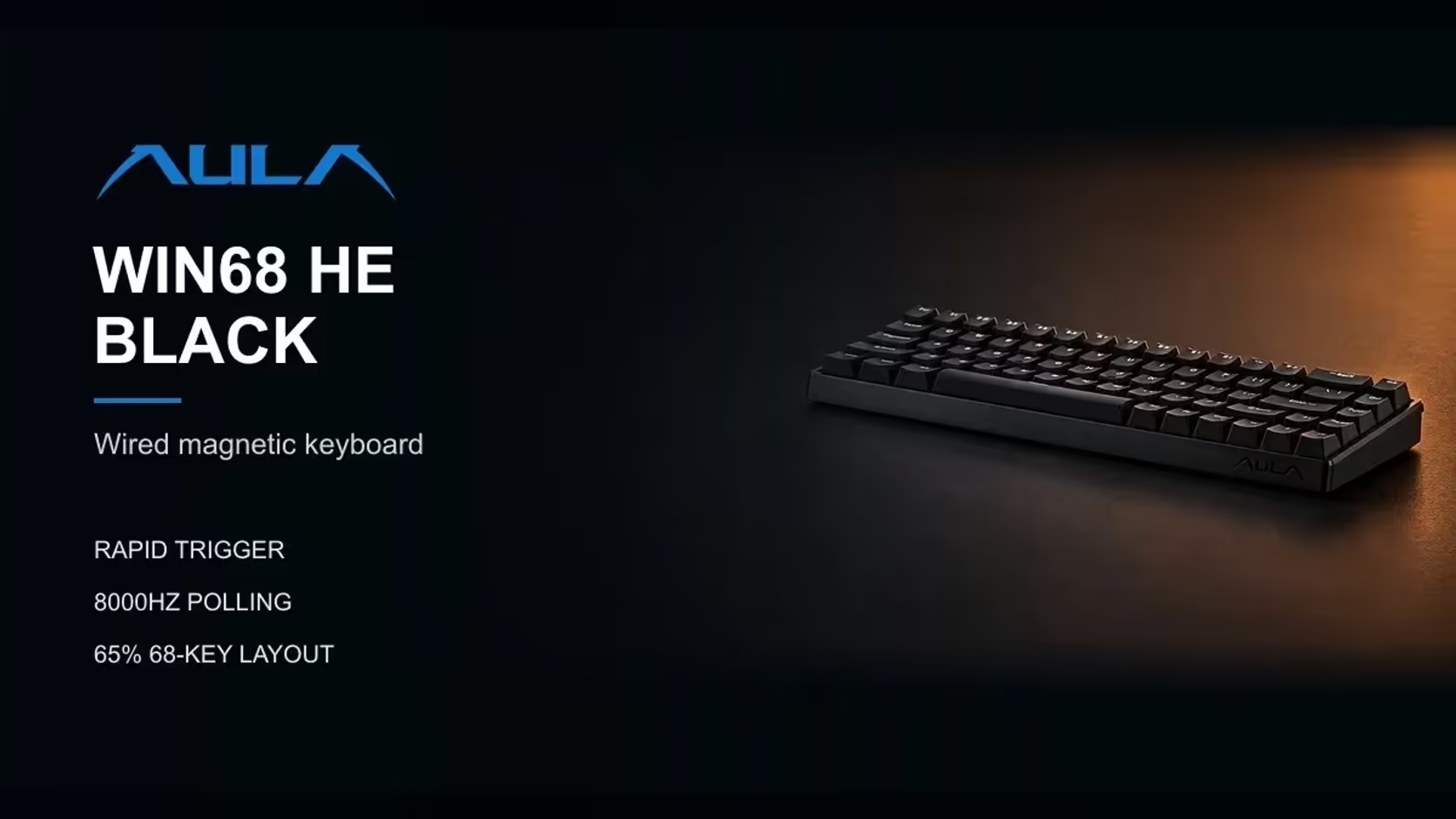
The WIN68 HE and WIN68 MAX are twins on the outside, so the choice between them often comes down to a question most buyers never think to ask: which magnetic switch do I want under my fingers? AULA fits Gray Wood vs Wing Chun switches to the pair, and while both are Hall Effect designs with the same travel, they differ in force, in how finely they can be tuned and in the kind of player they suit.
In the AULA WIN68 HE, each Gray Wood switch fires at 32gf and needs 50gf to bottom out. Wing Chun switches in the AULA WIN68 MAX fire at 36gf and hit 49gf at full depth. Both travel 3.4mm, and Evetech sells the HE for R449 and the MAX for R699. The MAX publishes finer control, with actuation adjustable from 0.1mm to 3.4mm and Rapid Trigger rated at 0.01mm, while the HE offers per-key actuation without published precision figures.
Both switches work the same way at heart. A standard mechanical switch registers when two metal contacts touch. A Hall Effect switch has a small magnet in the stem, and a sensor on the circuit board measures the magnetic field as the stem moves. Because the reading changes smoothly with depth, the keyboard knows how far the key is pressed, not just whether it is pressed.
That shared principle unlocks the features both WIN68 editions offer:
Because the sensor reads a field strength rather than a yes-or-no contact, small differences between individual magnets and sensors can shift readings slightly. That is why many magnetic boards include a calibration routine that relearns where each key's top and bottom sit. AULA's WIN68 pages do not describe one, so check the manual after any switch change. None of this variation is unique to either WIN68 switch; it comes with the technology.
So neither switch is more magnetic than the other. What separates them is how they are weighted and what AULA lets you do with the reading.
Force figures come in pairs: how much push is needed to register, and how much at the very bottom of the stroke.
The Gray Wood switch needs 32gf to register and 50gf to bottom out. That is a light opening with a noticeable build of 18gf towards the floor. The opening part of the press feels quick and easy; the end of the press pushes back firmly, which gives the finger a clear landing and a lively return.
The Wing Chun switch needs 36gf to register and 49gf to bottom out. It starts four grams heavier but climbs only 13gf to the floor, so the stroke feels more even from top to bottom.
For typing, the Gray Wood's light start rewards a soft touch but punishes a heavy hand with stray letters. The Wing Chun asks for a touch more intent, which some typists find more controlled. In games, the Gray Wood makes direction keys feel very eager, while the Wing Chun offers a parked finger more backing before anything fires. Neither is better outright; the difference is feel.
Travel is the same for both. Each stroke measures 3.4mm, give or take 0.1mm, which rules out a short-throw feel on either board.
This is where the published specification splits the pair.
On the WIN68 MAX, AULA gives firm numbers. Actuation adjusts from 0.1mm to 3.4mm, Rapid Trigger precision is 0.01mm, and the dead zone can be set to zero so keys respond across their full travel. The MAX also pairs its switches with extra modes including SOCD, DKS and Mod-Tap, and seven polling levels up to 8000Hz.
On the WIN68 HE, AULA confirms Rapid Trigger with actuation and release points adjustable per key, but publishes no range or precision figure. In daily use that is less limiting than it sounds: you still move each key's trigger point to suit it. What you lose is the ability to plan around exact numbers, and the MAX's competitive modes.
A useful way to think about it: the Gray Wood board gives you the core benefits of magnetic sensing, and the Wing Chun board gives you those plus a fully documented tuning range and the extra modes built around it.
For a newcomer moving from a membrane or standard mechanical board, the Gray Wood is the gentler introduction. It is light, forgiving of casual play and paired with a board that keeps the settings simple. For a player who already knows they want SOCD, zero dead zone and precise numbers, the Wing Chun and the MAX are the natural pick.
The decision is not permanent. Each board accepts replacement magnetic switches without soldering, and the HE ships with two spare Gray Wood switches plus a keycap puller. If you want to experiment further, Evetech's keyboard switch catalogue is the place to browse. Stick to magnetic switches in these sockets, as they sense a magnet rather than a contact.
Everything else between the two editions is shared: a 65% layout with 68 keys, 8000Hz polling over USB-C, per-key south-facing RGB and AULA's browser-based driver. Cover is identical too: Evetech attaches a 2 Years Local Warranty to each, and you can see them with other magnetic boards in the gaming keyboards category.
The Gray Wood. It registers at 32gf, four grams lighter than the Wing Chun's 36gf.
No. The stroke is 3.4mm on each, within a tenth of a millimetre.
Only the Wing Chun in the MAX, rated at 0.01mm. AULA gives no precision figure for the Gray Wood board.
The Gray Wood in the HE is the gentler starting point, with a light press and a simpler set of settings.
Yes. Both boards let you set actuation per key, but only the MAX publishes its range of 0.1mm to 3.4mm.
Magnetic. Both are Hall Effect switches that sense a magnet in the stem rather than closing a metal contact.
Know which switch feel you are after? Compare the Gray Wood and Wing Chun boards with other magnetic options in Evetech's gaming keyboard range and settle on your match.
The Gray Wood. It registers at 32gf, four grams lighter than the Wing Chun's 36gf.
No. The stroke is 3.4mm on each, within a tenth of a millimetre.
Only the Wing Chun in the MAX, rated at 0.01mm. AULA gives no precision figure for the Gray Wood board.
The Gray Wood in the HE is the gentler starting point, with a light press and a simpler set of settings.
Yes. Both boards let you set actuation per key, but only the MAX publishes its range of 0.1mm to 3.4mm.
Magnetic. Both are Hall Effect switches that sense a magnet in the stem rather than closing a metal contact.
IPS vs VA for strategy and sim games should be judged by fit, not a single winner. Compare compatibility, latency, capacity, upgrade path, cost planning, and South African setup needs.
Read more
Gen 5 NVMe SSD guide for Bloemfontein gamers should be shortlisted around the job it must do. South African buyers should compare capacity, speed, thermals, and motherboard support, warranty path, and upgrade room before treating any pick as best.
Read more
Skip the RTX 5070 if your first-time builder budget needs better balance. Better SA picks can free room for the right CPU, PSU, case, monitor, storage, and cooling while still giving a strong first gaming PC experience this year in South Africa.
Read more
RTX 5080: weighing the pros and cons for SA should be shortlisted around the job it must do. South African buyers should compare GPU tier, VRAM, cooling, and PSU headroom, warranty path, and upgrade room before treating any pick as best.
Read more
Core i5-13400F gives South African PC builders a capable mid-range CPU choice with clear limits. Check its gaming fit, discrete GPU requirement, LGA1700 platform costs, and upgrade path before locking in your parts list.
Read more
Pros and cons of the Wi-Fi 7 routers for SA should be shortlisted around the job it must do. South African buyers should compare WiFi standard, coverage, latency, and device support, warranty path, and upgrade room before treating any pick as best.
Read more
Steam content servers unreachable needs a download-path check, not an immediate reinstall of every game. Restart the client, inspect download settings and compare another connection when practical. Clearing the download cache is separate from deleting installed games.

Keychron G6 HE has built-in and swappable battery versions with different weights. The product brief lists 42g and 46g respectively, each with a 3g tolerance. Choose by grip and battery preference before treating one headline weight as universal.

Corsair HS80 v2 MAX supports 2.4GHz wireless and Bluetooth. Its maximum battery figures use RGB-off conditions and differ by connection. Check microphone routing, comfort and the exact device support before assuming every wireless mode behaves alike.

Windows taskbar notification badges can be shown or hidden in Taskbar behaviours. This changes the small app indicators, not the underlying messages. Choose a calmer desktop while keeping a deliberate routine for checking important conversations and app updates.
Windows taskbar notification badges can be shown or hidden in Taskbar behaviours. This changes the small app indicators, not the underlying messages. Choose a calmer desktop while keeping a deliberate routine for checking important conversations and app updates.

Windows USB device in use can mean a program still has the drive open. Finish transfers and close files before retrying ejection. Better performance caching requires safe removal; a replacement drive is not the first fix for an open-file warning.

Windows Nearby Sharing not working starts with feature, Bluetooth and visibility checks on both PCs. My devices only depends on matching Microsoft accounts. Test a small harmless file before buying networking hardware or changing your home router.

Windows hardware reserved RAM is different from memory used by applications. Compare installed memory with firmware detection and the usable amount before buying modules. Reservations and reporting limits vary by system; no universal setting restores every byte.

Windows title bar window shake can minimise other open windows when you shake the active window by its title bar. Inspect the Multitasking setting and switch it off if that gesture interrupts your work. The preference costs R0 and does not require new hardware.

Windows Print Screen opens Snipping Tool when its keyboard preference is enabled. Change the option under Accessibility, Keyboard to choose another workflow. Test whether you need a clipboard image or a saved file.

Windows desktop icons missing may be a visibility setting. Right-click the desktop, choose View and inspect Show desktop icons. If only system icons are absent, use Desktop icon settings. Check the Desktop folder before assuming files were deleted.

Windows set time zone automatically greyed out calls for a location and device-policy check. Automatic time-zone selection relies on location services. A manual time-zone choice is separate from synchronising the clock; check both before replacing hardware.