


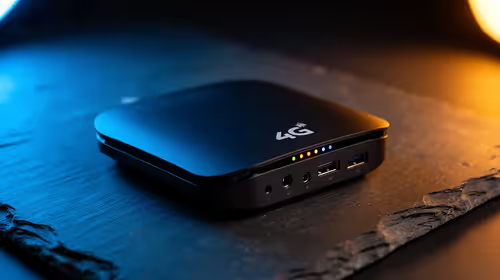
How to Use a Nano SIM 4G Router for Reliable Home Internet
Master using a Nano SIM 4G router as your primary internet solution. Get stable speeds and seamless connectivity for gaming and streaming at home! 🌐🚀
Read moreStruggling to choose between raw power and travel-friendly designs? We analyze handheld gaming PC performance to help you find the perfect balance. 🎮 Discover how battery life, weight, and cooling impact your on-the-go gaming experience. 🔋

Dreaming of playing Baldur's Gate 3 during load shedding or grinding in Warzone on the go? The new wave of handheld gaming PCs makes it possible. But before you splash the cash, there's a crucial choice to make. The battle between raw power and true portability is real, and picking the wrong side can ruin your experience. This guide explores the delicate balance of handheld gaming PC performance, ensuring you get the perfect rig for your needs.
At its core, every handheld gaming PC is a beautifully engineered compromise. Cramming a full-fat gaming experience into a device that fits in your hands means designers must make tough choices. Understanding these choices is key to finding the right device for you. The central conflict always comes down to handheld gaming PC performance versus battery life and ergonomics.
The heart of these machines is the APU (Accelerated Processing Unit), which combines the CPU and GPU. A more powerful APU delivers higher frame rates and prettier graphics but also generates more heat and drains the battery faster. It’s a constant tug-of-war between playing the latest AAA titles on high settings and having enough juice to last your whole commute. 🤔
If your goal is desktop-like performance on the move, you're looking for a device that prioritises power. These handhelds often feature top-tier APUs, high-refresh-rate screens, and robust cooling systems to handle the heat. They are designed to run demanding games at respectable settings, making them true portable powerhouses.
A prime example is the family of ASUS ROG Ally handhelds, which brought serious competition with its powerful AMD Z1 Extreme processor and a slick 120Hz display. Similarly, the new wave of Intel-powered devices, like the impressive MSI Claw gaming console, is pushing the boundaries of handheld performance even further. The trade-off? To unleash their full potential, you'll often need to be near a power outlet, as the battery can drain in as little as an hour under heavy load.
Most handhelds let you set a custom TDP (Thermal Design Power) limit in their software. For less demanding indie games, dropping the TDP from 15W to 10W or even 7W can dramatically extend your battery life without any noticeable impact on performance. It's the key to longer gaming sessions away from the plug!
On the other side of the spectrum are devices that lean into portability. While still incredibly capable, their design philosophy favours longer battery life, lighter weight, and more compact form factors. They might not run Cyberpunk 2077 with all the ray-tracing bells and whistles, but they are perfect for an extended session of Stardew Valley or Hades away from home.
This category is all about versatility. For instance, the unique design of the Lenovo Legion Go with its detachable controllers and larger screen offers a different kind of portability... a hybrid experience that mimics a tablet or even a small laptop. Optimising the performance of these handheld gaming PCs often involves using upscaling technologies like FSR or XeSS to get smooth frame rates without maxing out the hardware.
So, which path is right for you? The answer depends entirely on how you plan to play.
Ultimately, the best handheld gaming PC performance is the one that fits your lifestyle. Before making a final decision, it's worth taking a look at all the different handheld gaming consoles available in South Africa to compare specs and features side-by-side.
Ready to Find Your Perfect Match? The power vs portability debate is personal, but for the best advice and selection in South Africa, we've got your back. Explore our massive range of gaming promotions and find the perfect machine to level up your game, anywhere.
Yes, increasing TDP boosts framerates, but it significantly drains battery life and increases heat, requiring a balance for longer play sessions.
Devices like the Steam Deck OLED offer superior battery efficiency, while high-performance Windows handhelds often sacrifice longevity for raw power.
Weight is crucial; devices over 600g can cause wrist fatigue during extended sessions. Ergonomic grips help offset heavier high-performance models.
Generally, no. Most handhelds use integrated APUs. However, some support external GPUs (eGPUs) via USB4 or OCuLink for stationary performance boosts.
A 7-inch screen is the current standard, offering a good balance between visual immersion and keeping the device compact enough for travel cases.
Yes, powerful cooling systems add bulk and weight. Slimmer devices may suffer from thermal throttling, reducing sustained performance during AAA gaming.
Master using a Nano SIM 4G router as your primary internet solution. Get stable speeds and seamless connectivity for gaming and streaming at home! 🌐🚀
Read more
Confused by Cat4 vs Cat6 LTE routers? 🌐 We break down the technical differences to help you choose the right router for faster gaming and streaming. Get the speed you deserve today! 🚀
Read more
Learn how to setup a VPN server on your 4G LTE router to secure your remote access. Protect your data and browse safely from anywhere with our easy guide! 🌐🔐
Read more
Choosing the best 4G LTE router for South Africa ensures reliable internet when fibre is unavailable. Discover top connectivity tips for rural and urban areas. 🌐📶
Read more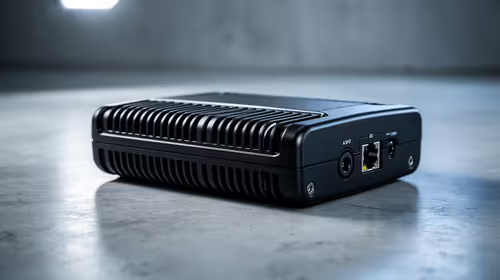
Discover what is passive PoE and how it streamlines outdoor router installations. Eliminate messy cabling and simplify your network setup with this efficient power delivery method. ⚡🌐
Read more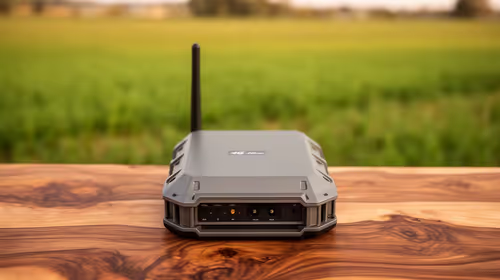
Need to extend internet coverage to outbuildings or farms? 📡 An outdoor 4G router is the ultimate solution for stable, high-speed connectivity in remote locations. Discover how to boost your range and stay connected anywhere on your property. 🌐
Read more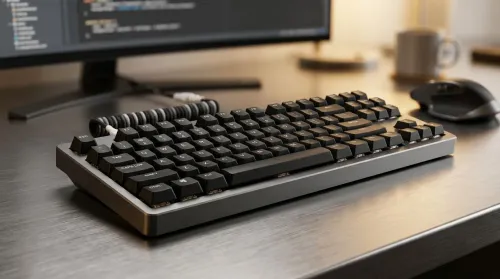
Wondering if a TKL wireless mechanical keyboard is worth it for everyday productivity? We break down latency, battery life, comfort, and workflow gains for real work. ⚡⌨️
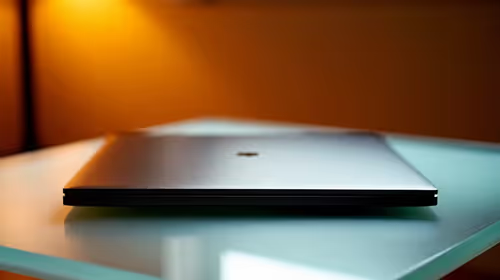
Maximise battery life on a fanless 15-inch laptop using efficiency core architecture. Cut idle drain, tune power profiles, and improve thermals for longer runtime. 🔋⚙️
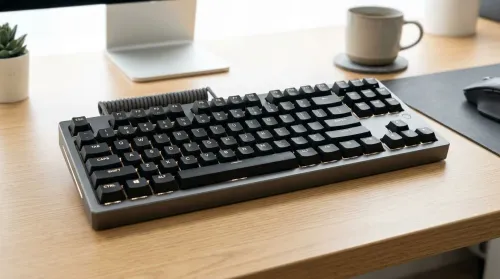
Learn how to reduce desk clutter with a TKL wireless keyboard using fewer cables, smart placement, and tidy essentials. Get a faster, calmer workspace with better ergonomics. ✅🧼
RGB keyboard lighting too distracting? Learn how to manage backlight modes, set brightness, and reduce distraction for focus and productivity 😌🖱️
Are themed gaming keyboards worth the extra cost? Compare build quality, switch options, features, and resale value to find the best fit for your setup 🎮⌨️
Full-Size vs Tenkeyless mechanical keyboards for gaming: find out if a smaller layout truly improves aim, speed, and comfort. We break down layout, desk space, latency-feel, and keybinds 🎮⌨️
Dedicated media rollers vs function key shortcuts: learn which setup gives you better workflow control, faster media access, and fewer mistakes. 🖱️🎧
Best Mechanical Switch Type for Gaming: Clicky vs Linear vs Tactile. Find your feel, speed, and noise balance with practical guidance for FPS, MOBA, and productivity 😄🎮
Direct mouse answer: Mouse not keeping up with your work? Everything that matters about dual-mode 2.4GHz + BT 5.0: DPI behaviour, channel switching, battery curves and per-app button mapping. Covers when 2.4GHz USB wins (low-latency desk) and when BT 5.0 wins (laptop, d
Plain wireless mouse guide: Mouse not keeping up with your work? Everything that matters about wireless productivity mouse: DPI behaviour, channel switching, battery curves and per-app button mapping. Includes DPI tuning tips, channel switch shortcuts, and ZAR-aware fea
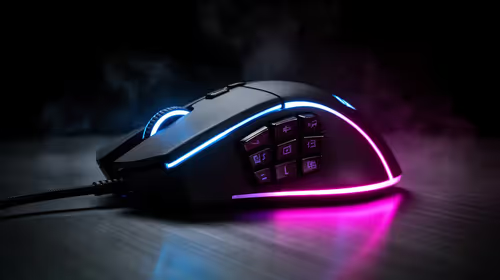
Real productivity numbers: Set up your wireless mouse in this order: everything that matters about wireless productivity mouse: DPI behaviour, channel switching, battery curves and per-app button mapping. Includes DPI tuning tips, channel switch shortcuts, and ZAR-aware
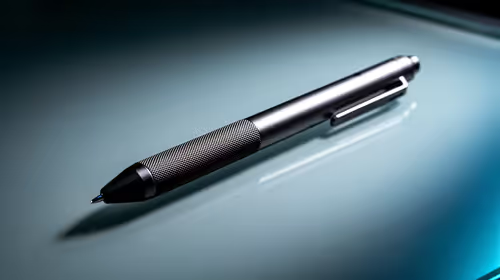
Pen not feeling like paper? Stylus lag and skipping usually trace to old drivers, dirty nibs, or display refresh mismatches, not the pen itself. Covers pressure curve tuning, tilt thresholds, nib swap timing, and SA pricing brackets.