South African content creators have more USB mixer choices than ever, but pricing in Rand spans a range wide enough to be genuinely confusing without a framework. The price brackets roughly correspond to capability tiers, and knowing which tier your setup needs means you spend on what matters rather than on features that sound impressive but go unused. All-in-one USB audio mixers in SA typically run from around R2,500 at the entry end to over R6,000 for prosumer configurations, and the features that separate each bracket are predictable once you have worked through them.
Quick Answer
Budget R2,500 to R3,500 for a single-XLR unit covering one host. A dual-XLR model with Bluetooth and onboard effects runs R4,500 to R5,500. Mixers above R6,000 add multitrack USB recording, more channels, or professional metering. Most streamers and podcasters land comfortably in the R3,500 to R5,000 bracket.
💰 The Entry Bracket: R2,500 to R3,500
At the lower end of this range you get a single-channel device: one XLR or combo input, one microphone at a time, USB audio output to a computer, and a basic headphone monitor output. Some units in this range include a simple mute button and a gain trim knob, which are the two controls that matter most for a solo streaming host.
What the entry bracket gives you that a standard USB microphone does not is a real gain stage with physical control. A USB microphone with a fixed gain chip clips when you get too close or raises the noise floor when you are in a quiet room; a mixer lets you adjust the gain trim to match the microphone and the environment. For a solo host who records in a single consistent location, that control is worth more than any single feature on a more expensive unit.
What you give up at this price point is a second input. If a guest ever joins you, either remotely through software routing or physically in the same room, a single-channel mixer cannot accommodate a second microphone without an additional device.
🎙️ The Mid Bracket: R3,500 to R5,500
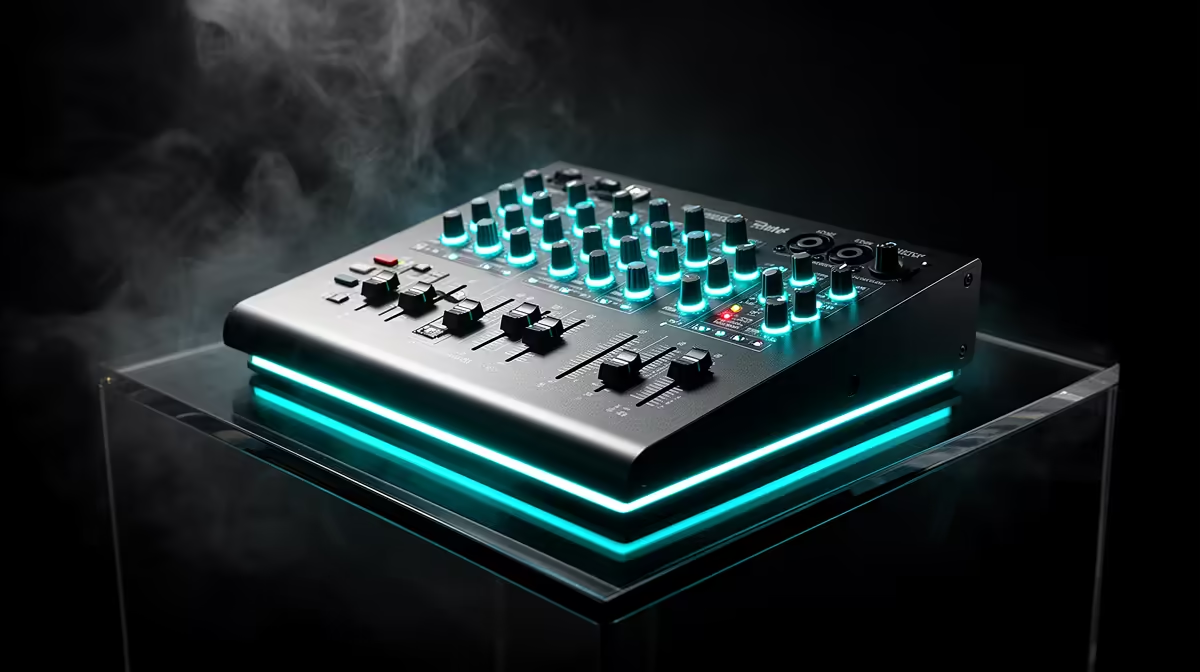
This is where most South African podcasters and streaming setups land, and the feature set reflects it. Dual XLR combo inputs, individual phantom power switching, Bluetooth for phone audio, USB stereo output, and a bank of sound mode presets are all standard at R4,500 to R5,500.
The second XLR input unlocks co-host and guest recording on a single unit. Both microphones go into one box, each with its own gain trim and fader, and the USB output sends a blended mix to the recording software. No virtual audio routing, no software stitching of two separate devices, just two mic signals in and one clean stereo mix out.
Onboard reverb and sound mode processing in this bracket is genuinely useful for live streams, where there is no post-production stage to apply EQ. Voice mode presets lift presence and add light compression on the mic channel, so a passable recording space produces a more broadcast-ready result than it would through a flat signal chain.
What Separates R3,500 from R5,500 in This Band
A R3,500 unit in this bracket typically shares phantom power across both channels from one rail. A R5,500 unit switches phantom per channel and usually includes a proper 2-inch LCD for level monitoring. The per-channel phantom control matters if one input runs a condenser and the other a dynamic or an instrument. The LCD matters if you want to verify levels without keeping a software meter open on screen.
Pro Tip ⚡
Before buying in this bracket, confirm the EIN specification, not just the gain range. A unit claiming 60dB of gain is useless if the noise rises sharply above 45dB. Look for -128dBu EIN or lower. That single figure predicts whether the mixer sounds clean at the gain settings your specific microphone actually needs.
🔥 Above R6,000: What the Premium Adds
Units above R6,000 push into features that matter for professional or advanced production rather than streaming. Multitrack USB recording, where each input channel is sent as a separate mono stream rather than blended into a stereo mix, is the most valuable addition for anyone who edits audio seriously. Post-production control over individual voices becomes possible, including individual EQ, noise reduction, and level adjustment without affecting the other channel.
Additional channel count also appears at this level. A four-channel unit allows two hosts, a call-in guest feed, and a backing track on separate faders simultaneously. For a long-running podcast with regular guests or a production that records music alongside speech, that flexibility justifies the premium.
Better metering and larger physical controls also come in at this price point: peak indicators per channel, clip lights, and higher-quality potentiometers that track more precisely and last longer under daily use.
🧠 Budgeting a Full Two-Mic Setup
The mixer price is only part of the total cost. A complete two-host setup from scratch in SA typically breaks down as follows: a dual-XLR mixer in the R4,500 to R5,500 range, two dynamic microphones at around R800 to R1,500 each depending on model, two mic stands at R250 to R500 each, and XLR cables at around R150 to R300 per cable. Total cost for a functional two-host setup sits roughly in the R7,000 to R9,000 band.
Prioritising the mixer over the microphones is sensible up to a point, since a noisy preamp cannot be fixed in post and a microphone upgrade always can be deferred. Beyond that, both components matter and neither should be sacrificed entirely.
Frequently Asked Questions
How much does the cheapest capable USB mixer cost in South Africa?
Single-XLR units with USB audio output and a headphone monitor start at around R2,500 to R3,000. At that price point you get physical gain control that no fixed-gain USB microphone can offer, but Bluetooth and a second input are generally absent.
How much should I expect to pay for a dual-XLR mixer with effects?
In SA, a dual-XLR unit with Bluetooth audio input, onboard reverb, sound mode presets, and phantom power sits between R4,500 and R5,500. Units at the lower end of that band share phantom across both channels; units at the upper end switch it individually and often include an LCD for level monitoring.
Why do some USB mixers cross R6,000?
Multitrack USB recording, additional input channels, better metering, and higher-quality potentiometers account for most of the price jump beyond R6,000. For streaming and podcasting on one or two mics, those features rarely justify the premium. For edited audio production with multiple hosts or regular guest recording, multitrack in particular earns its cost.
Is a R2,500 unit good enough to start podcasting?
Yes for a single-host format. It provides real gain control and a mute button, both of which a fixed-gain USB microphone does not offer. The limitation is channel count, not quality. If there is any chance a co-host joins later, stretching the budget to the R4,500 to R5,500 dual-XLR band from the start avoids replacing the unit sooner than necessary.
Does a higher price guarantee cleaner audio output?
Not automatically. Price is a rough guide to features, not to noise floor performance. A R3,500 unit with a -128dBu EIN preamp can produce a cleaner signal than a R5,500 unit with poor gain stage design. Check the EIN specification explicitly rather than relying on price alone as a quality indicator.
Ready to find the right USB mixer for your budget and your setup?
Browse the full USB audio mixer range at Evetech and compare models from entry single-XLR units to dual-channel prosumer configurations built for South African content creators.