Quick Answer
Adjust tilt sensitivity by opening your tablet driver's tilt settings, setting the tilt angle range between 40 and 60 degrees for most users, and mapping tilt to brush size or opacity in your drawing app. A 60-degree tilt range most closely mimics the feel of a pencil shading at an angle on paper.
What Tilt Sensitivity Does and Why It Matters ✏️
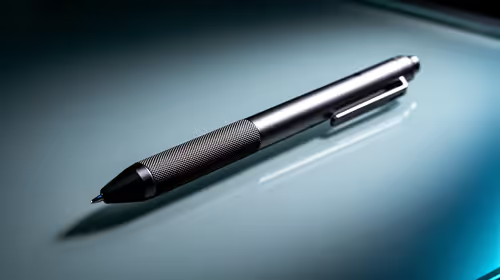
Tilt sensitivity measures the angle at which your pen leans relative to the tablet surface. When a stylus with tilt support (such as the Wacom Pro Pen 2 or XP-Pen Artist models) detects a lean, it reports that angle to the drawing software. Brushes configured to respond to tilt can widen their stroke, shift opacity, or rotate a texture to simulate a pencil shading on its side. Without tilt support, you'd need to manually adjust brush size to achieve the same shading variety, which interrupts the drawing flow. Most current tilt-supporting tablets report up to 60 degrees of tilt in any direction, which is enough to replicate the full range of pencil angles used in traditional art.
Setting Up Tilt in Driver and App Settings 🔧
In the Wacom driver, locate the "Pen" tab and check that tilt sensitivity is enabled. For XP-Pen and Huion, open the driver panel and look under the advanced or pen settings section for a tilt slider. Set the tilt threshold to around 10 to 15 degrees so that minor unintentional pen leans don't trigger the effect. In Clip Studio Paint, go to the brush tool's property panel, find the "Brush Size" or "Opacity" parameter, and add "Tilt" as a secondary input source. In Krita, open the brush editor, click the relevant parameter (size, opacity), and enable tilt under input options. Photoshop supports tilt for brush size in the brush settings panel under "Shape Dynamics"; set Control to "Tilt".
Replicating Paper Feel With Tilt 📝
To mimic a 2B pencil shading on paper, choose a round or flat graphite brush in your drawing app and set its width to respond to tilt at 70 to 100 percent sensitivity, and its opacity to pressure at 50 to 80 percent. Then hold the stylus at roughly 30 to 45 degrees from the vertical (the natural angle for shading with a pencil) and sweep broad strokes. The brush should widen and soften as you tilt further. For note-taking on a Windows tablet, the Microsoft Pen Protocol supports tilt and Windows Journal or OneNote can respond to it when a compatible stylus is used, making handwritten notes look more like pen-on-paper. Students and illustrators in South Africa using tablets in the R1,200 to R3,000 range will find full tilt support on most mid-range and above tablets from Wacom and XP-Pen.
Tilt for Left-Handers ⚡
If you are left-handed, rotate your tablet 180 degrees so the USB port faces the opposite side, then adjust the driver's orientation setting to match. Tilt response is direction-dependent, so this ensures leaning in your natural shading direction produces the correct widening effect rather than narrowing it.
FAQ
Not all stylus pens support tilt. How do I check if mine does?
Check the product specifications for "tilt support" or a tilt angle value (e.g. "60 degrees tilt"). If no tilt angle is listed, the pen likely does not support it. The driver panel will also show tilt settings only if the hardware supports the feature.
Does tilt sensitivity affect note-taking, or is it only useful for illustration?
Tilt improves note-taking too. In apps like GoodNotes and Notability, tilt can make handwritten strokes vary in width naturally, making notes easier to read and more visually organised without changing any settings manually.
What is the minimum tilt range I should look for in a tablet stylus?
Forty-degree tilt recognition covers most drawing needs. Sixty degrees is better for artists who shade at very low angles, mimicking the broadside of a pencil tip.
Want a more natural writing and drawing experience?
Browse Evetech's drawing tablets with full tilt support, covering everything from student-friendly entry models to professional-grade setups, all stocked locally in South Africa.