Quick Answer
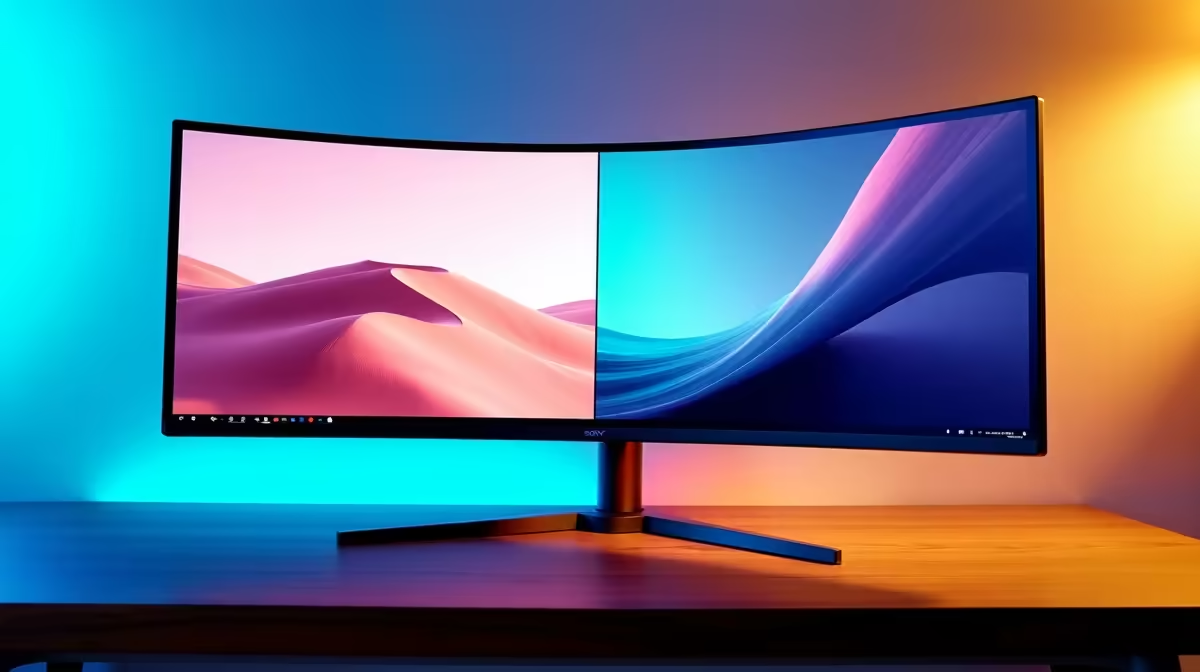
Calibrate your ultrawide WQHD monitor by resetting to factory defaults first, then setting brightness to 120 cd/m2 for gaming or 80 cd/m2 for daytime office work, colour temperature to 6500K, and gamma to 2.2. Confirm native resolution is 3440x1440 in Windows Display Settings. Free tools like DisplayCAL with a budget colorimeter deliver accurate results without a professional calibrator.
Factory Reset First 🔧
Before touching OSD sliders, perform a full factory reset via the monitor's OSD menu. Out-of-box settings drift during shipping and showroom warm-up cycles. Disable any preset modes labelled Vivid, Cinema, or Racing: these boost saturation in ways that skew colour accuracy for productivity. Set the mode to sRGB or Standard, confirm the colour space is not forced to DCI-P3 unless your workflow demands it, and keep the backlight below 50 percent before measuring. A 34-inch WQHD IPS ultrawide shows near-true colours once preset modes are cleared.
Brightness, Contrast, and Gamma 🖥️
Set brightness to 120 cd/m2 for a dark gaming room and 80 cd/m2 for an office with SA afternoon light streaming in. Contrast on IPS ultrawides should stay near factory default (50 to 60 percent): raising it clips whites without recovering real dynamic range on an SDR panel. Use gamma 2.2, the standard for SDR Windows content and most games. Colour temperature at 6500K, also labelled D65 or Warm in some OSD menus, matches the white point used by game engines and photo software. SA users in bright offices sometimes prefer 6800K to reduce daytime eyestrain, switching back to 6500K for colour-critical work. Many 34-inch WQHD models in the R7,000 to R14,000 range locally include per-channel RGB gain sliders for fine-tuning.
Gaming-Specific Tweaks 🎮
Enable the monitor's variable refresh rate (FreeSync Premium or G-Sync Compatible) and confirm it is active in the GPU driver panel. Set pixel response to the fastest usable setting (often Faster rather than Fastest to avoid inverse ghosting). Confirm your game supports 21:9 natively in its resolution list: titles like Cyberpunk 2077, Red Dead Redemption 2, and most modern FPS games support 3440x1440. Keep HDR disabled unless the monitor carries DisplayHDR 600 certification or higher; most entry WQHD ultrawides produce washed-out HDR due to insufficient peak brightness.
Calibrate After 30 Minutes Warm-Up ⚡
LCD backlights shift colour temperature during the first 20 to 30 minutes of operation. Always let the monitor warm up fully before taking brightness or colour readings. Setting brightness at cold-start can result in values 10 to 15 percent off once the panel stabilises, which causes frustration for SA photographers when print colours do not match screen colours.
FAQ
Do I need a hardware colorimeter to calibrate a WQHD ultrawide?
For gaming and general productivity, the free Windows Display Colour Calibration wizard is adequate. A mid-range colorimeter (R1,200 to R2,000 locally) with DisplayCAL adds meaningful accuracy for photo editing and colour work.
Why does my ultrawide look stretched in some apps after calibration?
Stretching is a resolution or aspect ratio mismatch, not a calibration issue. Confirm native resolution is 3440x1440 in Windows Display Settings and that the application is not forcing a 16:9 output mode.
How often should I recalibrate a WQHD ultrawide?
For colour-critical work, every three to six months. LCD backlights drift over time. For pure gaming, yearly or after any major OSD adjustment is sufficient.
Ready to upgrade to ultrawide WQHD?
Browse 34-inch and wider WQHD ultrawide monitors at Evetech, stocked locally with fast SA delivery and full warranty support.