


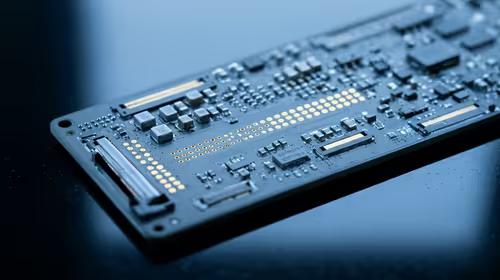
Hot-Swappable PCB Architecture in Modern Keyboards: Guide
Learn hot-swappable PCB architecture in modern keyboards—what it is, how sockets and traces work, and how to pick the right board. Speed up swaps, reduce risk, and upgrade faster 🔧⚡
Read moreStep-by-step setup for choose a rand-conscious e-atx case without paying for unused features covers cabling, settings and the SA-specific gotchas Evetech customers hit on this build. ZAR price bands, SA Evetech stock notes and the gotchas specific to choose a rand-cons.
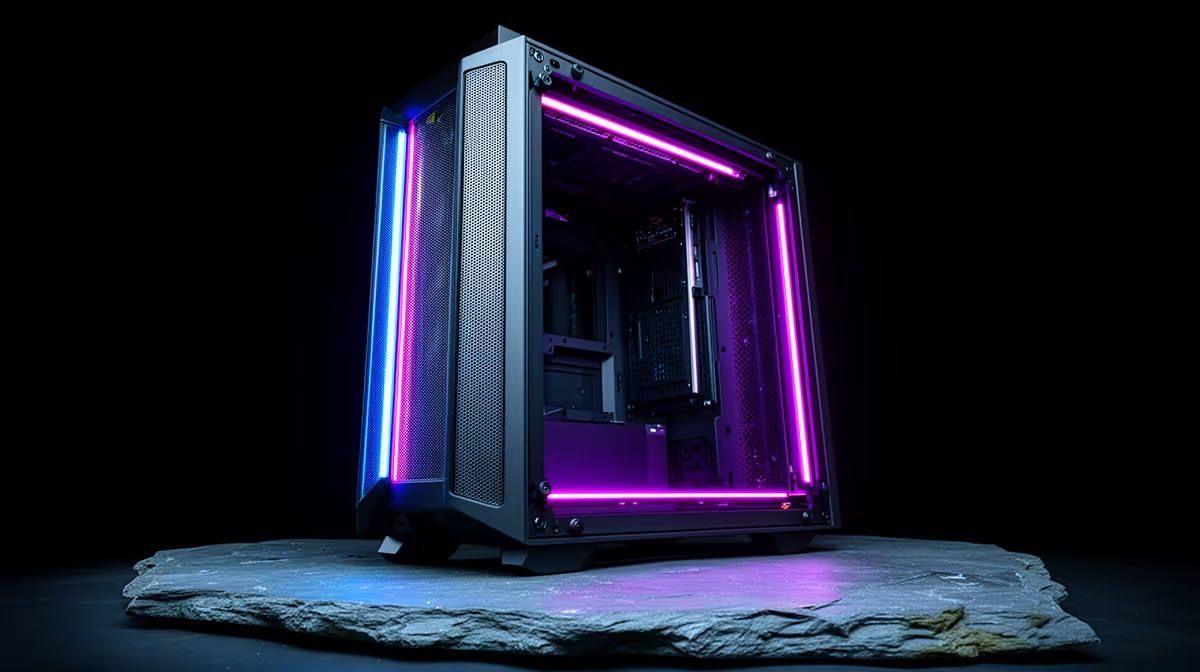
Focus on the specs your build actually uses: confirm the E-ATX motherboard dimensions match the case's declared support, check GPU length and CPU cooler height clearances, then ignore premium upsells like built-in LCD displays, argb hubs, or vertical GPU risers if you have no plans to use them. A solid E-ATX mid-tower from brands stocked at Evetech can be had in the R2,000 to R3,800 range without paying for those extras.
E-ATX is not a fixed standard. Motherboards labelled E-ATX range from 305mm x 277mm all the way up to 305mm x 330mm. Before shortlisting a case, measure or look up your board's exact dimensions on the spec sheet. A case rated for E-ATX might only clear 280mm wide boards, which would block some high-end HEDT or AMD Threadripper Pro boards.
Once you have the board dimensions confirmed, GPU length clearance is next. Current triple-fan RTX 5080 and RX 9070 XT cards run between 310mm and 360mm long. Verify the case's advertised GPU clearance, not just the category label.
Not every premium E-ATX feature is a waste. GPU sag brackets or integrated braces are genuinely useful when housing an RTX 5090 Founders Edition style card that weighs over 2kg. PSU shrouds with cable management channels save hours of cleanup and improve airflow in the lower chamber, which is worth the small price premium. Removable drive trays matter if you run multiple SSDs or HDDs in a NAS-adjacent workstation build.
What you can often skip: case-integrated USB 3.2 Gen 2x2 hubs if your motherboard already has front panel headers for those speeds, proprietary RGB controller hubs that lock you into a single ecosystem, and built-in fan controllers if you already manage fan curves in BIOS. Skipping these can save R400 to R800 on equivalent-quality cases.
Create a short checklist before shopping: motherboard width and length, GPU length, CPU cooler height limit, radiator support size needed (240mm, 360mm, or 420mm), drive bay count, and front panel IO requirements (USB-C, USB-A speeds). Run each candidate case through this list. Any case that fails even one hard requirement drops out immediately, regardless of aesthetics or brand.
SA builders ordering from Evetech can filter by form factor in the cases category and compare specs side by side before adding to cart. Cases in the R2,500 to R4,500 range cover 90 percent of E-ATX builds with quality materials and adequate cooling support.
Download the motherboard manual PDF and note the exact PCB dimensions, then cross-check against the case spec sheet's declared maximum board width. A 5mm mismatch discovered after delivery means a return, and local courier turnaround adds days to your build timeline.
For pure gaming, standard ATX is almost always sufficient and saves R500 to R1,500 on case costs. E-ATX makes sense for dual-CPU workstation boards, extreme overclocking platforms, or HEDT motherboards with more PCIe slots than standard ATX allows.
Most E-ATX mid-towers allow 165mm to 185mm cooler height. High-end dual-tower air coolers like the Noctua NH-D15 stand 165mm tall, which clears most options. Confirm the case's specific limit before ordering a cooler that sits near the maximum.
Budget E-ATX cases start around R1,800 but often lack proper cable management routing. The practical sweet spot for quality builds is R2,500 to R4,000, covering tempered glass panels, good airflow layout, and metal construction that won't flex during transport.
Ready to find the right E-ATX case for your build? Check the full selection of full-tower and E-ATX-compatible mid-tower cases at Evetech, with specs listed so you can match before you buy.
Learn hot-swappable PCB architecture in modern keyboards—what it is, how sockets and traces work, and how to pick the right board. Speed up swaps, reduce risk, and upgrade faster 🔧⚡
Read more
Mechanical switch lifespan explained—what the 50 million keystroke rating really means, plus tips to extend switch life and reduce double-press issues 🔧⌨️
Read more
60-percent vs full-size mechanical keyboard layouts—learn what each layout includes, who it suits, and how to choose the right fit 🧩⌨️ for typing, gaming, and productivity.
Read more
Double injection keycaps last far longer than standard printed keycaps in most setups. Learn typical lifespan ranges, what shortens them, and how to maximize durability for smoother daily typing and gaming 😊⌨️
Read more
Full-key anti-ghosting: does it stop missed inputs during fast-paced gaming? We break down latency, polling, and key matrix limits so you can buy smarter 🎮⚡
Read more
Protect mechanical keyboard switches from South African dust and summer humidity with practical cleaning and storage habits. Keep your switches smooth, reduce failures, and extend lifespan. 🌬️💧
Read more
Wondering if a TKL wireless mechanical keyboard is worth it for everyday productivity? We break down latency, battery life, comfort, and workflow gains for real work. ⚡⌨️

Maximise battery life on a fanless 15-inch laptop using efficiency core architecture. Cut idle drain, tune power profiles, and improve thermals for longer runtime. 🔋⚙️

Learn how to reduce desk clutter with a TKL wireless keyboard using fewer cables, smart placement, and tidy essentials. Get a faster, calmer workspace with better ergonomics. ✅🧼

RGB keyboard lighting too distracting? Learn how to manage backlight modes, set brightness, and reduce distraction for focus and productivity 😌🖱️

Are themed gaming keyboards worth the extra cost? Compare build quality, switch options, features, and resale value to find the best fit for your setup 🎮⌨️

Full-Size vs Tenkeyless mechanical keyboards for gaming: find out if a smaller layout truly improves aim, speed, and comfort. We break down layout, desk space, latency-feel, and keybinds 🎮⌨️

Dedicated media rollers vs function key shortcuts: learn which setup gives you better workflow control, faster media access, and fewer mistakes. 🖱️🎧

Best Mechanical Switch Type for Gaming: Clicky vs Linear vs Tactile. Find your feel, speed, and noise balance with practical guidance for FPS, MOBA, and productivity 😄🎮

Direct mouse answer: Mouse not keeping up with your work? Everything that matters about dual-mode 2.4GHz + BT 5.0: DPI behaviour, channel switching, battery curves and per-app button mapping. Covers when 2.4GHz USB wins (low-latency desk) and when BT 5.0 wins (laptop, d

Plain wireless mouse guide: Mouse not keeping up with your work? Everything that matters about wireless productivity mouse: DPI behaviour, channel switching, battery curves and per-app button mapping. Includes DPI tuning tips, channel switch shortcuts, and ZAR-aware fea

Real productivity numbers: Set up your wireless mouse in this order: everything that matters about wireless productivity mouse: DPI behaviour, channel switching, battery curves and per-app button mapping. Includes DPI tuning tips, channel switch shortcuts, and ZAR-aware

Pen not feeling like paper? Stylus lag and skipping usually trace to old drivers, dirty nibs, or display refresh mismatches, not the pen itself. Covers pressure curve tuning, tilt thresholds, nib swap timing, and SA pricing brackets.