Quick Answer
Thermal throttling occurs when a CPU or GPU exceeds its safe temperature threshold, typically 95 to 100 degrees Celsius for CPUs and 83 to 87 degrees Celsius for modern GPUs, and reduces clock speeds to lower heat output. SA gamers face elevated ambient temperatures that push components toward these thresholds faster than in cooler climates. The solution combines adequate case airflow, quality thermal interface material, and fan curves tuned for SA ambient conditions.
Why SA Summers Accelerate Throttling 🌡️
CPU and GPU coolers maintain a temperature delta above ambient. A cooler holding a 40-degree Celsius delta keeps a CPU at 60 degrees in a 20-degree room, but 75 degrees in a 35-degree SA summer environment, already close to throttle territory under gaming load. Add a GPU like the RTX 5080 generating 320W in the same enclosure, and throttling during extended Elden Ring or competitive gaming sessions becomes almost inevitable without proper airflow.
The single most effective intervention is maximising case airflow: enough fresh air in and hot air out that CPU and GPU coolers operate on air close to room temperature rather than the 45 to 55-degree interior of a poorly ventilated build.
Practical Anti-Throttle Fan Configuration 🔧
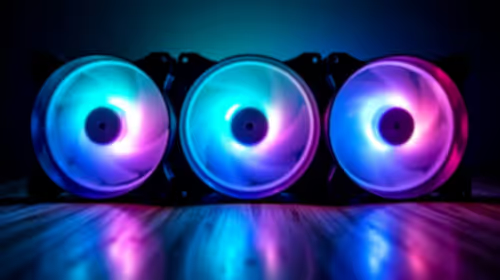
For a standard ATX gaming build targeting sustained performance through SA summers, use three 120mm intake fans at the front plus one rear exhaust. Set all intake fans to the same PWM curve on a CPU temperature trigger. Target intake airflow of 150 to 200 CFM total from three front fans running 50 to 60 CFM each at full speed. This keeps CPU temps 5 to 10 degrees lower than a two-fan setup at the same ambient, translating directly to fewer throttle events during two-hour summer gaming sessions.
Thermal Paste and Cooler Maintenance 💰
Fan configuration alone cannot compensate for dried thermal paste. A CPU with dried compound two or more years old can run 10 to 15 degrees hotter than the same chip with fresh paste. In SA's thermal cycling environment, paste degrades faster than in stable-temperature climates. Reapply quality compound like Thermal Grizzly Kryonaut or Noctua NT-H2 annually for high-performance rigs. At R200 to R400 for a syringe, it is the cheapest performance upgrade available. Combined with a three-fan intake setup using PWM 120mm fans at R200 to R350 each locally, you can recover 10 to 15 frames per second in throttle-limited scenarios.
Set Fan Curves for SA Summer Ambient, Not European Defaults ⚡
Most motherboard fan curve presets assume a 20 to 22-degree Celsius ambient room temperature. In a SA summer home reaching 28 to 32 degrees indoors, these presets start fans too late. Shift your ramp start from 50 degrees to 45 degrees CPU temp and reach full speed by 75 degrees rather than 85 degrees. This proactive ramp prevents throttling before it starts.
FAQ
Will adding more fans eliminate GPU throttling, or only CPU throttling?
Improved case airflow reduces GPU temperatures by 3 to 8 degrees in a well-ventilated case, which reduces throttle frequency. However, GPU throttling is also controlled by the GPU's own fan curve. Ensure your GPU fan curve is set aggressively enough for SA summer conditions.
Is undervolting my CPU or GPU safe for SA gaming?
Yes. Undervolting reduces heat without reducing performance in most cases. Ryzen 9000-series CPUs and RTX 50-series GPUs both support safe voltage reduction through BIOS or driver tools. A 50 to 100mV undervolt can reduce peak temperatures by 5 to 10 degrees, buying significant thermal headroom in hot SA environments.
How do I know if my PC is actually throttling during gaming?
Use monitoring software to log CPU and GPU clock speeds during gaming. If your CPU drops from its rated boost clock to base clock during extended play, throttling is occurring. GPU throttling appears as frame time spikes rather than consistent FPS drops.
Losing frames to thermal throttling during SA summer gaming sessions?
Browse PWM case fans, AIO coolers, and thermal compound at Evetech to build a cooler, faster rig.