Quick Answer
For front 420mm radiator placement, mount it as an intake to push cool outside air over the CPU coldplate. For top 420mm placement, mount it as exhaust to expel hot air from the case. Cases supporting both simultaneously allow the current ceiling of consumer AIO cooling performance.
Front vs Top 420mm Placement: The Core Trade-Off 🔧
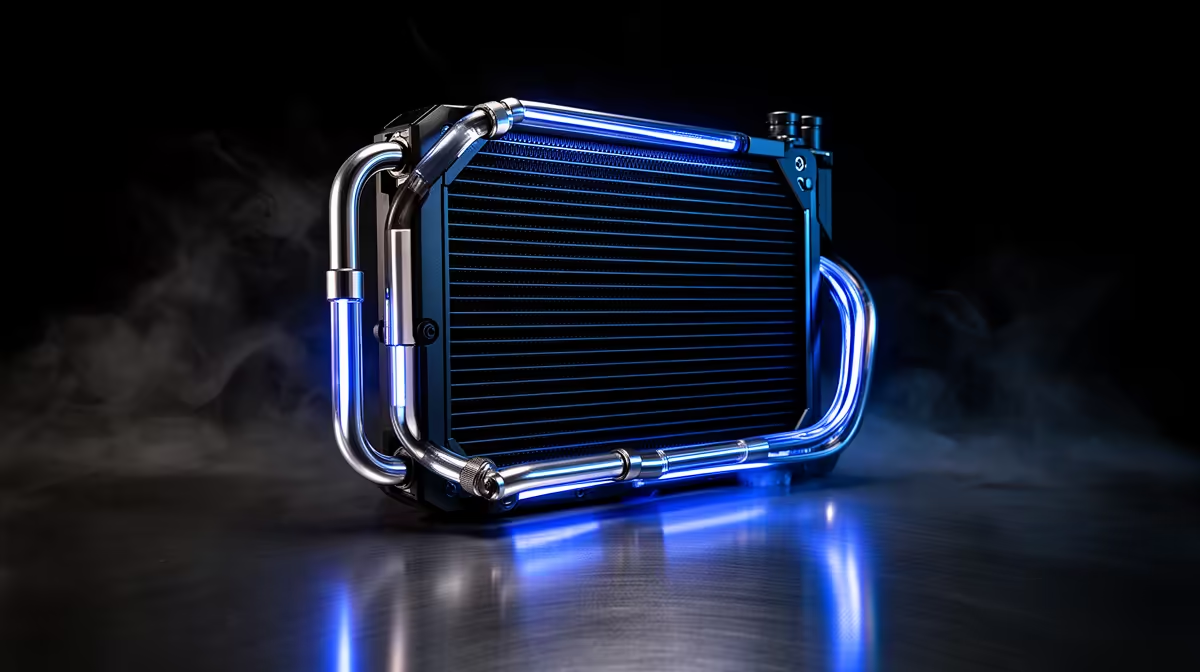
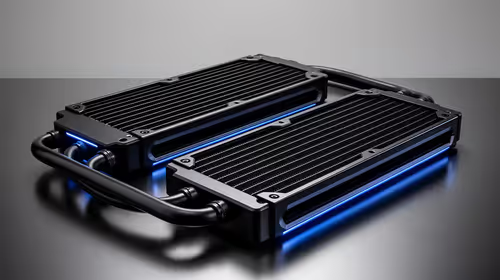
A 420mm radiator (three 140mm fans wide) is the largest common AIO or custom loop radiator size in consumer cases. Front intake means outside ambient air, the coldest available, passes through the radiator before entering the case. This maximises radiator efficiency because it always sees the lowest possible air temperature. The drawback is that the radiator dumps heat into the case interior, slightly warming air that reaches the GPU. For a CPU-only cooling loop, this is acceptable since GPU cards have their own intake from below. Top exhaust means case air (already warmed by GPU and VRM heat) passes through the radiator. This is slightly less efficient for the CPU but keeps heat entirely out of the case, benefiting the GPU. For a combined CPU and GPU water-cooling loop, the top exhaust position is preferred.
Clearance and Compatibility Checks 📐
Before ordering a 420mm AIO, measure three clearance points. First, front radiator depth: some cases have a front mesh-to-motherboard tray distance of only 30 to 35mm, insufficient for a 30mm-thick radiator with fans (68mm total). Cases like the Lian Li O11D EVO XL and Corsair 7000D provide 55 to 80mm front clearance. Second, top clearance: check the distance from the top radiator mount to RAM slots on your motherboard. Tall DDR5 heat spreaders can conflict with top-mounted radiators in mid-tower cases. Third, radiator length: a 420mm radiator is 441 to 456mm long and requires the front or top panel to be at least that length. Confirm your case explicitly supports 420mm rather than only 360mm.
Filling a Dual-Radiator Layout 🌡️
If your case supports front and top 420mm simultaneously (Phanteks Enthoo 719, Corsair 7000D), you can run two AIOs or a custom loop through both radiators in series. A dual-420mm custom loop handles an RTX 5090 plus Ryzen 9 9950X at 75 to 80 degrees Celsius under full combined load. Custom loop components add R4,000 to R10,000 on top of radiator cost. Compatible cases for dual-420mm builds are stocked at Evetech from around R3,500 to R8,000.
Orient Pump Head Below the Radiator ⚡
For a front-mounted 420mm AIO, ensure the pump head sits lower than the radiator top. Air bubbles rise and must exit into the radiator, not collect in the pump. Mounting the radiator higher than the CPU coldplate with tubes going upward achieves this orientation naturally and prevents long-term pump noise from air gurgling through the pump chamber.
FAQ
Does a 420mm radiator cool better than a 360mm for overclocked CPUs?
Yes, measurably. A 420mm has 17 percent more surface area than a 360mm. For an overclocked Ryzen 9 9950X pushing 200 to 250W TDP, the 420mm keeps temperatures 5 to 10 degrees Celsius lower at the same fan speed, translating to quieter operation or sustained higher boost clocks.
Can a 420mm AIO fit in a mid-tower case?
Very few mid-towers support 420mm radiators. The Lian Li Lancool III and Fractal Meshify 2 XL are exceptions. Most standard mid-towers cap at 360mm. Check specifications carefully, as some manufacturers list 420mm for front-only mounting even in cases that feel mid-tower sized.
Is a 420mm AIO overkill for a Ryzen 7 9800X3D?
For gaming only, a 280mm AIO is sufficient for the Ryzen 7 9800X3D at 120W TDP. A 420mm is worthwhile if you run rendering or video encoding at sustained 100 percent CPU load, or if you want near-silent operation at very low fan speeds.
Planning a 420mm liquid cooling build?
Evetech stocks AIO liquid coolers in 240mm, 360mm, and 420mm configurations alongside full-tower cases with front and top 420mm support.