Quick Answer
Yes, many compact mATX cases support 360mm radiators, but you must verify three measurements before buying: the top or front radiator mount dimensions, the GPU length clearance once the radiator is installed, and the CPU cooler height limit. Cases like the DeepCool CH370 and Lian Li LANCOOL 216 are popular choices that accommodate full 360mm top mounts in a sub-45-litre footprint.
Measuring Before You Buy 📐
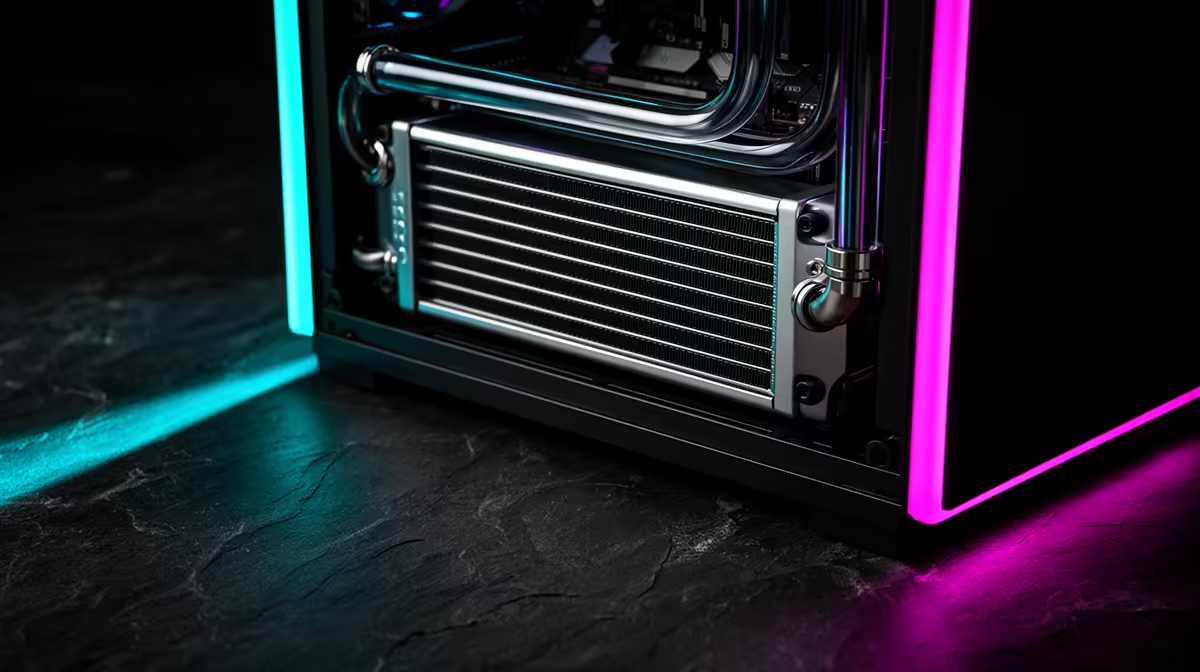
The golden rule for a 360mm AIO in a compact mATX build is to check the case spec sheet, not the marketing copy. You need at minimum 394mm of radiator mounting space (360mm fans plus end brackets). Top-mount radiators demand you measure the clearance between the radiator and your RAM sticks; low-profile DDR5 kits sitting at 35mm tall usually clear a 30mm-thick radiator with fans attached, but standard-height DIMMs often collide.
Routing Tubes and Cables in a Tight Chassis 🔧
With a 360mm radiator occupying the top panel, your cable routing path changes significantly. Most compact mATX cases route the 24-pin ATX connector along the right spine of the motherboard tray, but a top-mounted radiator pump head will often sit close to the CPU power connector. Plan to use a 90-degree angled 8-pin CPU power adapter or route the cable under the radiator before final installation. AIO pump heads with 300mm to 400mm hoses work well for top mounts; shorter hoses create tension that can torque the CPU socket over time. Keep all hoses away from case fans to avoid vibration noise.
GPU and Storage Clearance After Radiator Install 💻
Once the 360mm radiator is mounted, measure the remaining GPU clearance again, physically if possible. Modern flagship cards like the RTX 5080 can reach 340mm in length, which means a case advertised as supporting 320mm GPUs becomes too tight after radiator bracket thickness is accounted for. Budget around R3,500 to R7,000 for a quality 360mm AIO such as a Corsair iCUE H150i or DeepCool MYSTIQUE 360 to pair with your chassis, and factor this into the total build budget before purchasing the case. Also check storage bay positions: compact mATX cases sometimes lose a 3.5-inch bay position to front radiator mounts.
360mm Radiator Orientation Tip ⚡
Mount the radiator so the pump head sits at the lowest point of the loop relative to the CPU block. This keeps air bubbles away from the pump impeller, reducing gurgling noise and extending pump lifespan. A top-rear pump head position works well in most upright tower mATX cases.
FAQ
Which mATX cases officially support 360mm radiators in 2026?
Cases with confirmed 360mm support include the DeepCool CH370, Fractal Design Pop Mini Air, and Lian Li LANCOOL 216. Always cross-reference the manufacturer radiator support table, not just the maximum fan size, as some cases quote fan support without confirming radiator thickness clearance with fans attached.
Do I need a specific motherboard layout for a 360mm AIO in mATX?
Yes. Boards with top-edge VRM heatsinks taller than 40mm can block top-panel radiator mounts. mATX boards measuring 244mm by 244mm all share the same CPU socket position, but heatsink topology varies by brand.
Will a 360mm AIO in an mATX case keep temps below 80°C under gaming load?
For CPUs up to 200W TDP like the Ryzen 9 9900X, a 360mm AIO typically keeps peak junction temperatures below 85°C under sustained load, with package temps in the 70°C to 80°C range. SA summer ambient temps add 5°C to 8°C versus European benchmarks, so always run your case with positive pressure fan curves to push warm air out efficiently.
Ready to spec your mATX radiator build?
Browse compact mATX cases and 360mm AIO coolers in Evetech's PC components section to find combinations that confirm radiator and GPU fitment before you order.